
How to Choose a Roofer in Tampa Bay
Vet Tampa Bay roofers: verify DBPR license, insurance, permits, written estimate, materials, and code compliance.
Lorem ipsum dolor sit amet, consectetur adipiscing elit. Suspendisse varius enim in eros elementum tristique. Duis cursus, mi quis viverra ornare, eros dolor interdum nulla, ut commodo diam libero vitae erat. Aenean faucibus nibh et justo cursus id rutrum lorem imperdiet. Nunc ut sem vitae risus tristique posuere.
Tampa Bay roof replacements often run $8,000 to $22,000+ (verify with client before publish), so a bad hire gets expensive fast.
If you’re choosing a roofer in Tampa Bay, start with license, insurance, permits, and contract details before you compare price. Florida storms, salt air, and Hillsborough County permit rules leave little room for guesswork, and the lowest bid can cost more if the roofer skips code steps or leaves permits open.
Here’s the short version:
- Check the roofer’s active Florida DBPR license
- Confirm general liability and workers’ comp
- Make sure the contractor, not the homeowner, pulls the permit
- Review the quote for dry-in, flashing, ventilation, cleanup, and warranty terms
- Match the roof system to your home’s structure and Tampa Bay weather
Think a low quote means you found a deal? But... price alone tells you almost nothing. A solid roofer can show the paperwork, explain Florida code triggers like the 25% reroof rule, and put every cost in writing.
After you read this, you should know what to ask, what to check, and when to walk away.
A Tampa Bay roofer must prove license, insurance, and local accountability
Before you compare bids, make sure the contractor has a valid Florida DBPR roofing license, current insurance, and a real local office. In a wind-heavy coastal market, paperwork is not busywork. It shows who can legally pull permits and who will still be around if something goes wrong.
Use these four checks before you sign:
| What to verify | Why it matters | Document to request |
|---|---|---|
| Florida DBPR roofing license (CCC or CGC) | Confirms the contractor is legally authorized and meets state standards | Active DBPR license number - verify at MyFloridaLicense.com |
| General Liability Insurance | Protects your property from damage caused during installation | Certificate of Insurance (COI) naming you as an additional insured |
| Workers' Compensation | Prevents homeowner liability if a crew member is injured on-site | Workers' comp certificate |
| Local Physical Address | Permanent street address - so you can reach the company for warranty or repair service | Permanent street address - not a P.O. box |
Florida DBPR license status and complaint history are public records you can check
Go to MyFloridaLicense.com and search the contractor's name or license number. The status should read Active. You should also check for disciplinary actions tied to abandonment, fraud, or license problems.
Then match the license name to the proposal, contract, and permit application. If those names do not line up, that can point to an uninsured subcontractor setup. That's a red flag.
Missing permits can delay resale and financing.
General liability and workers' comp should cover your property and roof scope
Ask for a Certificate of Insurance (COI) before work starts. But don't stop there. A printed COI alone does not prove the policy still applies, so call the agent and confirm it is active for your address and your job date.
General liability coverage helps if the crew damages your home or belongings during installation. Workers' compensation matters just as much. If an uninsured worker gets hurt on your property, medical bills can top $50,000, and you may be the one on the hook.
For larger or higher-value homes, check that coverage limits fit the home value and the roof scope. In other words: a small policy may not do much good on a big job.
Once the license and insurance check out, the next step is confirming permits and inspections.
sbb-itb-85e0110
Permits, inspections, and Florida code knowledge separate a real contractor from a sales-driven roofer
After you check license and insurance, look at the permit process. That’s where you can spot the difference between a roofer who runs jobs the right way and one who just wants a signed contract.
A real roofer pulls the permit, sets the inspections, and walks you through how the job meets the Florida Building Code 8th Edition. The permit is the legal record of the work. If a contractor tells you to pull the permit yourself, treat that as a major red flag. In many cases, that points to a licensing or insurance problem.
A qualified roofer should be able to explain the full job path, from the first inspection to final sign-off:
| Project Stage | What Should Happen |
|---|---|
| Inspection and Scope | Full inspection of attic, flashing, and ventilation, with photos |
| Contract | Itemized materials, labor, permit fees ($150–$400), and warranty terms |
| Permit Application | Filed by the contractor under their license name with Hillsborough County |
| Tear-off and Deck Review | Remove old materials; inspect and re-secure decking to wind-uplift standards |
| Dry-in (Weatherproofing) | Install underlayment and secondary water barrier; document it |
| Final Inspection | County official verifies completed work against the permit and Florida Building Code |
Inspectors also check Florida Product Approval numbers (FL#) for approved materials.
On older roofs, code triggers can change the whole job. Fast.
The Florida 25% Rule and reroof code triggers can change the scope on older homes
Many homeowners think a reroof means swapping shingles and moving on. But older homes don’t always work that way.
If damage goes past 25% of the roof area, the job can trigger a full-code reroof. That means the entire roof has to meet current code, including underlayment, flashing, and ventilation. In other words: a patch-sized problem can turn into a full-scope code job.
A qualified roofer should check that threshold before you sign the contract, not after tear-off starts. If they wait until the roof is open, your price and timeline can shift when you have the least room to push back.
A Hillsborough County reroof permit should lead to documented inspections, not verbal assurances
Talk is cheap. A closed permit is what counts.
Your contractor should schedule the deck, dry-in, and final inspections with Hillsborough County. You should not have to track this down on your own. If a contractor says, “Don’t worry, we’ll handle it,” ask for the inspection records when the job wraps up.
An open permit can slow down a home sale or complicate an insurance claim. Ask for the closed-permit record after the final inspection passes.
Asphalt shingles, metal roofing, and tile perform differently in Tampa Bay wind, salt air, and heat
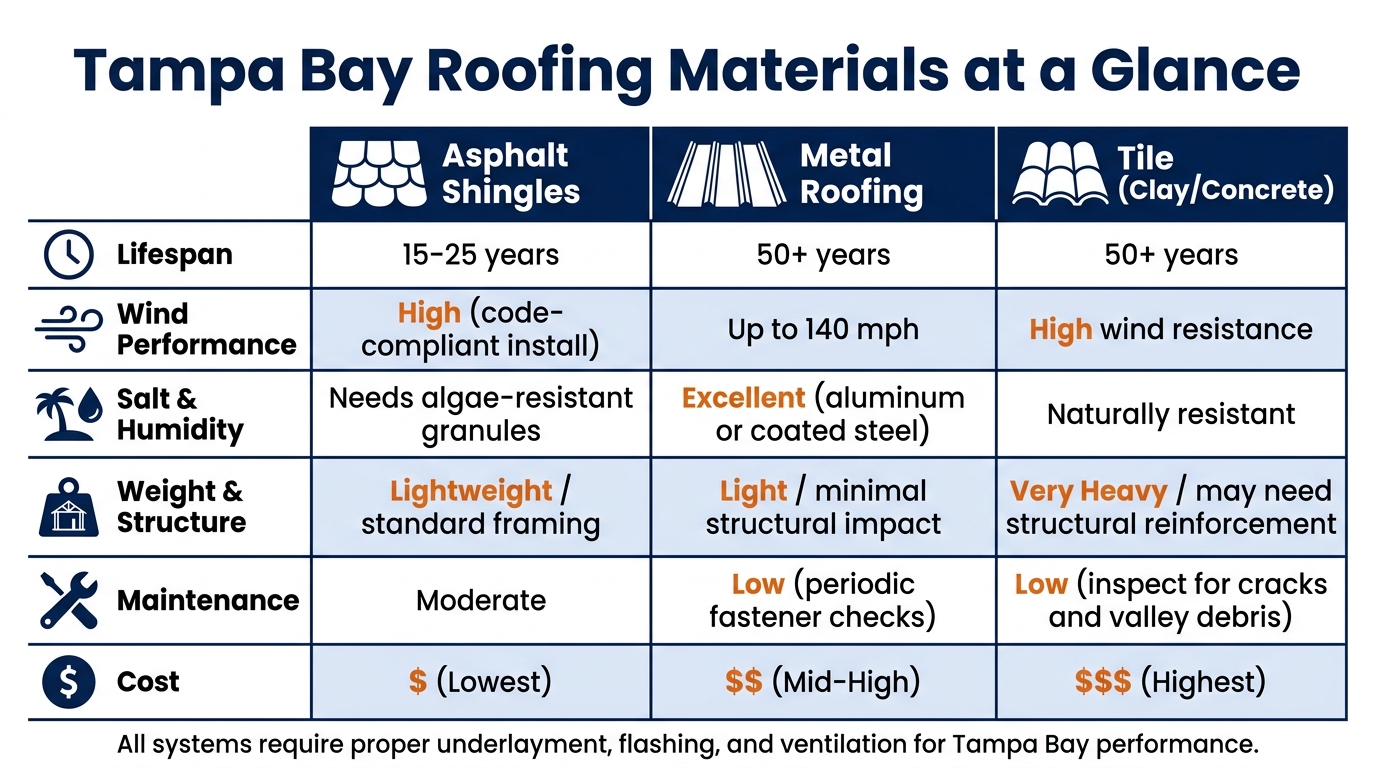
Tampa Bay Roofing Materials Compared: Asphalt vs Metal vs Tile
After you confirm a roofer can handle permits and code, the next call is material. Tampa Bay weather puts every roof system to work. High UV, coastal salt air, humidity, and strong wind can wear down even a well-built roof.
That’s why you want a system that matches Tampa Bay wind loads, your roof structure, and the amount of upkeep you’re willing to take on.
Once the contractor can manage permits the right way, compare how each roof system gets installed and supported. A good roofer won’t just name a material. They’ll explain why it fits your home and how they’ll install it.
| Material | Typical Lifespan | Wind Performance | Salt-Air & Humidity | Weight & Structure | Maintenance | Cost |
|---|---|---|---|---|---|---|
| Asphalt Shingles | 15–25 years | Rated for high wind when installed to code and manufacturer specs | Algae-resistant granules needed for humidity; UV can contribute to granule loss | Lightweight; standard framing | Moderate; inspect for blistering and granule loss | Lowest |
| Metal Roofing | 50+ years | High; up to 140 mph | Aluminum or coated steel is best for coastal salt air | Light; minimal structural impact | Low; periodic fastener inspection | Mid-High |
| Tile (Clay/Concrete) | 50+ years | High wind resistance | Naturally resistant to salt and moisture | Very heavy; often requires structural review or reinforced framing | Low; inspect for cracked tiles and valley debris | Highest |
Asphalt shingles are widely used, but underlayment, flashing, and ventilation drive real performance
Most homeowners look at the shingle first. But the part you don’t see often matters just as much.
For asphalt shingles, the layers under the shingles play a huge role in how the roof holds up. Use a secondary water barrier, usually self-adhering underlayment, along with a tear-resistant synthetic underlayment instead of felt.
Ventilation matters too. Tampa’s UV index often hits 11 or higher, and poor attic airflow can speed up warping and granule loss. Flashing at penetrations, valleys, and wall intersections also needs close inspection.
When you review a shingle quote, ask about three things:
- The underlayment spec
- The fastener pattern
- How the roofer will handle ridge ventilation
If a roofer can’t explain those details in plain English, they’re selling you a product, not a roof system.
Metal roofing and tile roofing require the right crew, attachment method, and structural review
If you want a roof that lasts longer, ask what the roofer can install in metal or tile, and what your home can support.
Metal roofing works well near the Tampa Bay coastline because aluminum and coated-steel systems resist salt-air corrosion and can be engineered for wind gusts up to 140 mph. But installation decides a lot here. Fastener spacing and crew quality matter. Reflective metal systems can also cut attic temperatures by 20°F to 40°F.
Tile roofing, whether clay or concrete, also offers long service life and strong resistance to salt and moisture. But it comes with one big issue: weight.
In other words: tile may look like a straight material upgrade, but your framing has to be ready for it. Concrete and clay tile weigh much more than asphalt shingles or metal, so older homes often need reinforced framing before tile can go on.
Tile systems also use system-specific attachment methods, so the crew needs direct experience with that type of installation. Before a roofer recommends tile, they should inspect the framing and confirm the structure can carry the load.
A written estimate should itemize tear-off, dry-in weatherproofing materials, flashing, ventilation, cleanup, and warranty terms
A vague quote can derail a roofing job fast. Require an on-roof inspection, photos, and a written line-item estimate before work starts. That on-site inspection should be the baseline, then the contractor should turn those findings into a bid you can compare line by line.
Here’s what each quote item should spell out, and why fuzzy wording causes trouble once the old roof is already off your home.
| Quote Item | What Should Be Listed | Why Vague Wording Is a Problem |
|---|---|---|
| Tear-off | Complete removal of all existing layers down to the wood deck | Phrases like as needed or overlaying the old roof can hide deck rot and trap heat, shortening shingle life |
| Decking | Fixed per-sheet price for plywood replacement | Lets contractors inflate costs during the job once the roof is open |
| Underlayment | Specific type, such as synthetic or self-adhering secondary water barrier | Generic felt paper degrades quickly in Tampa heat and tears easily |
| Flashing | Full replacement at chimneys, valleys, walls, and pipe boots | Reusing old, rusted flashing is a primary cause of leaks in new roofs |
| Drip Edge | New 26-gauge metal drip edge per 8th Edition Florida Building Code | Reusing rusted metal is a code violation and allows water into the fascia |
| Ventilation | Specific system with intake/exhaust calculations and vent brand | Poor ventilation cooks shingles from inside, causing premature curling and granule loss |
| Cleanup | Daily debris removal and a final magnetic nail sweep of the yard and driveway | Stray nails pose a real safety risk to tires, pets, and children |
| Change-order terms | Written, signed authorization required for any scope or price change | Verbal agreements during the job are how budgets quietly grow |
A real roof inspection covers attic ventilation, flashing details, and signs of water intrusion
That written scope should come from a physical inspection, not aerial photos alone. Photos from above can miss what’s happening underneath.
The attic often tells the real story. It can show ventilation balance, water intrusion, and sagging soffits, and those findings often change decking, flashing, or ventilation costs. In other words: if no one checks the attic, your estimate may miss the parts that cost the most.
Florida's 80% humidity levels frequently lead to hidden deck rot that only becomes visible after a full tear-off. For homes near the bay, the inspection should also check metal parts for faster salt-air corrosion.
Put workmanship coverage, manufacturer coverage, and storm-delay terms in writing
The estimate should also spell out what happens after installation. The manufacturer's warranty covers material defects, and premium materials often carry 25 to 30 years or lifetime coverage.
The workmanship warranty covers how the crew installed the roof. Standard coverage runs 5 to 10 years, though some contractors offer longer terms. But... that only helps you if the contract states the term clearly.
Storm terms matter too. The contract should explain how the crew secures exposed decking if weather interrupts the job, how fast work resumes, and how storm delays are handled. Post-storm repair response expectations and scheduling windows should be written out, not left to a verbal promise.
Deposit terms deserve a close look. A deposit of 10% to 33% is typical, while 50% or more upfront is a red flag.
Conclusion: The right Tampa Bay roofer can document credentials, explain code, and stand behind the work
Once you’ve checked licenses, permits, materials, and quotes, this decision comes down to one thing: documentation.
The right roofer should be able to prove an active Florida CCC or CGC license through the DBPR, show current general liability and workers’ compensation coverage, pull the permit with Hillsborough County, and explain the Florida 25% Rule and secondary water barrier rules without hesitation.
Paperwork comes first. Install fit comes next.
Choose the roof system your home can support, then hire the crew that knows how to install it the right way like Bayshore Exteriors.
Your estimate should spell out every cost and term in plain language. Sign only when the contract clearly states scope, materials, and warranty coverage. If a roofer can’t prove the basics in writing, keep looking.
FAQs
How many roofing quotes should I get?
Get multiple written estimates before you sign a contract. That gives you a clean side-by-side view of each bid, instead of trying to compare vague promises.
Review each itemized quote line by line. Check the pricing, materials, and installation methods against Tampa Bay code and hurricane requirements.
The lowest price can look tempting. But... cheap work often costs more later. Quality and code compliance matter most if you want long-term protection for your home.
What are the biggest red flags when hiring a roofer?
Watch for roofers who push hard for a fast decision, knock on your door out of the blue after a storm, or insist you sign the same day. Never sign an Assignment of Benefits (AOB) form.
Other red flags are just as clear: no proof of Florida license or insurance, refusal to pull permits, asking you to pull an owner-builder permit, vague or verbal-only estimates, no permanent local office, or weak knowledge of Florida code and wind rules.
How long does a roof replacement usually take?
A roof replacement usually takes more than one day. For most homes, a standard residential re-roof takes a few days, though the exact timing depends on your home’s size and the roofing material you choose.
But weather can change that fast. In Tampa Bay, afternoon thunderstorms often interrupt roof work, so you should ask your contractor to confirm the installation schedule before the job starts.
Related Blog Posts
✔ START TODAY
Personal and targeted approach

✔ FAQ
Your Questions. Our Expertise.
How do I get an accurate price for my project?
Are you licensed and insured in Florida?
How long does a typical installation take?
Does your work come with a warranty?
Why do you recommend James Hardie siding for Florida?
What specific services do you provide?
✔ START TODAY
Ready to Get Started?
Trusted and reliable Hardie board siding services backed by expert craftsmanship and high performance materials. We help homeowners achieve a durable, low maintenance exterior that looks great and stands strong for years to come.
Book an Appointment
We have received your estimate request and will be reaching out to you shortly.
.webp)