My Safe Florida Home: Can Tampa Homeowners Get a Roof Grant?
Explains how Tampa homeowners may get up to $10,000 for wind-mitigation roof work and who qualifies.
Lorem ipsum dolor sit amet, consectetur adipiscing elit. Suspendisse varius enim in eros elementum tristique. Duis cursus, mi quis viverra ornare, eros dolor interdum nulla, ut commodo diam libero vitae erat. Aenean faucibus nibh et justo cursus id rutrum lorem imperdiet. Nunc ut sem vitae risus tristique posuere.
Yes, some Tampa homeowners can get up to $10,000 for roof-related wind-mitigation work, but you cannot use My Safe Florida Home for a basic reroof alone.
If your home is owner-occupied, has a homestead exemption, carries an insured value of $700,000 or less, and the first permit date was before 01/01/2008, you may qualify. But the program pays only for work the inspection flags, such as roof-to-wall connections, roof deck attachment, secondary water resistance, or code-linked roof covering work.
Here’s the short version:
- Grant cap: $10,000
- Standard reroof: Not covered
- Full roof replacement: Covered only if it is tied to approved mitigation work
- Home type: Site-built primary residence
- Occupancy rule: Owner-occupied with homestead exemption
- Insured value limit: $700,000 or less
- Permit cutoff: Before January 1, 2008
- Income note: Households above 120% of county median income may get an inspection but not grant funds
- Timing rule: You must wait for official approval before work starts
- Deadline note: If you ignore a program RFI for 60 days, the application can close
Completing Required Grant Indication of Interest For My Safe Florida Home Program 2.0
sbb-itb-85e0110
Quick Comparison
| Topic | What the program allows | What it does not allow |
|---|---|---|
| Roof work | Wind-mitigation items found in the inspection | Routine repairs or cosmetic roof work |
| Reroof | Only when needed for approved mitigation or code compliance | Standalone reroof |
| Eligibility | Site-built, owner-occupied, homesteaded home, pre-2008 permit, insured at $700,000 or less | Non-homesteaded, non-owner-occupied, newer, or higher-value homes |
| Funding | Reimbursement after approval, work, and final inspection | Upfront payment for unapproved work |
| Priority | Low- and moderate-income homeowners, with added focus on owners age 60+ in 2025–2026 | Open grant access for every applicant |
In other words: you should treat this program as a way to cut part of a roof mitigation bill, not pay for a full new roof by itself. The inspection report, your income status, and your timing will decide whether your Tampa project fits.
Tampa eligibility depends on home type, occupancy, insured value, and inspection findings
Tampa homeowners can apply, but only homes that meet the rules can get grant money. The first screen looks at the property itself. After that, the inspection determines whether any roof-related funding is on the table.
A Tampa home must be site-built, owner-occupied, first permitted before January 1, 2008, and insured for $700,000 or less. It also needs an inspection that identifies a qualifying mitigation upgrade. But here's the catch. Approval still hinges on what the inspection finds.
Which Tampa homes are more likely to qualify
Older Tampa homes tend to have the kinds of roof weak points this program pays to fix. Homes first permitted before January 1, 2008 usually have a better shot because they are more likely to show issues with roof-to-wall connections, roof deck attachment, or secondary water resistance. Those are the exact upgrades the program targets.
Why program approval does not guarantee roof grant money
A free inspection helps, but it does not promise funding. The inspection report must specifically recommend at least one eligible mitigation upgrade before the grant can move forward. That includes roof-to-wall connections, roof deck attachment, secondary water resistance, or wind-rated roof coverings.
Income also matters. Households above 120% of the county median income may still qualify for the inspection, but they are currently not eligible for grant money.
From there, the process shifts to inspection reports, permits, and contractor records.
The program funds mitigation upgrades, not repairs or cosmetic reroof work
My Safe Florida Home does not pay for general roofing work. It covers only hurricane mitigation upgrades listed in the inspection report, not leak repairs, routine upkeep, or cosmetic reroofing. So the inspection report drives the grant scope, not the roof’s age by itself.
Roof-to-wall attachment, roof deck attachment, and secondary water resistance explained
Roof-to-wall attachment strengthens the link between the roof frame and the walls with clips or straps. That work can qualify because it cuts the risk of roof lift during high winds.
Roof deck attachment tightens the nailing pattern that holds the sheathing to the rafters or trusses. In many cases, contractors need to remove the current roof covering to do that work.
Secondary water resistance (SWR) adds a sealed barrier over the roof deck seams. If a storm tears off the main roof covering, SWR helps limit water intrusion. When the program approves SWR, it must cover the full roof deck.
When full roof covering replacement may be part of the grant scope
Think a full reroof qualifies on its own? It doesn’t. Full roof replacement counts only when contractors must do it to complete an approved mitigation upgrade or to meet current Florida Building Code rules.
In other words: a standalone reroof does not qualify unless it ties directly to an approved mitigation item.
Once the scope is set, the next step is permits, contractor paperwork, and final verification.
How the grant process works from inspection to final verification
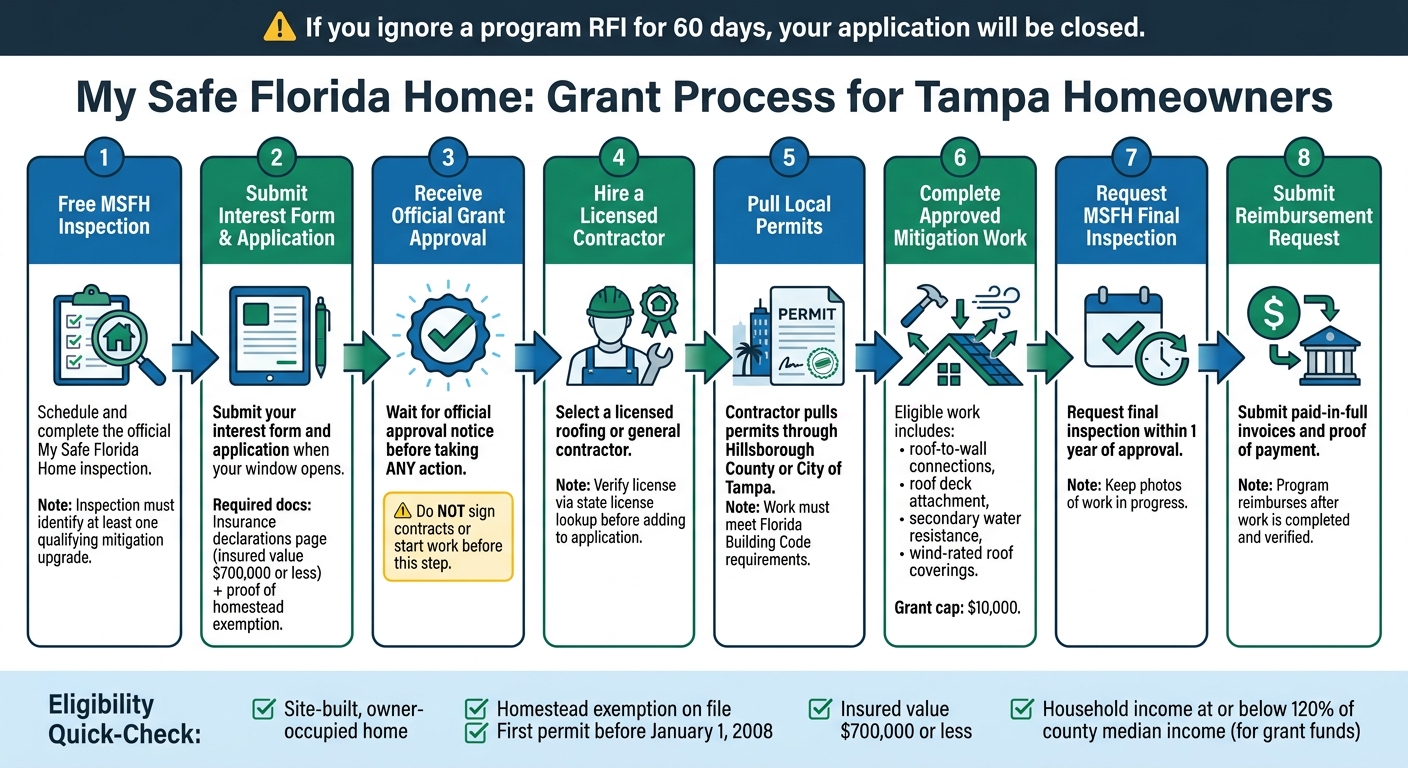
My Safe Florida Home Grant Process for Tampa Homeowners
Once the inspection spells out which roof work qualifies, you move into paperwork and approval. The MSFH process follows a set path: inspection, interest form, application, approval, permitted construction, final inspection, and reimbursement request.
What inspections, permits, and contractor records are required
Start with the MSFH inspection. Then use that report to line up your contractor’s scope of work with the approved mitigation items.
When your application window opens, send in your insurance declarations page showing a dwelling value of $700,000 or less and proof of homestead exemption. You also need a licensed roofing contractor or licensed general contractor. Before you add them to the application, check their license in the state license lookup.
After you get official grant approval, your contractor must pull the local permits through Hillsborough County or the City of Tampa. The work has to meet Florida Building Code rules and pass local inspections.
Once the job is done, request the MSFH final inspection within one year of approval. After that, submit your reimbursement request with paid-in-full invoices and proof of payment.
Where Tampa homeowners commonly see delays or disqualifications
A common mistake trips people up fast: starting work before official grant approval. Think signing a contract locks in your spot? It doesn’t. If construction starts too soon, the work does not qualify for reimbursement. Do not sign a construction contract or let work begin until you have the approval notice in hand.
Another problem comes from missed follow-up. If the program sends a Request for Information (RFI) and you do not answer within 60 days, they close the application for nonresponse.
Keep a file with:
- the inspection report
- contractor estimates
- building permits
- product approvals
- photos of the work in progress
- final paid invoices
Other setbacks show up when permit records are missing, the contractor is unlicensed, or the invoices and photos are incomplete.
Keep your approved scope, permits, invoices, and payment records matched all the way through the final inspection.
For Tampa homeowners, the grant offsets roof project costs rather than covering full replacement
After inspection and approval, the next issue is cost. The $10,000 cap usually pays for only part of a Tampa roof project. You should treat the grant as a way to cut what you owe, not wipe out the full bill.
That budget check matters only if the home and the roof work still fit the program rules. Before you apply, check three things: confirm the home still meets the program’s property and income rules, make sure the inspection finds a qualifying mitigation item, and verify that the scope goes beyond routine repair.
If those tests pass, the program may fit your project. But if the work is only a roof repair, the grant does not apply. If those tests fail, the project falls outside MSFH.
FAQs
What if my Tampa home is worth more than $700,000?
If your Tampa home has an insured value above $700,000, you can't get a My Safe Florida Home hurricane mitigation grant.
That's the cutoff. The program only accepts homes insured for $700,000 or less.
Can I pick my own roofing contractor?
Yes. The My Safe Florida Home program no longer keeps a list of authorized or pre-approved contractors.
That means you can choose your own contractor. But there’s a catch. The contractor must hold the right license and stay registered with the Florida Department of Business and Professional Regulation.
When you apply, you’ll need to give:
- The contractor’s name
- License number
- Contact information
It’s pretty straightforward, but the license part matters. If the contractor isn’t properly licensed and registered, your application can hit a wall.
How long does reimbursement usually take?
The program materials do not list a set reimbursement timeline.
You get paid only after you finish the mitigation work, submit a draw request through the Applicant Portal, and pass the required final inspection. But there’s a catch. Payments often slow down when paperwork is missing or permits have not been fully closed out.
Related Blog Posts
✔ START TODAY
Personal and targeted approach

✔ FAQ
Your Questions. Our Expertise.
How do I get an accurate price for my project?
Are you licensed and insured in Florida?
How long does a typical installation take?
Does your work come with a warranty?
Why do you recommend James Hardie siding for Florida?
What specific services do you provide?
✔ START TODAY
Ready to Get Started?
Trusted and reliable Hardie board siding services backed by expert craftsmanship and high performance materials. We help homeowners achieve a durable, low maintenance exterior that looks great and stands strong for years to come.
Book an Appointment
We have received your estimate request and will be reaching out to you shortly.
.webp)