
Metal Roof Installation in Tampa: Costs and Timeline
Tampa metal roof costs typically $9–$28+/sq ft; projects usually take 2–8 weeks from inspection to final approval.
Lorem ipsum dolor sit amet, consectetur adipiscing elit. Suspendisse varius enim in eros elementum tristique. Duis cursus, mi quis viverra ornare, eros dolor interdum nulla, ut commodo diam libero vitae erat. Aenean faucibus nibh et justo cursus id rutrum lorem imperdiet. Nunc ut sem vitae risus tristique posuere.
Tampa metal roof projects often land at $9.00 to $20.00+ per square foot installed, and the full process usually takes 2 to 8 weeks.
If you’re pricing a metal roof in Tampa, you should expect local code, permit review, and storm-season timing to shape both cost and schedule. The roof install itself often takes only 3 to 7 business days, but Hillsborough-area permitting, Florida product approvals, and dry-in requirements can stretch the job before crews even start.
Think the quote is mostly about panels and labor? But Tampa pricing often climbs because contractors must include code-required layers, wind-rated fastening patterns, and permit handling.
What matters most in your estimate:
- Roof system type drives the biggest price swing
- Roof shape and access change labor time fast
- Permits, underlayment, and deck repairs add costs after inspection
- Weather and material lead times often decide the schedule
If you’re comparing bids, you should look past the bottom-line number and check whether the contractor included the full code scope, repair allowances, and a schedule that fits Tampa conditions.
Why Metal Roof Quotes in Tampa Range from About $9.00 to $20.00+ Per Square Foot Installed
Metal roof quotes in Tampa swing most based on roof shape, panel system, deck condition, and code-driven items.
The panel system usually drives price more than anything else. Exposed-fastener panels often land at $9.00 to $15.00 per square foot installed, while standing seam systems with concealed fasteners can hit $16.00 to $28.00+ per square foot installed. And that's before you factor in steep pitch, tricky access, or repair work.
How Roof Size, Pitch, and Roofline Complexity Affect Labor Costs
Think a metal roof price comes down to square footage alone? Not quite. Roof details can change labor fast.
Valleys, hips, dormers, skylights, chimneys, and steep slopes all call for more custom cuts, more flashing, and more install time. On Tampa homes, those labor swings often matter just as much as the panel system.
Standing Seam, Exposed Fastener Panels, and Metal Shingles Cost Different Amounts
The three most common residential metal roofing systems each fit different budgets and performance goals:
- Exposed-fastener panels (Maxi-Rib/5-V): $9.00–$15.00 per sq. ft. installed. These need fastener checks every 5 to 10 years and work best on ranch-style homes and simple gable roofs.
- Standing seam (concealed fasteners): $16.00–$28.00+ per sq. ft. installed. These need little upkeep, carry ratings for 140+ mph winds, and fit modern, coastal, and high-end homes.
- Metal shingles / stone-coated steel: $14.00–$22.00 per sq. ft. installed. These use interlocking panels, need little upkeep, and often suit historic bungalows and Mediterranean-style homes.
Pricing reflects Tampa market ranges and varies by roof size, pitch, access, and system choice [4][1][7].
For homes on Davis Islands or near Ballast Point, salt air can speed up corrosion on standard Galvalume panels. In those spots, your quote should spell out aluminum substrates or a Kynar 500 (PVDF) coating.
After panel choice, the next big price jumps usually come from code-required layers and roof repairs.
Underlayment, Deck Repairs, and Florida Code Upgrades Can Add Costs After Inspection or Tear-Off
Florida re-roofing rules often call for a peel-and-stick secondary water barrier and other code-required details. In other words: the lowest quote may not be the better deal if another contractor left those materials out.
Deck repairs found after tear-off usually cost $60 to $120 per 4×8 sheet. Many Tampa homeowners set aside a 5% to 10% contingency for surprise deck repairs or re-nailing.
Permit and engineering fees through Tampa or Hillsborough County can add $250 to $900. Those are the kinds of line items that push total project costs higher on larger or more complex Tampa homes.
sbb-itb-85e0110
What a Metal Roof Project Typically Costs for Common Tampa Home Types
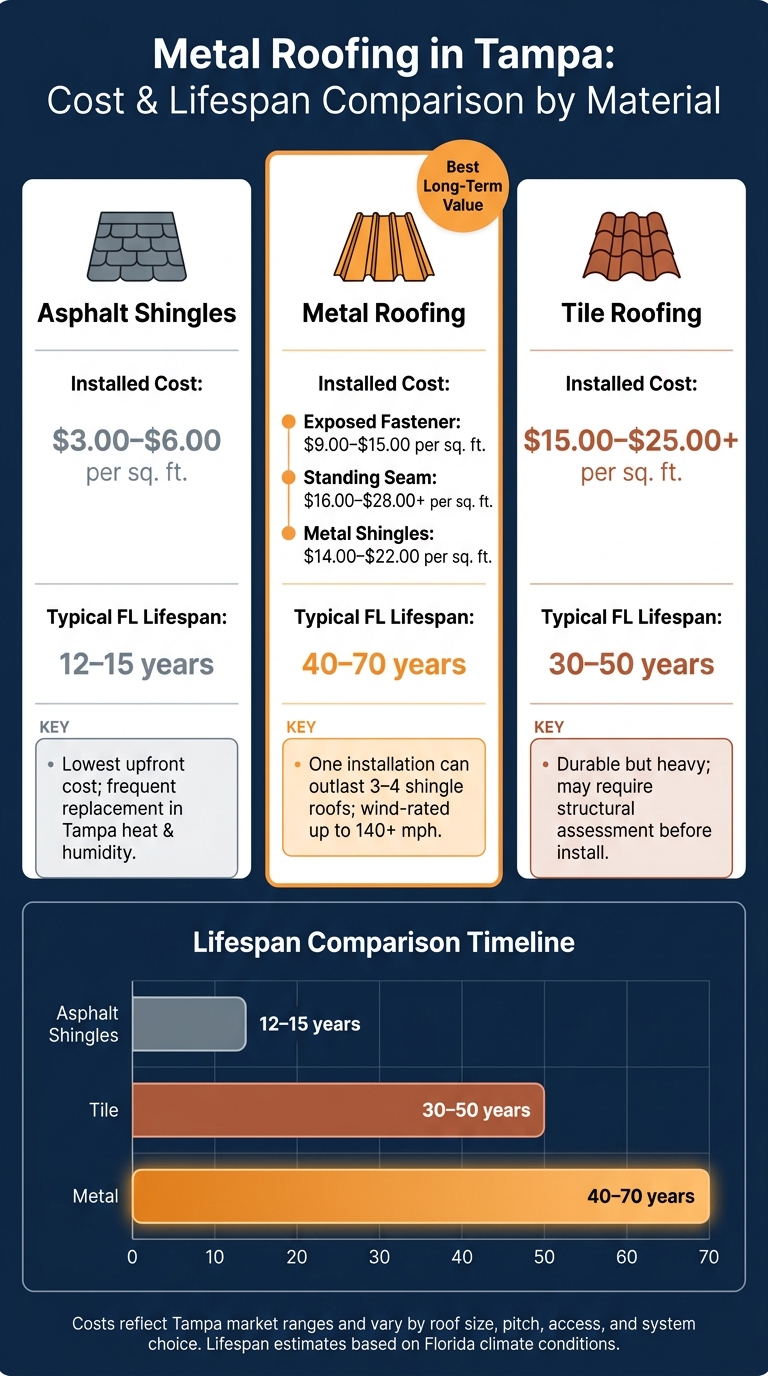
Metal Roofing vs. Asphalt Shingles vs. Tile: Tampa Cost & Lifespan Comparison
The numbers start to click when you match them to homes you actually see around Tampa. A small one-story bungalow and a larger two-story house can use the same roofing material, but the final price can be far apart.
Single-Story Versus Two-Story Homes: How Project Totals Differ
A single-story bungalow or gable-roof home with about 1,500 to 2,000 square feet of living space will often have a roof area of 20 to 25 roofing squares, or 2,000 to 2,500 square feet. On that kind of home, an exposed-fastener panel system usually costs $16,500 to $22,000 installed, while a standing seam system is closer to $27,500 to $35,000 installed.
A two-story home with 2,500 to 3,000 square feet of living area and a more complex roofline often covers 30 to 40 squares. For that home, the same exposed-fastener system usually runs $29,000 to $35,000, and standing seam often lands at $42,300 to $65,000+.
Think the jump comes down to square footage alone? It doesn't. The bigger driver is roof complexity. More valleys, more transitions, steeper sections, and harder access all add labor time and detail work.
These totals assume full roof removal, standard Tampa code scope, and a 5% to 10% contingency for deck repairs.
How Metal Roofing Costs Compare to Asphalt Shingles and Tile Over Time
Asphalt shingles cost less at the start. But Tampa's heat, UV exposure, humidity, and constant expansion-and-contraction cycle wear them down fast. In many cases, they last only 12 to 15 years before they need replacement.
A metal roof plays a different game. It is built to last 40 to 70 years, which means one installation can outlast several shingle roofs on the same house.
In other words: the first invoice is only part of the story. If you plan to stay in your home for decades, lifespan changes the math.
| Material | Typical Installed Cost (per sq. ft.) | Typical Lifespan in FL |
|---|---|---|
| Asphalt Shingles | $3.00–$6.00 | 12–15 years |
| Metal Roofing | Higher upfront cost; one roof can last 40 to 70 years | 40–70 years |
| Tile Roofing | $15.00–$25.00+ | 30–50 years |
Tile also does well in Florida, but its weight can bring extra structural checks before installation. Metal often sits in the middle on upfront cost, while still giving homeowners a long service life and strong wind performance.
After price, the next thing most homeowners look at is timing, especially permits and material lead times.
The Full Tampa Project Timeline: 2 to 8 Weeks from Inspection to Final Approval
Once you know the price, the next issue is timing. Most Tampa metal roofing jobs fall into four phases: inspection and contract, permitting and material lead time, on-site installation, and final inspection.
Some jobs move fast. Others stall in permitting or material pickup. That’s why the full timeline usually lands between 2 and 8 weeks from the first inspection to final approval.
Inspection, Estimate, Selections, and Contract: The First Few Days to 2 Weeks
The project starts with a free inspection and site visit. The contractor measures the roof, checks the deck condition, reviews pitch and roof complexity, and notes anything that could change the scope or price.
A written estimate often follows within 24 hours.
If you pick your panel type and color fast, you can sign the contract within a few days to 2 weeks. If you take longer to choose, the permit filing and material order usually slide back by the same amount.
Permitting and Material Lead Times Are Where Tampa Projects Most Often Slow Down
After the contract is signed, the contractor submits the permit application to the City of Tampa or Hillsborough County. This step tends to drag the most because the permit package has to match the exact panel system, clip type, and fastener pattern needed for code approval.
Standard colors usually move faster. Special-order panels and custom trim can tack on several weeks.
If you want a non-standard color, ask your contractor to confirm stock before you sign. That one detail can save you a nasty delay later.
Storm season can also jam up labor schedules across the region. Tampa homeowners who book work during the drier months, January through April or October through December, usually have a better shot at a smooth schedule.
Once the permit clears and the materials show up, things usually speed up. Paperwork ends. Roof work starts.
On-Site Work: Tear-Off, Dry-In, Installation, and Final Inspection
For most Tampa homes, on-site work takes 3 to 7 business days. A simple single-story gable roof lands near the short end. A two-story home with valleys, dormers, and multiple transitions takes longer.
The work follows a set order:
- Tear-off starts first, with crews removing old roofing and checking the wood deck for rot or soft spots.
- Dry-in happens on day one, when crews install underlayment as the secondary water barrier before they leave the site.
- After that, crews fasten the panels to code and finish custom-bent flashing around chimneys, vents, and valleys.
That dry-in step matters a lot in Tampa. Afternoon thunderstorms can roll in fast, and the underlayment helps protect the house if work has to pause.
When installation wraps up, the contractor schedules the required final inspection with the City of Tampa or Hillsborough County. Passing that inspection closes the permit.
However, there’s still one more place the timeline can stretch. Inspector availability can add a few extra days at the end.
| Phase | Typical Duration | Primary Delay Factors |
|---|---|---|
| Permitting & Materials | 1–4 weeks | Municipal review, product-approval docs, special-order lead times |
| On-Site Installation | 3–7 business days | Weather interruptions, roof complexity |
| Final Inspection & Approval | 1–2 weeks | Inspection scheduling |
The Right Estimate Covers Code-Required Scope, Allowances, and a Realistic Schedule - Not Just the Lowest Price
A Tampa metal roof quote should show the full scope, not just a bottom-line number. Once you know the price range and timeline, compare bids by what they include, not by total alone.
A solid estimate names the exact panel system and gauge, lists the Florida Product Approval numbers for the panels, clips, and fasteners, and confirms that the wind ratings match Hillsborough County's 150 mph design wind speed requirement. You also want the underlayment type, permit handling, and an allowance for hidden deck repairs spelled out in writing. If those items are missing, you're comparing a complete quote to a stripped-down one, and the stripped-down one will almost always look cheaper.
The lowest bid often looks smaller because the scope is smaller. A low number frequently leaves out work you'll pay for after the job starts: deck repairs found at tear-off, code-required underlayment, or permit fees that never made it into the original quote.
Use a Florida-licensed roofing contractor who carries adequate liability insurance and takes responsibility for permits, final inspection scheduling, and wind mitigation paperwork. That last item carries real financial value. A properly documented installation with a secondary water barrier can help your home qualify for insurance premium discounts of up to 35%.
When you review estimates, confirm these items appear in writing:
- Panel system and gauge
- Florida Product Approval numbers
- Underlayment type
- Permit handling
- Hidden deck repair allowance
- Inspection responsibility
- Wind mitigation documentation
- Warranty terms
Bayshore Exteriors (License #CGC1536143) covers every item on that list in every roofing estimate. If you're ready to move forward or want a second opinion on a quote you've already received, request an estimate and we'll walk through the full scope with you.
FAQs
Can I stay in my home during the installation?
Yes. You can usually stay in your home during a metal roof installation, and in most cases, you won't need to leave.
But... it will get loud. Expect heavy noise during tear-off and while crews install the metal panels overhead.
You should also plan for a few day-of logistics:
- Coordinate access to your property so the crew can move materials and equipment.
- Ask about protection for landscaping, patio areas, or the pool.
- Keep pets and children away from work zones for safety.
Crews will work above you for much of the job, so a little planning goes a long way.
Will my homeowners insurance help cover the cost?
Homeowners insurance usually does not pay for a new roof unless a covered event caused the damage, such as a storm.
But there’s a catch. In Tampa, a wind-rated metal roof may cut annual homeowners insurance premiums by up to 35%.
To help qualify for those credits, your installer should meet current code requirements and use high-performance synthetic underlayment.
How do I know if a quote includes the full code-required scope?
Make sure the estimate is written and itemized. It should spell out the panel brand, gauge, coating, underlayment type, flashing, ridge vents, clip spacing, and the fastener types the Florida Building Code calls for.
It should also list permits, wind-documentation engineering, full tear-off, synthetic underlayment or peel-and-stick secondary water barriers, and final inspection fees so you don’t get hit with hidden costs.
Related Blog Posts
✔ START TODAY
Personal and targeted approach

✔ FAQ
Your Questions. Our Expertise.
How do I get an accurate price for my project?
Are you licensed and insured in Florida?
How long does a typical installation take?
Does your work come with a warranty?
Why do you recommend James Hardie siding for Florida?
What specific services do you provide?
✔ START TODAY
Ready to Get Started?
Trusted and reliable Hardie board siding services backed by expert craftsmanship and high performance materials. We help homeowners achieve a durable, low maintenance exterior that looks great and stands strong for years to come.
Book an Appointment
We have received your estimate request and will be reaching out to you shortly.
.webp)