
Energy-Efficient Windows in Tampa Bay: Do They Pay Off?
Low-E, double-pane and impact windows can cut Tampa Bay cooling costs and improve comfort, but energy payback often takes years.
Lorem ipsum dolor sit amet, consectetur adipiscing elit. Suspendisse varius enim in eros elementum tristique. Duis cursus, mi quis viverra ornare, eros dolor interdum nulla, ut commodo diam libero vitae erat. Aenean faucibus nibh et justo cursus id rutrum lorem imperdiet. Nunc ut sem vitae risus tristique posuere.
Yes, they can pay off in Tampa Bay, but energy savings alone often take years to cover the full cost.
If your home has older single-pane windows, worn frames, or heavy west-facing sun, your payoff tends to look better. Cooling can make up 40% to 50% of a Florida power bill, and some homes see AC costs climb to 70% in peak summer months. That puts weak windows under a harsh spotlight.
Here’s the short version:
- Low-E glass cuts solar heat gain, which matters most in Tampa Bay.
- Double-pane and argon help more when you’re replacing older windows.
- Impact windows can lower cooling load and meet storm-code needs.
- Insurance discounts and avoided shutter costs can improve the numbers.
- Comfort often changes the decision, even when strict payback looks slow.
Think new windows always “pay for themselves” fast? They often do NOT.
But... that does not mean they are a poor move.
In other words: if your current windows let in heat, leak air, and leave you relying on shutters, replacement can solve more than one problem at once.
Why One Impact Window Quote is Thousands Higher Than the Other | Miami
sbb-itb-85e0110
Quick Comparison
| Option | Main job | Best fit | Main payoff driver | Limits |
|---|---|---|---|---|
| Low-E glass | Blocks solar heat | Sunny rooms, west/south exposure | Lower AC runtime | Does not fix old leaky frames by itself |
| Double-pane + argon | Slows heat transfer | Older single-pane windows | Better insulation, less heat transfer | Smaller gains if current windows are already newer double-pane |
| Impact windows | Storm protection + energy control | Coastal homes, wind-borne debris zones | Cooling savings, insurance cuts, no shutters | Higher upfront cost |
| Hurricane shutters | Storm protection only | Homes focused on lower upfront spend | Lower project cost | No daily energy savings or comfort gain |
That’s the core decision: your best return usually comes when the upgrade cuts heat, tightens air leaks, and adds storm protection at the same time.
Why Older Windows Drive Up Cooling Costs in Tampa Bay Homes
Older windows push Tampa Bay cooling costs up in three main ways: they let in solar heat, they leak conditioned air, and they make your AC run longer.
Solar Heat Gain Is Usually the Biggest Window Problem in Tampa Bay
In Tampa Bay, heat gain is the issue, not heat loss. Standard clear glass lets 75% to 85% of the sun's heat pass straight into your living space. That’s why a sunny room can feel 10–15°F hotter than the rest of the house.
West- and south-facing windows usually cause the biggest spikes. They take the hardest hit from afternoon sun, which creates hot spots and uneven indoor temperatures.
That matters in a place like Pinellas County, where air conditioning can account for up to 70% of total energy costs during peak summer months. In other words: if your windows pull in too much sun, your AC has to fight that load hour after hour. That’s also why solar-control glass often gives you more for your money here than a basic insulation upgrade.
Air Leakage and Frame Condition Often Matter as Much as the Glass
Glass gets most of the attention. But old frames and worn seals can do just as much damage.
In humid Tampa Bay air, leaks pull moisture indoors along with hot air. Your AC then has to cool that air and remove the extra humidity. Dehumidification is one of the most energy-intensive jobs an air conditioner handles, so even windows with decent glass can still drive up your bill if the frame or seals have worn down.
Older aluminum frames add another problem. They move heat fast unless they use a thermal break or get replaced with better-insulated frames. Standard aluminum frames have U-values of 4.0 to 6.0 W/m²K, which is much higher than the glass itself. Or put another way: when you look at replacement payback, the frame matters just as much as the pane.
Florida Code Sets a Performance Floor, Not the Full Value Picture
Think meeting code means you’ve solved the window problem? Not quite.
The Florida Building Code 8th Edition says windows in Wind-Borne Debris Regions, which covers nearly all of Pinellas County and coastal Hillsborough, must be impact-rated or protected by approved shutters. That’s about storm safety first. It does not tell you how much the window will cut cooling strain.
On the energy side, ENERGY STAR Version 7.0, which took effect in October 2023, tightened Southern Climate Zone rules to a U-factor of 0.32 or lower and an SHGC of 0.23 or lower. However, those numbers only set the minimum target. Sun exposure, air leakage, and frame condition still shape the payback you see in daily use. Those limits lead to the next step: figuring out which window package changes the math.
Low-E, Double-Pane, Argon, and Impact Windows: What Each One Actually Changes
In Tampa Bay, each window type changes payback in a different way: lower cooling demand, better insulation, or storm-code compliance. That's the real lens to use. Not which option sounds best, but which one does enough for your home's cooling and storm protection to earn its price.
Low-E Glass Cuts Solar Heat Gain More Than Most Homeowners Expect
Low-E means low-emissivity. The glass uses a thin metallic coating that reflects infrared heat while still letting visible light pass through. In Tampa Bay, contractors should specify Solar Control or Southern Climate Low-E coatings, because those coatings are tuned to block heat from coming in, not hold heat inside like northern-climate coatings do.
That difference matters more than many homeowners think. Low-E coatings cut solar heat gain and UV without changing how the glass looks.
A spectrally selective Low-E coating can bring SHGC down to 0.20–0.25, which blocks about 75% of solar heat gain compared with clear glass. It also blocks about 99% of ultraviolet (UV) radiation, which helps protect flooring, furniture, and artwork from fading.
Double-Pane and Argon Fill Improve Insulation, but Gains Depend on What You're Replacing
Double-pane windows add a sealed gap between two pieces of glass. That gap slows heat transfer better than a single pane can. Argon fill improves the gap even more, since argon is denser than air and cuts convective heat transfer inside the space by another 20–30%.
But the starting point changes the story. A lot.
If your home still has 1980s-era single-pane aluminum windows, moving to a modern double-pane Low-E unit with argon can deliver a 65–70% improvement in insulation. If you're swapping out newer double-pane clear glass, the gain is smaller. In other words: the older the window you're replacing, the bigger the jump tends to be.
Impact-Rated Windows Combine Daily Energy Performance With Storm Protection
Impact-rated windows use laminated glass, with two panes bonded by a tough interlayer, plus reinforced frames built to stay in place under debris impact. That setup gives you storm protection without having to put up shutters before a storm. For Florida Product Approval compliance, the full assembly matters: the glazing, the frame, and the frame-to-opening connection all need to perform as rated.
Pair impact laminated glass with Low-E coatings and argon fill in an insulated glass unit (IGU), and you get the strongest option for Tampa Bay. Daily energy performance and storm protection, in one package.
Compared with single-pane clear glass, these units can cut cooling costs by 25–40% while also giving you code-compliant opening protection. Modern impact IGUs can reach U-factors of 0.28–0.32 and SHGCs of 0.22–0.28. They may also help Florida homeowners qualify for a 15–35% reduction in the wind portion of their insurance premiums.
Those gaps show up most when you compare three things:
- How much direct sun your windows get
- The condition and age of your current windows
- Your home's storm exposure and wind-risk profile
How to Judge Payback: Sun Exposure, Window Condition, and Storm Protection All Factor In
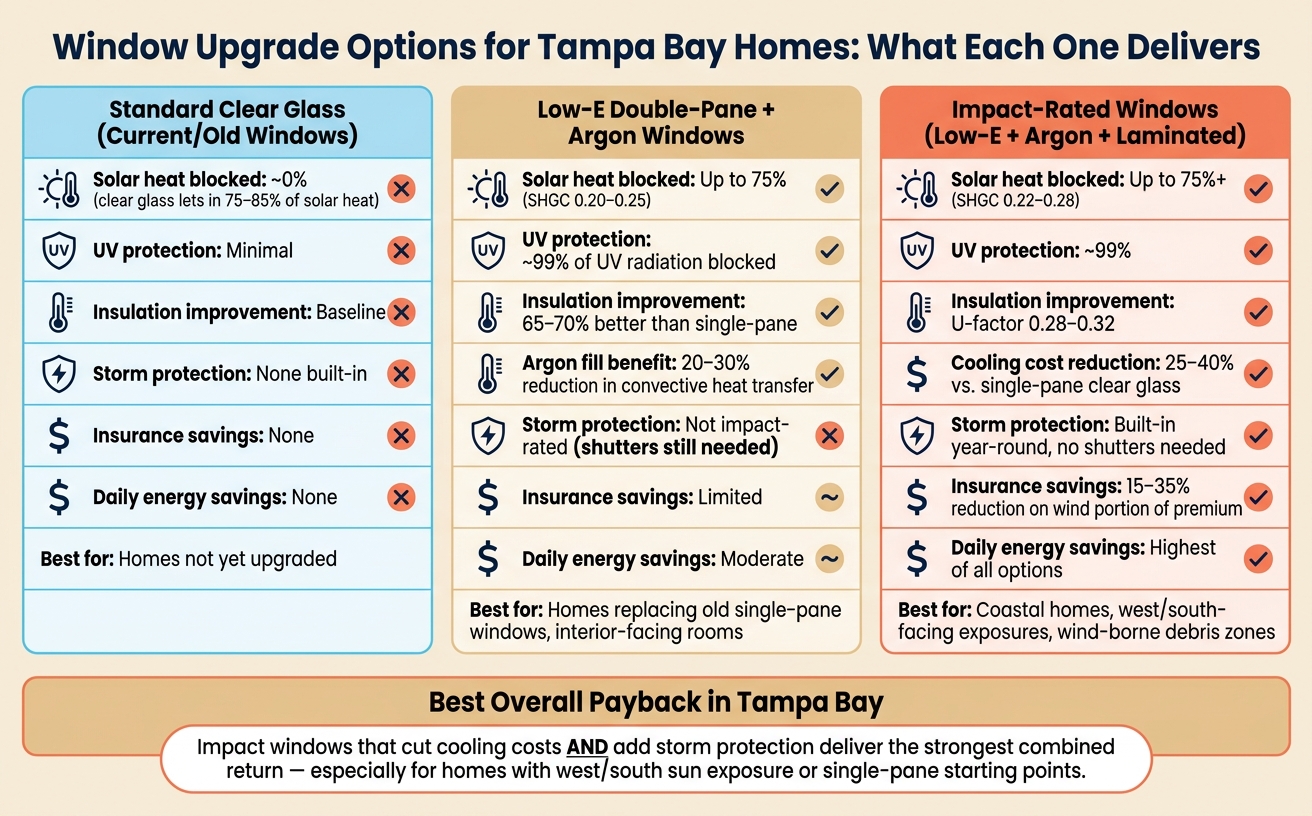
Impact Windows vs. Hurricane Shutters vs. Standard Windows: Tampa Bay Cost & Savings Comparison
Once you know the window types, the next step is figuring out which homes get their money back faster. The answer usually comes down to cooling savings, possible insurance savings, AC runtime, and what you would otherwise spend on storm protection. In Tampa Bay, sun exposure and the condition of your current windows often matter more than the product label by itself.
Homes With Single-Pane Glass and Heavy West Exposure Usually See the Fastest Payback
Homes with single-pane or clear-glass windows usually see the biggest jump, especially when those windows face west. That late-day sun hits hard in Tampa Bay, and weak glass lets a lot of heat pour in.
If you replace the weakest units with Low-E double-pane or impact-rated windows, the payback case gets stronger. Lowering HVAC load can also ease strain on your equipment over time.
Energy Savings Alone May Not Justify the Cost, but Insurance and Comfort Change the Math
The basic formula is straightforward: payback = installed cost ÷ annual savings. In Tampa Bay, those savings should include lower cooling costs, possible insurance savings, and avoided shutter or panel costs.
On energy savings alone, payback can still take a while. But... that’s not the whole picture.
Impact-rated windows can also make your home feel better day to day. You get more even indoor temperatures, less heat coming through the glass, and built-in storm protection. For homeowners who plan to stay in the house for years, that can shift the math in a meaningful way.
Impact Windows vs. Hurricane Shutters: Different Costs, Different Outcomes
This tradeoff stands out most when you compare impact windows and shutters side by side. Shutters cost less up front. Impact windows may deliver savings and other gains all year.
| Factor | Impact Windows | Hurricane Shutters |
|---|---|---|
| Daily energy savings | Reduces solar heat gain and AC runtime | None |
| Storm protection | Built in year-round | Added before storms |
| Payback drivers | Cooling savings, potential insurance savings, avoided shutter costs | Storm protection only |
Choosing the Right Window Upgrade for Your Tampa Bay Home
The payback case changes from one home to the next. You need to match the upgrade to your home's sun exposure, the shape your windows are in, and the level of storm protection you need. Once you do that, the next step gets a lot easier: figure out which homes gain the most, and which upgrade pays back fastest.
Older South Tampa Homes and Coastal Properties Usually Have the Clearest Case for Replacement
If your home was built 15 to 30 years ago and still has the original windows, full replacement often makes sense. Older units in Tampa Bay tend to struggle with heat, moisture, and wear, and that shows up fast in comfort and cooling bills.
Coastal and waterfront homes face more pressure. Salt air can wear down window parts over time, and higher storm exposure makes impact-rated windows a stronger option. That can push replacement higher on the priority list.
Some homes in this group may also qualify for insurance credits for opening protection when impact-rated windows meet policy rules. But there’s a catch. The windows still need Florida Product Approval and the local permit required for the job.
Replacing the Worst Windows First Can Improve the Numbers When Full-Home Payback Looks Weak
If a full replacement project doesn’t fit your budget, start where the heat hits hardest. Focus on the worst windows in the hottest rooms, which usually means west- and south-facing sides of the house.
Afternoon sun is the main problem in many Tampa Bay homes. So if one bedroom, living room, or upstairs space turns into an oven by 3:00 p.m., that’s often your first target.
This phased approach works well when full-home payback looks thin or the upfront cost feels too high. You spread out the spend, fix the biggest trouble spots first, and make the rooms you use most feel better sooner.
Best Payback: Cut Cooling Costs and Add Storm Protection
The strongest window projects fix two problems at once. In Tampa Bay, the best return usually comes from one upgrade that cuts cooling costs and lowers storm risk at the same time.
In other words: if your new windows help your AC run less and give your home better storm protection, the numbers start to look a lot better. Add possible insurance premium reductions and day-to-day comfort, and the case gets stronger.
Bayshore Exteriors provides home-specific evaluations and impact window replacement in Tampa Bay.
FAQs
How long is the typical payback period?
For most Tampa Bay homeowners, energy-efficient windows usually pay for themselves in 5 to 10 years from lower energy bills alone.
Impact-rated windows can pay back faster. In coastal or high-velocity areas, the timeline may drop to 3 to 8 years once you add insurance discounts, skipped hurricane shutter labor, and resale value.
But energy savings by themselves don't always close the gap fast. In some homes, energy-only payback can still take 10 to 15 years.
Are impact windows worth it over shutters?
It comes down to two things: your budget and how long you plan to stay in your home.
Impact windows cost more up front. But they protect your home 24/7, not just when a storm is coming. They can also help lower energy use and may add home value in ways shutters usually don’t.
If you expect to stay in your home for at least five years, impact windows often make more sense over time. That’s especially true when insurance discounts, energy savings, and state grants help cut the total cost.
Which windows should I replace first?
Start with windows that take direct afternoon sun. They bring in the most heat, and that can push your cooling bill up fast.
Next, move to windows with clear signs of trouble: drafts, air leaks, condensation between panes, or frames that stick when you try to open and close them. Those problems usually mean the window isn't doing its job.
If your home still has original single-pane windows, put those at the top of the list. They leak heat and air more than newer options.
In Tampa Bay, it also makes sense to focus on the rooms you use most. Think bedrooms, the living room, or your home office. Then look at spots with more storm exposure, since those windows take a harder hit from wind and rain.
Related Blog Posts
✔ START TODAY
Personal and targeted approach

✔ FAQ
Your Questions. Our Expertise.
How do I get an accurate price for my project?
Are you licensed and insured in Florida?
How long does a typical installation take?
Does your work come with a warranty?
Why do you recommend James Hardie siding for Florida?
What specific services do you provide?
✔ START TODAY
Ready to Get Started?
Trusted and reliable Hardie board siding services backed by expert craftsmanship and high performance materials. We help homeowners achieve a durable, low maintenance exterior that looks great and stands strong for years to come.
Book an Appointment
We have received your estimate request and will be reaching out to you shortly.
.webp)