
Replacing Windows in a Tampa HOA: What the Rules Allow
Get HOA and permit guidance for hurricane-rated window replacements in Tampa—why same-size impact windows usually clear approvals fastest.
Lorem ipsum dolor sit amet, consectetur adipiscing elit. Suspendisse varius enim in eros elementum tristique. Duis cursus, mi quis viverra ornare, eros dolor interdum nulla, ut commodo diam libero vitae erat. Aenean faucibus nibh et justo cursus id rutrum lorem imperdiet. Nunc ut sem vitae risus tristique posuere.
You need two approvals before window work starts in a Tampa HOA: HOA approval for appearance and a permit for code.
Think the HOA can block any window you want to install? Here's what happens. The board can control how the window looks from the outside, but it cannot reject a code-compliant hurricane protection upgrade based on looks alone. In Tampa, permit staff check wind-load rules, impact standards, anchoring, and the product's FL# or Miami-Dade NOA.
For most homeowners, the easier path looks like this:
- Keep the same window opening size
- Pick a product with a valid Florida Product Approval
- Match the HOA's rules for frame color, tint, and grid pattern
- Send a full ARC package before ordering materials
- Have a licensed contractor pull the permit
But... changing the opening size often adds cost, drawings, and delay. Tampa-area replacement windows usually need to meet wind standards tied to storms, with impact testing under ASTM E1886 and E1996, and the article notes a baseline of 150 mph for local wind conditions.
HOA Window Rules: Don't Make This Expensive Mistake!
sbb-itb-85e0110
Quick comparison
| Topic | HOA review | Permit review |
|---|---|---|
| Main focus | Exterior look | Safety and code |
| Checks | Color, tint, grids, visible match | FL#, NOA, wind load, anchoring |
| Can it stop the job? | Yes, if you break recorded design rules | Yes, if the product fails code |
| Same-size replacement | Often less friction | Often less paperwork |
| Opening size change | More scrutiny | Sealed engineering drawings often required |
Impact windows vs. shutters
| Option | What you see outside | HOA path | Storm prep |
|---|---|---|---|
| Impact windows | Little visible change | Often easier | None after install |
| Hurricane shutters | Tracks, panels, or boxes may show | Often stricter | You must deploy them |
In other words: if you want the lowest-friction route, a same-size impact window that matches HOA appearance rules usually gets fewer objections than shutters or resized openings.
The rest of the article breaks down where each review starts, what documents boards ask for, and what to do if the HOA sends back a denial or a conditional approval.
HOA Approval and Building Permits Are Two Separate Reviews
HOA approval and the building permit are not the same step. You need both before installation starts. The window product you pick can affect how smoothly each one moves, and that matters because impact windows and shutters may go through different review paths.
- HOA review: exterior appearance only
- Permit review: code, wind load, anchoring, and product approval
What an HOA Board Typically Reviews on Replacement Windows
HOA boards review the community’s recorded standards and look at the outside appearance of the window: frame color, grille pattern, glass tint, and visible consistency.
That sounds straightforward. But boards can’t reject a window just because someone on the board doesn’t like how it looks. They have to base the decision on the recorded standards, not personal taste. Under Florida HB 293, HOAs must adopt specific hurricane protection standards and cannot deny an application for code-compliant hurricane protection.
When you submit your ARC application, send physical frame color swatches instead of photos alone. Here’s why: a color like “bronze” can look different from one manufacturer to the next.
That appearance check is the first gate. After that, the next question is whether the window meets Florida code.
What the Permit Office Reviews Before Installation Can Begin
The permit office does not care about appearance. It checks wind ratings, anchoring, and Florida Product Approval. In other words: the city or county wants to know whether the window can be installed legally and safely.
Every replacement window must have a valid Florida Product Approval number, or FL#, or a Miami-Dade NOA that shows it meets state wind-load standards. Your contractor should file the permit application.
If you keep the existing opening, approval is often simpler. But if you change the opening size or shape, both the HOA review and the permit review usually take more work.
How Florida Code Sets the Baseline for Window Replacement in Tampa
Once you clear the permit question, the next issue is the opening itself. If your replacement window stays inside the current opening, the path is usually easier. But Florida code still sets the floor before any HOA says a word.
In Tampa’s high-wind zone, replacement windows must meet local wind-load and impact rules. That means a rating of at least 150 mph and impact testing for wind-borne debris under ASTM E1886 and E1996. If the window doesn’t have that approval, the permit process stops there.
That’s why same-size replacement often has the edge.
When Same-Size Window Replacement Is More Straightforward
Replacing a window inside the current rough opening is usually the simplest route. If the new unit fits that opening and meets the required design pressures, you can often avoid new structural engineering.
You still need a permit. But the paperwork is lighter. The contractor submits the Florida Product Approval number and the manufacturer’s installation instructions, and the review usually stays focused on wind-load compliance.
From the HOA’s point of view, same-size replacement keeps the exterior profile the same. So the review often comes down to a few visible details:
- Frame color
- Glass tint
- Grid pattern
Impact windows often fit this route better because they keep the opening as-is and preserve the building’s exterior look. In other words: they tend to move through HOA review with fewer headaches than projects that change the opening.
When Changing the Opening Size Adds HOA and Permit Complexity
Once you change the opening, the project is no longer a basic replacement. A new size or shape triggers a different approval track.
Florida code requires sealed structural drawings from a Florida-licensed engineer before the city can issue a permit for any opening change. That adds time and cost. No way around it.
On the HOA side, a resized opening can trigger concern about appearance rules. In condos, the review often gets tighter because the opening may affect common elements or a shared structural system.
Get the engineering drawings and HOA approval before you pick a product or book the install.
Impact Windows vs. Hurricane Shutters: Which Option HOAs More Often Accept
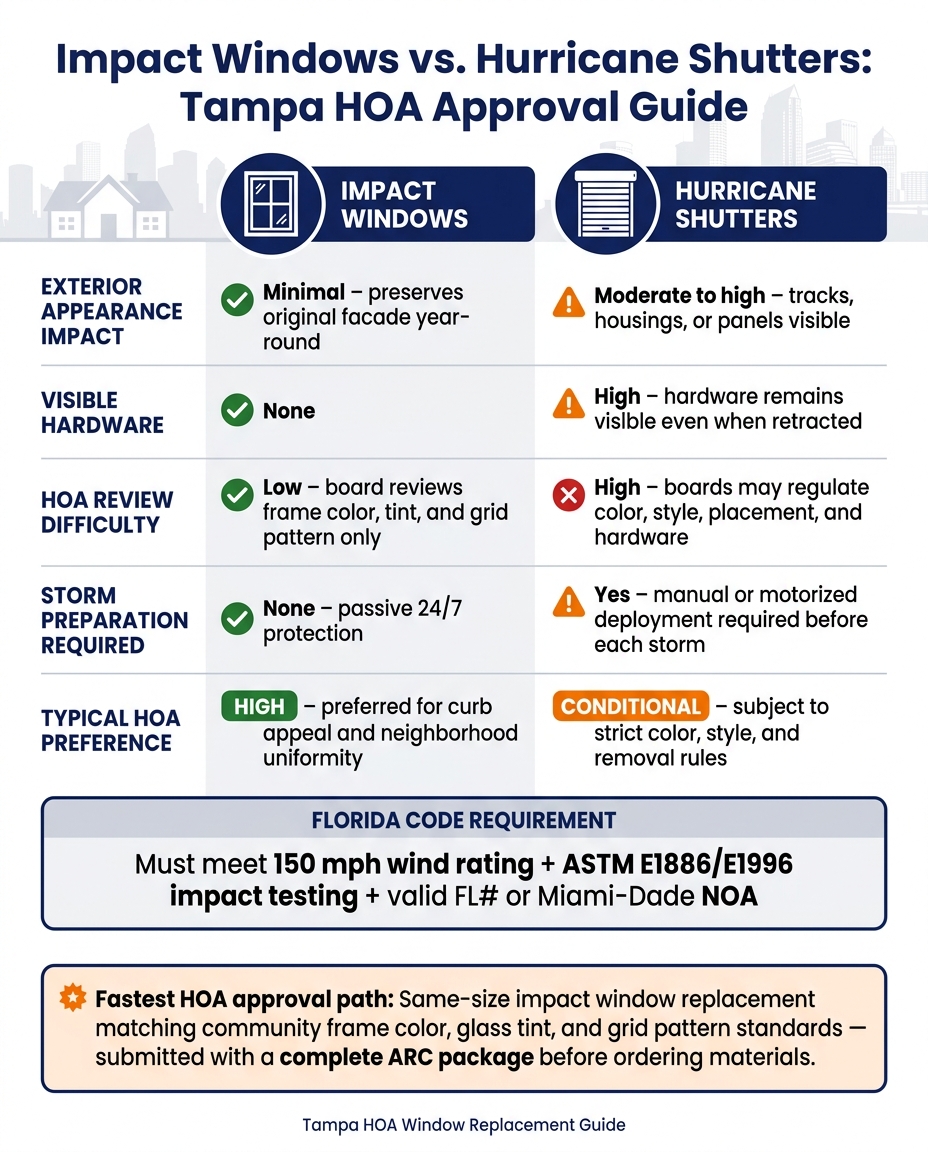
Impact Windows vs. Hurricane Shutters: Tampa HOA Approval Guide
HOAs usually approve impact windows more easily than shutters because they keep the facade looking the same and don’t leave hardware in plain sight. Shutters can still get the green light. But boards often add tighter appearance rules.
Once code compliance is handled, the HOA usually focuses on what people see from the street. That’s where the gap between these two options becomes obvious.
| Option | Exterior appearance impact | Visible hardware | HOA review difficulty | Storm preparation required | Typical HOA preference |
|---|---|---|---|---|---|
| Impact Windows | Minimal; preserves the original facade year-round | None | Low; review focuses on frame color, tint, and grid pattern | None; passive 24/7 protection | High; preferred for curb appeal and neighborhood uniformity |
| Hurricane Shutters | Moderate to high; tracks, housings, or panels visible | High; hardware remains visible even when retracted | High; boards may regulate color, style, placement, and hardware | Manual or motorized deployment required | Conditional; often subject to strict color, style, and removal rules |
Why Impact Windows Often Align Better with HOA Appearance Standards
HOAs tend to favor impact windows because they keep the outside clean and uniform. No tracks. No boxes. No panels stacked against the wall. Day to day, the home looks the same, and that matters in communities with written architectural rules.
They also make the review process easier. The board can usually stick to a short list: frame color, glass tint, and grid pattern. Shutters bring more visual changes, so boards often look harder at color, style, placement, and whether mounting hardware stays visible.
When Shutters May Still Be Approved but Face More Conditions
Shutters do get approved. But they often come with extra conditions.
Boards may limit shutter color, how much hardware shows, and how long the shutters can stay up after a storm threat passes. Many require fast removal once the threat is over.
Get the HOA’s hurricane protection specs before you buy anything. Those details usually need to go into your HOA submittal with the product papers.
What a Complete HOA Submittal Package Looks Like and What Approval Outcomes Mean
Once you know which rules apply, the next step is building a submittal package that answers those rules head-on. A complete package cuts down on back-and-forth and helps the review stay on track.
A full package usually includes FL# or NOA, manufacturer cut sheets with DP ratings, physical color and finish samples, glass specs, labeled exterior photos, and contractor license and insurance documents.
The board usually gives one of three responses:
| Approval outcome | What it usually means | Common reason | Next step |
|---|---|---|---|
| Approved as submitted | Work can proceed as proposed | Full alignment with CC&Rs and aesthetic standards | Contractor pulls the building permit |
| Approved with conditions | Approval granted only if specific changes are made | Minor frame color mismatch or missing glass tint specs | Homeowner confirms changes with contractor before ordering |
| Rejected with revisions | Application rejected in its current form | Missing FL# product data, unlicensed contractor, or non-compliant style | Update packet with requested specs and resubmit |
A denial doesn't always end the process. Under Florida HB 293, the board must cite a specific clause from the governing documents when it rejects an application for aesthetic reasons. In other words: they can't send a vague "no" and leave you guessing.
If your submittal gets rejected, ask for the written denial with the exact CC&R citation. Then fix ONLY what the board flagged and send it back in. Courts generally treat 30 days as a reasonable response window, so keep a record of your submission date.
Conclusion: Choose the Window Option That Satisfies Both the HOA and Florida Code
For most Tampa-area homeowners, a well-documented impact window replacement that matches the community's aesthetic standards is the clearest path. Same-size units keep the exterior profile intact, which reduces HOA friction, and a valid FL# keeps the permit review moving. Prep determines speed. A submittal that matches HOA standards and Florida code on the first try is the fastest approval path there is.
Bayshore Exteriors handles impact window installations across Tampa Bay and can prepare a permit-ready HOA submittal package as part of the estimate process.
FAQs
What if my HOA denies my window application?
Ask for a written denial that names the exact rule or covenant you violated and points to the exact part of your impact window proposal that doesn’t comply. A vague denial that leans only on looks isn’t enough.
Check the HOA’s written standards, then revise your application if needed or appeal to the board. But here’s the key point: under Florida law, HOAs can’t block code-compliant hurricane protection if it meets their adopted color and style rules.
Do I need HOA approval and a permit?
Yes, you usually need both.
Florida law protects your right to install hurricane-resistant windows. But your HOA will often still ask for architectural approval for details like frame color, window style, and glass tint.
At the same time, most Florida cities and counties require a building permit. That permit checks that the installation meets code for wind load and impact resistance.
Handle both at the same time if you can. It saves you time and cuts down on back-and-forth.
How long does HOA window approval usually take?
HOA window approval timelines change from one community to the next. A simple review may take 5 to 10 business days. Many standard HOAs take 2 to 6 weeks. High-end condominiums with multi-step reviews can stretch the process to 6 to 10 weeks.
Some HOA documents also set a formal response window of 30 to 60 days. That means even a small window project can move slower than you expect.
To cut down on delays, send a complete package the first time:
- Product specs
- Color samples
- Installation details
Missing one item can slow the review and push your project back.
Related Blog Posts
✔ START TODAY
Personal and targeted approach

✔ FAQ
Your Questions. Our Expertise.
How do I get an accurate price for my project?
Are you licensed and insured in Florida?
How long does a typical installation take?
Does your work come with a warranty?
Why do you recommend James Hardie siding for Florida?
What specific services do you provide?
✔ START TODAY
Ready to Get Started?
Trusted and reliable Hardie board siding services backed by expert craftsmanship and high performance materials. We help homeowners achieve a durable, low maintenance exterior that looks great and stands strong for years to come.
Book an Appointment
We have received your estimate request and will be reaching out to you shortly.
.webp)