Tampa Siding Installers: What Licensed Fiber Cement Pros Do
Why Tampa homes should choose HZ10 fiber cement installed by licensed pros—permits, WRB, flashing, and wind fastening.
Lorem ipsum dolor sit amet, consectetur adipiscing elit. Suspendisse varius enim in eros elementum tristique. Duis cursus, mi quis viverra ornare, eros dolor interdum nulla, ut commodo diam libero vitae erat. Aenean faucibus nibh et justo cursus id rutrum lorem imperdiet. Nunc ut sem vitae risus tristique posuere.
Tampa Bay homes see 130 mph design wind speeds, heavy humidity, salt air, and hard summer sun. If you started by looking at vinyl siding, here’s the short answer: for most Tampa homes, I’d lean toward fiber cement installed by a licensed contractor because Florida code, moisture control, and wind fastening matter as much as the board itself.
Vinyl usually costs about $4 to $8 per sq. ft. installed (verify with client before publish). James Hardie fiber cement usually runs $8 to $14 per sq. ft. installed (verify with client before publish). But in Hillsborough County, the lower upfront price does not tell the whole story. A bad install can lead to water damage, loose panels, failed inspections, or warranty trouble.
| Factor | Fiber Cement | Vinyl |
|---|---|---|
| Upfront cost | Higher | Lower |
| Heat and sun | Holds shape better | Can warp or fade |
| Storm performance | Better when fastened to spec | More prone to blow-off |
| Termites and rot | Resists both | Can hide wall issues |
| Install demands | Higher | Lower |
After this, you should know what licensed siding installers handle, what your proposal should list, and what to ask before you sign.
sbb-itb-85e0110
Tampa Fiber Cement Projects Must Follow Florida Code, HZ10 Specs, and Local Permit Rules
In Tampa, fiber cement siding is a code-driven job, not just a swap from one material to another. The install has to line up with the Florida Building Code 8th Edition, the maker's specs, and local permit rules before a single board goes on the house.
That matters because Tampa-area design wind speeds hit 130 mph or higher. A licensed contractor takes those load demands and turns them into the right product choice, fastening pattern, and flashing setup.
HZ10 Product Selection Determines What Gets Installed on a Tampa Exterior
HZ10 means HardieZone 10, James Hardie's product class for Tampa Bay's humidity, UV exposure, and storm conditions. That's not a small detail. It tells the installer which products fit this climate instead of treating the job like a standard siding replacement.
ColorPlus® Technology adds a 15-year warranty against peeling, cracking, and chipping.
Florida License, Insurance, and Permit Responsibility Affect Your Risk as a Homeowner
Your contractor should handle the permit, follow code, and confirm the install meets the rules. Before you sign anything, check that the company has an active DBPR license.
You should also ask for proof of:
- General liability coverage
- Workers' comp coverage
When you compare bids, look at the scope of work line by line. Make sure pulling permits and scheduling inspections through Tampa or Hillsborough County are clearly included. If a contractor skips the permit, that can affect warranty enforceability.
Once the permit process is in place, the installer can inspect the wall assembly and set the job scope before work starts.
What Licensed Fiber Cement Pros Inspect Before Installation Begins
Once code checks and permits are in place, the installer looks at the wall itself before any demo starts. A licensed crew begins with an inspection, not a tear-off.
Existing Siding, Sheathing, and Moisture Damage Define the Scope of Work
The installer looks for failed caulk, missing flashing, rot, surface breakdown, edge damage, and signs of leaks. When the old siding comes off, the job can grow if the wall shows sheathing or framing damage.
Any rotted sheathing, damaged framing, or termite loss needs repair before the new siding goes up.
The installer also checks clearance from grade, roofs, and hard surfaces. That matters more than some homeowners think.
That inspection should lead straight to a written scope. Not a vague bid.
A Professional Scope Should List Flashing, WRB, Fasteners, and Inspection Milestones in Writing
The inspection should produce a written scope that fits the wall conditions. A solid scope should list:
| Scope Item | What to Look For in the Proposal |
|---|---|
| Cladding Selection | HZ10-rated James Hardie product specified by name |
| WRB | Continuous barrier, shingled installation method noted |
| Flashing Locations | Window heads, sill pans, kickout flashing at roof-to-wall transitions |
| Fasteners | Corrosion-resistant, approved for coastal/high-wind use |
| Clearances | Minimum distances from grade and hard surfaces documented |
| Wall Conditions | Sheathing, framing, and substrate findings from pre-install inspection |
If a contractor gives you a quote without measuring the property in person, or skips a written scope that covers these items, the job is underdefined.
From there, the crew can install the WRB, flashing, and siding in the right order.
Proper Fiber Cement Installation in Tampa Requires Moisture Control, Wind Fastening, and Finish Details
Once the scope is clear, the work moves to the wall itself: WRB, flashing, fasteners, then finish. In Tampa, those hidden parts do the heavy lifting. They decide whether the siding stays dry, stays attached, and holds up when storms push rain sideways.
That’s the moment the written scope turns into the actual wall assembly.
Water-Resistive Barriers and Flashing Details Stop Hidden Wall Damage from Wind-Driven Rain
Installers place a WRB behind the siding and tie flashing into windows, doors, and roof-to-wall joints. In Tampa, rain doesn’t just fall straight down. During storms, wind can push water into gaps and transitions from the side, so layout and sequencing need to be right.
They also keep the required clearances from grade, roofs, and hard surfaces. That space helps limit moisture trouble before it starts.
Corrosion-Resistant Fasteners and Stud-Attached Nailing Are Required in Hurricane Conditions
Fiber cement weighs more than vinyl, so crews fasten it into studs, not only sheathing. They follow the manufacturer’s nailing pattern and use corrosion-resistant fasteners approved for coastal exposure.
That part matters. A lot. Properly installed fiber cement can withstand winds exceeding 150 mph.
Cut Edges, Joint Spacing, Caulk Compatibility, and Finish Choices Affect How Long Siding Lasts
This is where bad installs tend to show up first in Florida. Crews use fiber-cement cutting tools and dust control so edges stay clean and boards fit as they should.
They also leave small gaps at butt joints for thermal movement, then seal those joints based on manufacturer guidance to help keep wind-driven rain out. In other words: small finish details can decide how long the whole job holds up.
| Detail | Why It Matters in Tampa | What to Confirm with Your Contractor |
|---|---|---|
| WRB and flashing | Creates a secondary defense against wind-driven rain | WRB behind siding; flashing at openings and roof-to-wall transitions |
| Clearances | Helps prevent moisture wicking and edge damage | Proper spacing from grade, roofing, and hard surfaces |
| Fasteners | Supports attachment in coastal, hurricane-prone conditions | Corrosion-resistant fasteners and manufacturer-specific nailing patterns |
| Butt-joint spacing | Allows for thermal movement and joint management | Small gaps left and sealed per manufacturer guidance |
| Factory finish | Better UV resistance than field-applied paint; ColorPlus® Technology carries a 15-year warranty against peeling, cracking, and chipping | Factory-applied finish specified in the scope |
These details help explain why fiber cement often beats vinyl in Tampa’s climate.
James Hardie Fiber Cement vs. Vinyl Siding: How They Compare in Tampa Bay
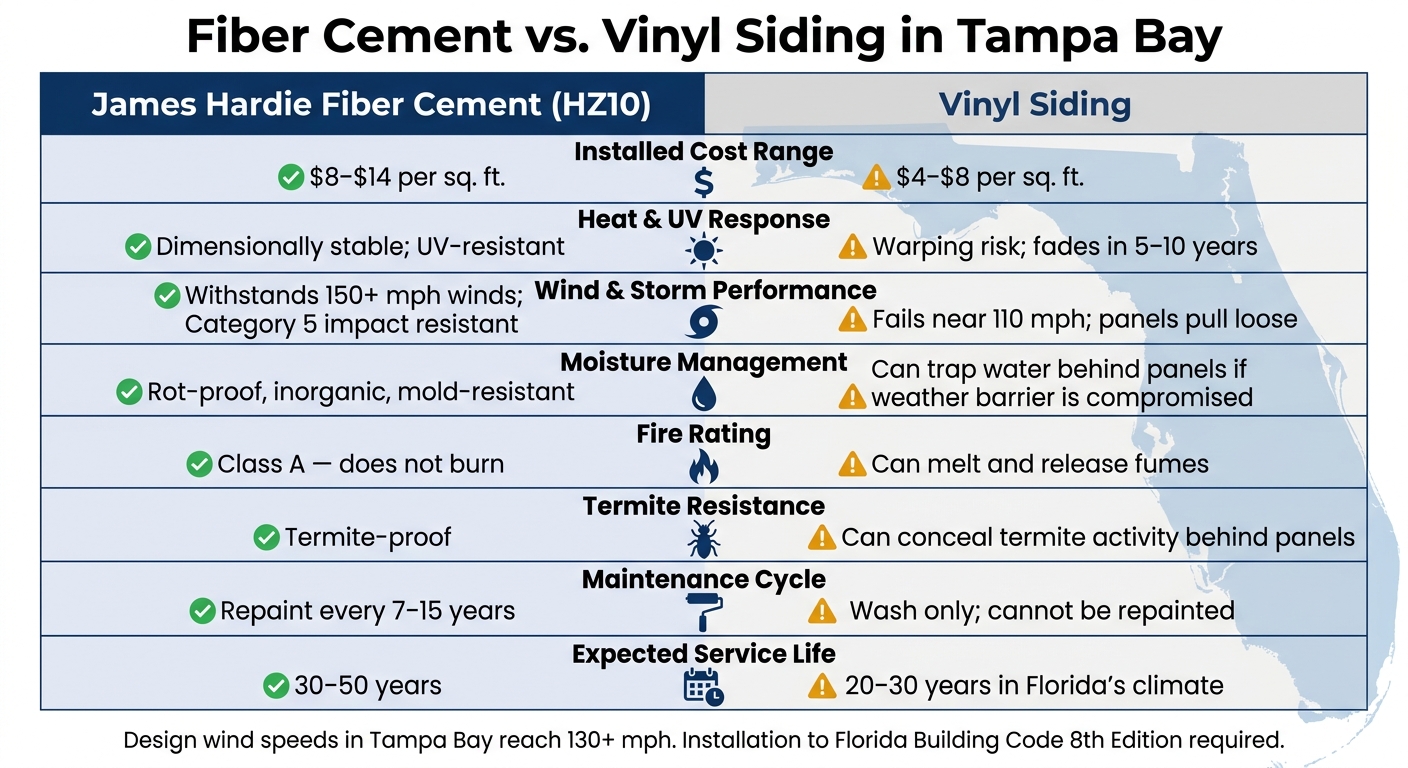
Fiber Cement vs. Vinyl Siding in Tampa Bay: Full Comparison
Once the wall details are set, your next call is the siding itself. In Tampa Bay, that choice goes past price. Heat, storms, salt air, and years of sun will test the material fast.
Heat, Humidity, Salt Air, and Hurricanes Expose Vinyl's Weak Points Faster in Tampa
Vinyl is made from PVC, and PVC softens under heat. Florida heat index levels can top 110°F, and that can make dark vinyl siding soften or lose its shape. On sun-beaten walls in Tampa Bay, surface temperatures can hit 150°F.
That matters more than many homeowners think. Over time, vinyl also fades under Florida UV exposure, often within 5 to 10 years. And if the color goes, you can't repaint it.
Storms make the gap even clearer. Standard vinyl panels can fail at around 110 mph and pull loose from their locking strips. James Hardie HZ10 fiber cement, when a contractor installs it the right way with corrosion-resistant hardware, can handle winds above 150 mph and resist debris impacts that simulate Category 5 conditions.
Fire performance is another split. Fiber cement has a Class A fire rating, which means it does not burn. Vinyl can melt and release fumes when heat from a nearby fire hits it, including heat from downed power lines after a storm.
Then there's termites. Florida has the highest termite pressure in the U.S. Fiber cement is termite-proof, while vinyl can still conceal termite activity behind the panels.
Long-Term Ownership Cost Favors Fiber Cement When Repairs and Replacement Cycles Are Counted
Vinyl costs less at the start. That's the part people see first. But over time, repair bills, storm damage, and shorter replacement cycles can eat into that early savings.
Fiber cement usually lasts longer, needs fewer storm-related fixes, and tends to return more at resale than vinyl. Or put another way: the upfront gap can shrink once you count what ownership looks like over 20 to 30 years.
For Tampa Bay homes, fiber cement is the stronger long-term choice.
| Feature | James Hardie Fiber Cement (HZ10) | Vinyl Siding |
|---|---|---|
| Installed Cost Range | $8–$14 / sq. ft. | $4–$8 / sq. ft. |
| Heat & UV Response | Dimensionally stable; UV-resistant | Warping risk; fades in 5–10 years |
| Wind & Storm Performance | Excellent; Cat 5 impact resistant | Fair; fails near 110 mph |
| Moisture Management | Rot-proof; inorganic; mold-resistant | Can trap water behind panels if the weather barrier is compromised |
| Maintenance Cycle | Repaint every 7–15 years | Wash only; cannot be repainted |
| Expected Service Life | 30–50 years | 20–30 years in Florida's climate |
That gap in performance is why the next step is checking the contractor's license, scope, and warranty terms.
How to Choose the Right Contractor: License Verification, Written Scope, and Warranty Coverage
After you sort out the wall assembly details, your contractor becomes the last quality check. That matters. In Tampa, a bad install can wreck a good product.
Start with the basics. Verify the contractor's Florida license and insurance. Check that the license number is active on the DBPR website, and ask for proof of liability insurance and workers' compensation coverage.
Get one more thing in writing: the contractor pulls permits and schedules inspections. Don't leave that to a verbal promise.
Then move to the written scope. This is where vague bids cause trouble. Your proposal should name the exact HZ10-rated James Hardie product, WRB, flashing, and fastener specs.
It should also connect those materials to the installation schedule and the change-order process. In other words: you should know what goes on your house, when it gets installed, and how the contractor handles changes. If any part feels fuzzy, ask for a revision before work starts.
Next comes warranty coverage. Keep it on paper. The manufacturer covers the product, while the contractor covers labor through a workmanship warranty.
Ask how long the workmanship warranty lasts and what it covers. Be specific. A "warranty" doesn't mean much if no one spells out the term, the labor coverage, or the repair process.
A siding contractor who confirms license, scope, and warranty in writing cuts your risk before the first day of work. In Tampa, performance comes from code-compliant installation, not material alone.
FAQs
Do I need a permit for fiber cement siding in Tampa?
Yes. You need a permit for fiber cement siding in Tampa, and licensed pros usually take care of that step for you.
That matters because the permit process helps make sure the job meets local building codes.
How can I verify a siding contractor’s Florida license and insurance?
Ask the contractor for proof of both license and insurance. Then check their license through the Florida Department of Business and Professional Regulation.
In Tampa Bay, a licensed, fully insured contractor helps you stay on the right side of local code and cuts your risk if someone gets hurt or your property takes damage. That quick check can save you a big headache later.
What should a fiber cement siding proposal include before I sign?
Before you sign, a fiber cement siding proposal should spell out a few non-negotiables:
- Manufacturer installation guidelines: The bid should state that the crew will follow the manufacturer’s written instructions. That matters because warranty coverage often depends on it.
- Moisture control measures: The proposal should explain how the contractor will handle water management behind the siding. That includes steps that help keep moisture from getting trapped where it can cause damage.
- Proper clearances from grade and other surfaces: The scope should list the required gaps between the siding and the ground, rooflines, decks, driveways, and other surfaces. Small spacing mistakes can lead to big problems.
- Flashing, water-resistive barriers, and fastening or nailing patterns: This part should be clear, not vague. You want to see how the contractor plans to install flashing, what water-resistive barrier they’ll use, and whether fastening will match the required nailing pattern.
- Compliance with local building codes and permit requirements: The proposal should confirm that the job will meet local code rules and that the contractor will handle permit needs when required.
If a proposal skips these details, that’s a red flag. A short bid might look easier to read, but missing scope often means trouble later.
Related Blog Posts
✔ START TODAY
Personal and targeted approach

✔ FAQ
Your Questions. Our Expertise.
How do I get an accurate price for my project?
Are you licensed and insured in Florida?
How long does a typical installation take?
Does your work come with a warranty?
Why do you recommend James Hardie siding for Florida?
What specific services do you provide?
✔ START TODAY
Ready to Get Started?
Trusted and reliable Hardie board siding services backed by expert craftsmanship and high performance materials. We help homeowners achieve a durable, low maintenance exterior that looks great and stands strong for years to come.
Book an Appointment
We have received your estimate request and will be reaching out to you shortly.
.webp)