Impact Window Approvals in Tampa: FL# vs. Miami-Dade NOA
Tampa permits usually require a Florida Product Approval (FL#); Miami‑Dade NOAs apply only if the approval exactly matches the installed unit.
Lorem ipsum dolor sit amet, consectetur adipiscing elit. Suspendisse varius enim in eros elementum tristique. Duis cursus, mi quis viverra ornare, eros dolor interdum nulla, ut commodo diam libero vitae erat. Aenean faucibus nibh et justo cursus id rutrum lorem imperdiet. Nunc ut sem vitae risus tristique posuere.
If you live in Tampa, your permit usually needs a Florida Product Approval, not just a Miami-Dade NOA.
Here’s the short answer: Tampa sits outside the High-Velocity Hurricane Zone, so permit reviewers usually start with the FL#. However, they may accept a Miami-Dade NOA if it matches your exact window setup, including size, design pressure, frame, glass, and anchor pattern. That match decides the permit.
Before you order impact windows, check these points:
- Approval type: FL# is the standard path in Tampa; NOA can work in some cases
- Code basis: Tampa follows the Florida Building Code 8th Edition through December 2026
- Wind zone: Much of Tampa falls in a Wind-Borne Debris Region
- Design wind speeds: 140 mph in WBDR areas, or 130 mph within 1 mile of the coast
- Opening protection rule: Every glazed opening in those zones needs approved impact protection or shutters
- Product match: The approval must fit the exact series, size, DP rating, glazing, and install method
- Site factors: Corner openings can face 30% to 40% more pressure than mid-wall openings
- Exposure: Homes within 1,000 feet of large open water may fall under Exposure D, which pushes DP needs higher
- Inspection records: Missing labels or mismatched paperwork can block permit approval and hurt OIR-B1-1802 insurance credit
Think the label alone settles it? It doesn’t. You need the approval record to match the window in the wall. In other words: a valid number helps, but the listed size, pressure, and fastener details carry the job.
Quick Comparison
| Item | Florida Product Approval (FL#) | Miami-Dade NOA |
|---|---|---|
| Main use | Standard approval path for Tampa permits | Built for HVHZ use |
| Issued by | Florida DBPR / Building Commission | Miami-Dade Product Control |
| Where used most | Florida counties outside HVHZ | Miami-Dade and Broward |
| Tampa permit use | Usually the first record reviewers expect | May work if the exact setup matches |
| What must match | Series, size, DP, glazing, anchors | Series, size, DP, glazing, anchors |
| Helps with OIR-B1-1802 | Yes, if labels and records line up | Yes, if labels and records line up |
The approval number is only part of the job. Your permit packet, product label, and installed window all need to say the same thing before Tampa signs off.
sbb-itb-85e0110
What Tampa and Hillsborough County code requires before comparing approval types
The Florida Building Code (FBC) 8th Edition controls window permits in Tampa and Hillsborough County through December 2026. It sets the minimum rules for wind load, impact resistance, and energy use. That code baseline decides which approval record Tampa will accept.
Tampa sits outside the HVHZ, so the city uses FBC product approvals rather than HVHZ-only test paths. HVHZ relies on TAS 201, 202, and 203. Tampa does not. That difference matters.
Much of Tampa falls inside a Wind-Borne Debris Region (WBDR). In WBDR areas, design wind speeds are 140 mph, or 130 mph within 1 mile of the coast. In those areas, the FBC requires opening protection for every glazed opening, either with impact windows or approved shutters. In other words: the approval has to match the full window assembly, not just the glass.
How impact windows qualify as opening protection under FBC 8th Edition
Under FBC 8th Edition, an impact window counts as opening protection only if the full assembly, frame, hardware, glass, and anchorage, was tested and approved as one system. A laminated pane inside an untested frame does not qualify. Every part of the installed unit has to match the tested setup listed in the product approval record.
For Tampa's WBDR, the key test standard is ASTM E1886 and E1996 large-missile impact. The product approval, whether an FL# or an NOA, shows that the assembly passed those tests in the exact form being installed.
What Hillsborough County permit reviewers check: sizes, pressures, and installation details
When Hillsborough County reviews a permit submittal, staff do more than confirm that a product has an approval number. They check whether the approval fits the exact window going into the home.
They cross-check the maximum tested dimensions, the Design Pressure (DP) rating, and the approved installation method for the wall type involved, such as wood frame, concrete block, or CMU. But corner openings change the math. Those areas can face 30% to 40% higher wind pressures than mid-wall openings.
Exposure also shifts the target. If your home falls under Exposure D, within 1,000 feet of large open water like Tampa Bay, the needed DP ratings go higher than they do for inland suburban homes in Exposure B. Or put another way: the same window may pass on one wall and fail on another, depending on location and exposure.
| What Reviewers Check | Why It Matters |
|---|---|
| FL# or NOA number | Confirms the tested assembly and approval path |
| Maximum tested size | Window dimensions cannot exceed what the approval report lists |
| Design Pressure (DP) rating | Must meet or exceed the site-specific wind load, including corner and Exposure D adjustments |
| Installation drawings | Must show anchor type, spacing, and sealant for the exact wall substrate |
After that review, the permit package has to line up with the product records exactly.
FL# and Miami-Dade NOA come from different approval systems and are used differently in Tampa
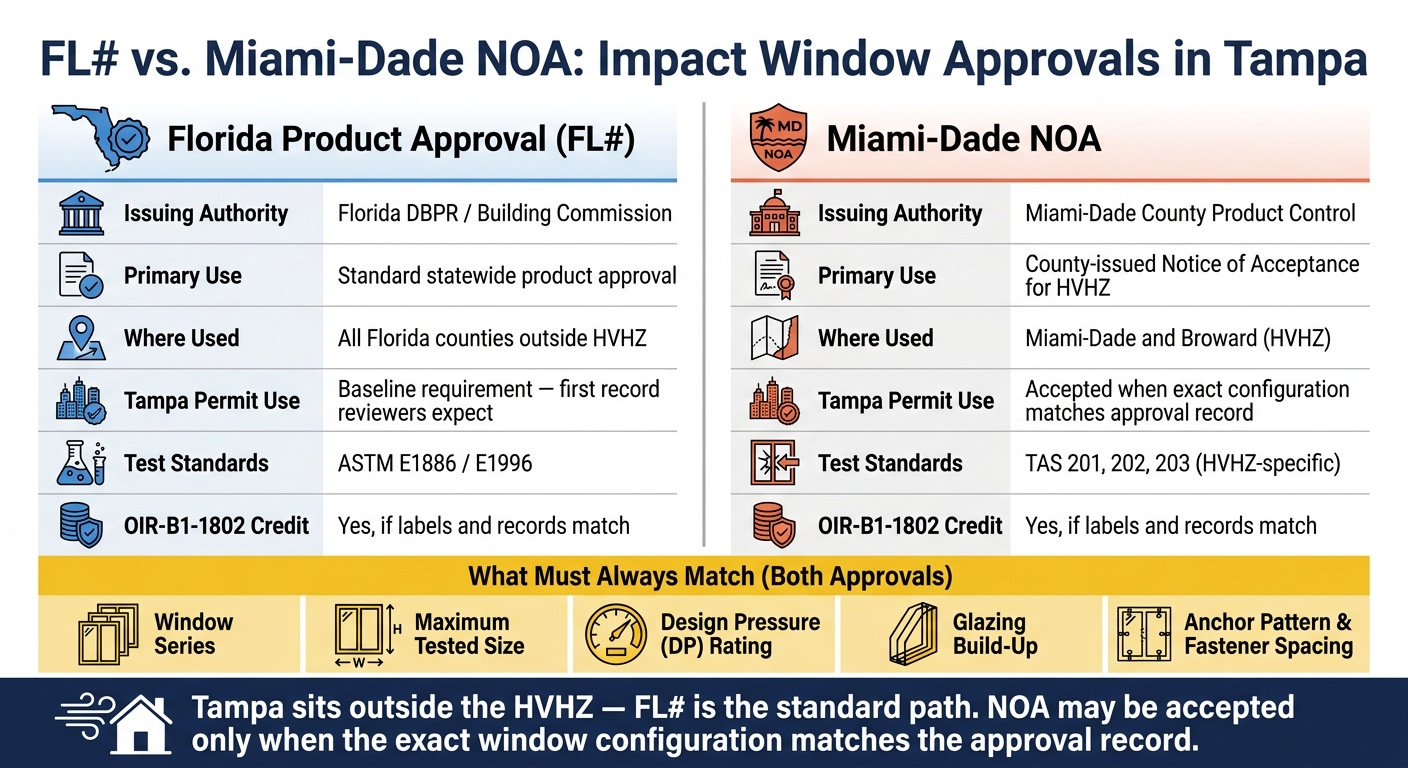
FL# vs. Miami-Dade NOA: Impact Window Approvals in Tampa
You’ll see both approval types on labels and spec sheets. They are not the same thing. Each comes from a different system and serves a different role.
For Tampa permits, the key issue is simple: does the approval record match the exact unit being installed? That’s what keeps Hillsborough County permit review moving.
| Field | Florida Product Approval (FL#) | Miami-Dade NOA |
|---|---|---|
| Approval type | Statewide product approval | County-issued Notice of Acceptance |
| Issuing authority | Florida DBPR / Building Commission | Miami-Dade County Product Control |
| Used in | All Florida counties outside HVHZ | Miami-Dade and Broward (HVHZ) |
| When Tampa accepts it | Baseline requirement for residential non-HVHZ jobs | Accepted in Hillsborough when the exact configuration matches the approval record |
A Florida Product Approval number (FL#) is the standard path for Tampa window permits
An FL# is the statewide product approval number managed by the Florida Department of Business and Professional Regulation, or DBPR. For window replacement in Hillsborough County, this is the standard path reviewers expect to see.
If the FL# lines up with the window series, dimensions, design pressure, and installation method, that document is enough for Hillsborough County permitting. In other words: the number alone doesn’t do the job. The match does.
A Miami-Dade NOA documents HVHZ acceptance and may still apply outside Miami-Dade
A Miami-Dade Notice of Acceptance (NOA) comes from Miami-Dade County Product Control. It was built for the High-Velocity Hurricane Zone, or HVHZ, which uses the strictest testing protocols in the country.
That does not make NOA a separate Tampa permit route. But... Tampa can still accept it. Hillsborough can use an NOA when the product record matches the exact window configuration being installed.
The right approval depends on the exact window configuration, not the product label
Think a product label settles it? It doesn’t. Neither an FL# nor an NOA gives blanket approval to an entire product line.
Both approvals are tied to a specific setup: a defined series, a maximum tested size, a certain glazing build-up, and a listed anchorage pattern. Reviewers and inspectors check the approval record, not the sales copy, to confirm compliance.
Or put another way: your label and permit paperwork must prove that the installed window matches the approved configuration.
The documents Tampa homeowners need: labels, approval records, and the OIR-B1-1802 match
Once you choose the approval type, one thing still decides whether the permit goes through: the installed window must match the approved record. If the label, permit packet, and installed unit don't line up, the approval doesn't help.
Where to find the FL# or NOA on labels, spec sheets, and permit packages
Every approved impact window must have a permanent label on the frame or glass. Under FBC §1709.5.3, that label must show the manufacturer and the FL# or NOA number where an inspector can see it.
You'll also find the FL# or NOA on the manufacturer's spec sheet, the evaluation report, and the permit package. That package includes window schedules, elevations, and the permit application.
Here's the part many homeowners miss. The approval record must match the exact product series, maximum tested size, design pressure, and installation method for the window being installed. That's the same match inspectors check when they review OIR-B1-1802.
How OIR-B1-1802 opening protection credit depends on matching installed windows to approval records
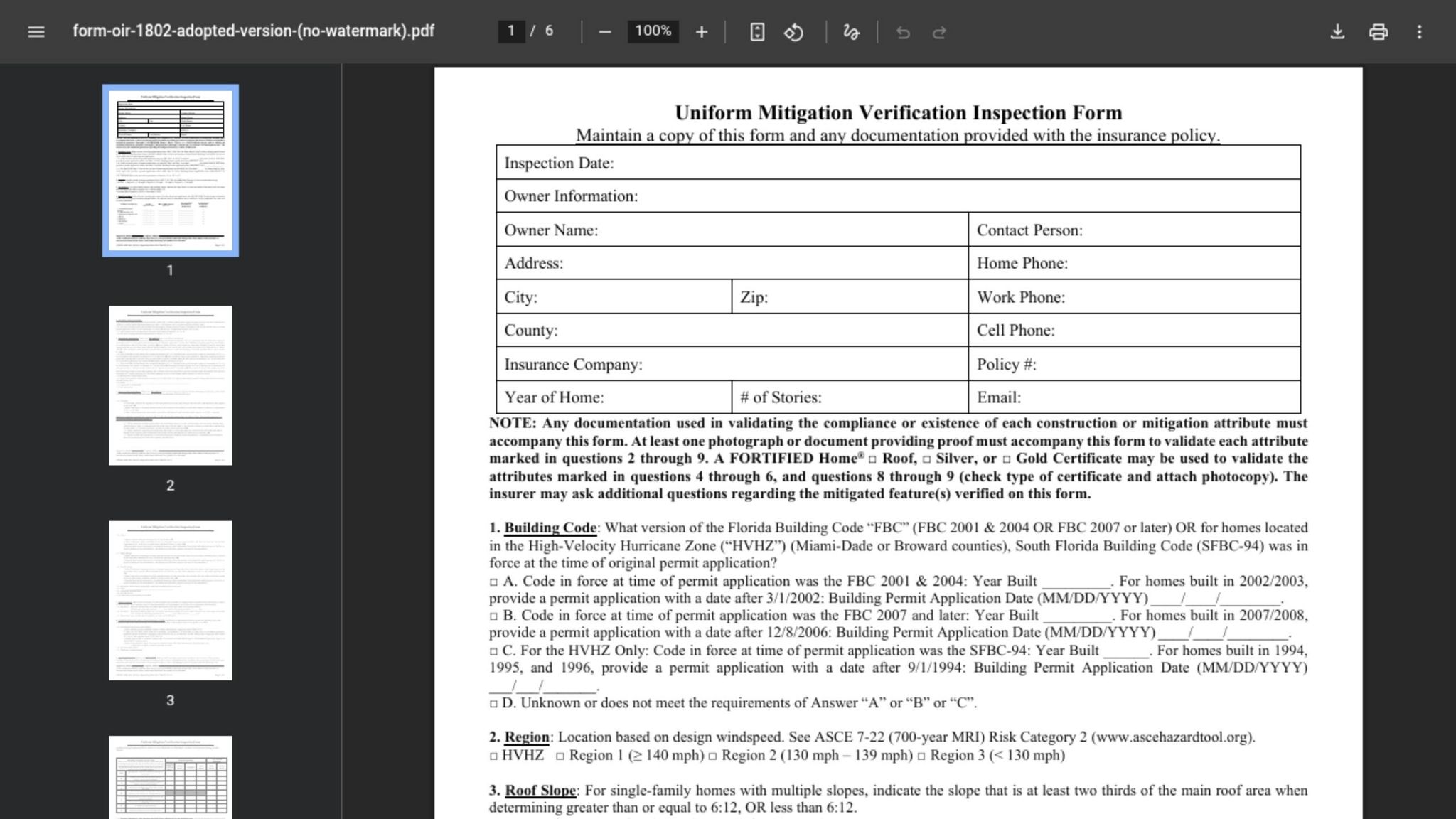
Those same records also affect your mitigation inspection. The OIR-B1-1802 Uniform Mitigation Verification Inspection Form is the form Florida insurers use to apply storm-hardening credits. Inspectors use it to verify opening protection, and the credit depends on proof that the installed product matches the approval records.
They need to see the permanent label on each installed window and confirm that it matches the FL# or NOA in the permit package. If labels are painted over, missing, or don't match, the credit can be denied. A closed permit shows the work passed inspection. An open permit can slow the credit.
Use this checklist to compare the permit packet with the installed unit:
| Item | Where to find it | Must match | Why it matters |
|---|---|---|---|
| Permanent label | Window frame or glass | Manufacturer name and FL# or NOA# | Required for field inspection and OIR-B1-1802 verification |
| FL# / NOA number | Quote, spec sheet, permit application | Exact product series, maximum tested size, and design pressure for the address | Decides whether the permit will be issued |
| Design pressure (DP) | Evaluation report; NFRC label | Must meet or exceed site-specific wind load requirements | Required for code compliance in Hillsborough County |
| Installation instructions | Permit package / manufacturer documents | Fastener type, spacing, and substrate | If the installer deviates from these, the approval can be void and the window can fail inspection |
| OIR-B1-1802 form | Post-installation inspection report | Opening Protection section must confirm the installed openings are protected | Needed to unlock insurance premium credits |
How to choose the right approved window for your Tampa home's wind zone, opening size, and permit package
Once you settle the approval type, the next step is matching it to the opening. In Tampa, the approval has to line up with the exact window and opening details in the permit package. Reviewers check one thing: whether the product paperwork matches your home's exposure category, opening dimensions, and design pressure requirements.
A window approval is not close enough because the brand and model look right. That is where jobs get stuck. The paperwork must match the exact setup listed for your home, not something similar.
DP requirements shift based on exposure, opening size, and distance from the coast. Homes within 1,000 feet of Tampa Bay or the Gulf can fall into Exposure D, which calls for the highest DP ratings. A window that passes on a mid-wall inland opening can fail on a corner opening in Exposure D, even with the same approval number.
Before you order, confirm each of these against the permit package:
- the exact window series
- the largest approved size
- the required DP for your specific opening and exposure
- the approved fastener, anchorage, and sealant pattern
A small change in anchor spacing or fastener type can void the approval and trigger an inspection failure. If the window installation on site does not match the paper trail, the inspector can flag it. Getting that match right before the order is what keeps permitting and final inspection aligned.
Bayshore Exteriors verifies approval records, exposure category, and design pressure requirements as part of every impact window estimate.
FAQs
Can Tampa reject a Miami-Dade NOA?
No. Tampa will not reject a Miami-Dade NOA.
Miami-Dade NOAs meet Florida’s toughest testing standards, so Tampa and Hillsborough County widely accept them as proof that impact-rated windows and doors comply.
An NOA is only required in the High-Velocity Hurricane Zone. But Tampa and Hillsborough County still accept it for permit submittals instead of a Florida Product Approval (FL#).
How do I verify my window’s FL# matches my opening?
Find the FL# or NOA on the manufacturer’s frame label or in your permit papers. Then check the approval in the official Florida or Miami-Dade product database and open the evaluation report.
Next, match your window’s size and design pressure to the listed limits. Also check that the installation uses the stated anchor types and spacing.
What can cause me to lose OIR-B1-1802 credit?
You can lose OIR-B1-1802 wind mitigation credit if the installation doesn’t match the approved product specs exactly.
Common reasons include:
- Using an expired approval
- Using the wrong anchorage detail
- Falling short on required design pressure
- Mixing parts that weren’t tested together
- Missing paperwork for an approved substitute
The installed windows must match the exact configuration, size, and installation method listed in the Florida Product Approval or Miami-Dade NOA.
Related Blog Posts
✔ START TODAY
Personal and targeted approach

✔ FAQ
Your Questions. Our Expertise.
How do I get an accurate price for my project?
Are you licensed and insured in Florida?
How long does a typical installation take?
Does your work come with a warranty?
Why do you recommend James Hardie siding for Florida?
What specific services do you provide?
✔ START TODAY
Ready to Get Started?
Trusted and reliable Hardie board siding services backed by expert craftsmanship and high performance materials. We help homeowners achieve a durable, low maintenance exterior that looks great and stands strong for years to come.
Book an Appointment
We have received your estimate request and will be reaching out to you shortly.
.webp)