How Impact Windows Reduce Florida Homeowners Insurance Costs
How impact windows reduce the wind portion of Florida insurance: OIR-B1-1802, product approvals, closed permits, inspections.
Lorem ipsum dolor sit amet, consectetur adipiscing elit. Suspendisse varius enim in eros elementum tristique. Duis cursus, mi quis viverra ornare, eros dolor interdum nulla, ut commodo diam libero vitae erat. Aenean faucibus nibh et justo cursus id rutrum lorem imperdiet. Nunc ut sem vitae risus tristique posuere.
Impact windows can lower your Florida homeowners insurance, but only on the wind part of the premium, not the full bill.
If your wind coverage makes up 40% to 70% of your premium, impact-rated openings may trim that piece. But the discount starts only after a licensed inspector files the OIR-B1-1802 form, and the carrier accepts it. No form, no credit.
Here’s the short answer:
- You can get a discount for impact windows and doors
- The discount applies to the windstorm/hurricane part of your policy
- You need the OIR-B1-1802 Rev. 04/26 inspection form
- You need Florida Product Approval or Miami-Dade NOA records
- You need a closed permit
- Every opening must qualify for the full opening-protection credit
- One missing or unproven opening can mean ZERO opening-protection credit
- Most carriers apply the change at renewal, not back to past bills
- Inspection cost often runs about $75 to $175, or about $200 with a 4-point inspection
- Carriers do not all give the same discount, so Citizens and private insurers can differ
Think a few impact windows are enough? But... that is where many homeowners get stuck.
In other words: your savings depend on three things: the wind share of your premium, your carrier’s credit rules, and your inspection paperwork. Or put another way: the glass matters, but the documents decide whether the discount shows up.
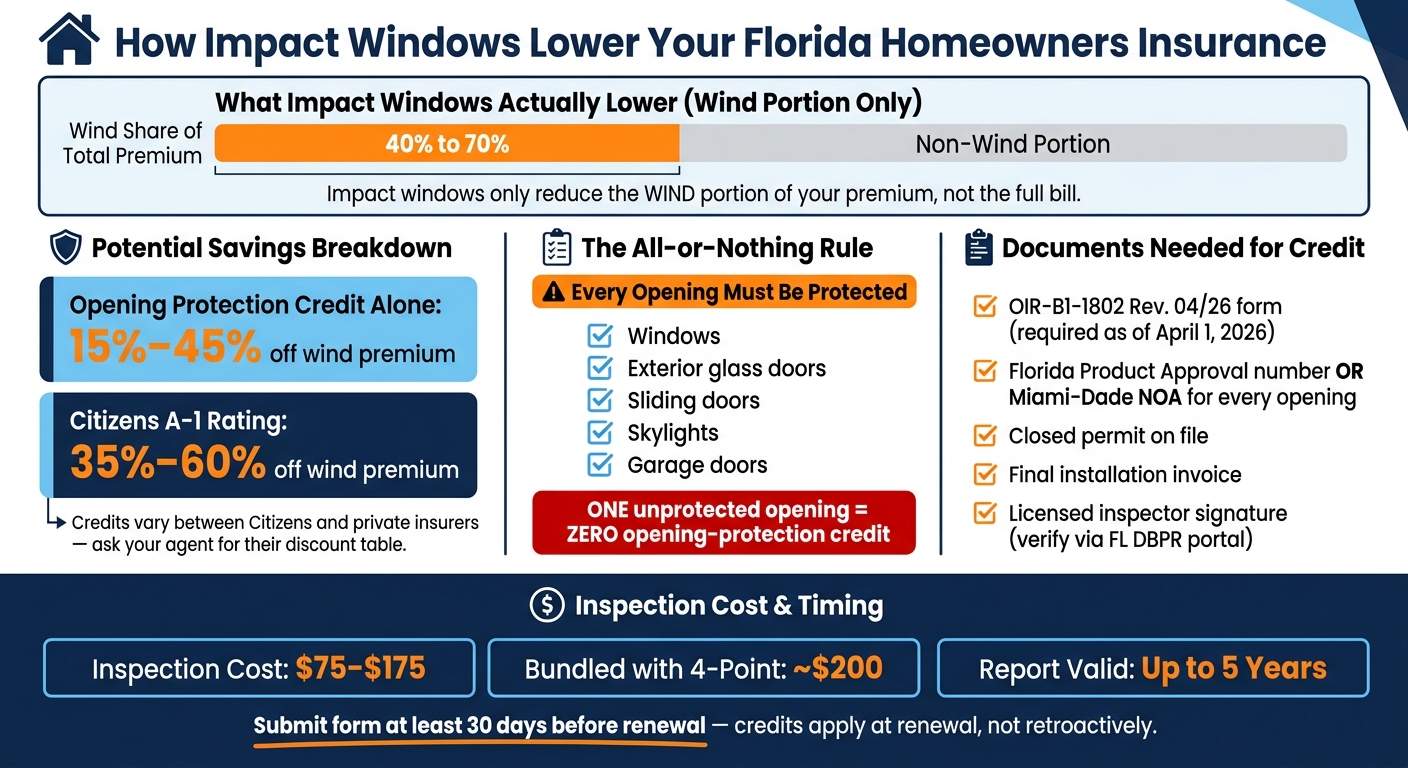
Impact Windows & Florida Homeowners Insurance: Key Requirements & Savings at a Glance
Quick Comparison
| Topic | What you need to know |
|---|---|
| What impact windows lower | The wind portion of your premium |
| Typical wind share of premium | 40% to 70% |
| Main form required | OIR-B1-1802 Rev. 04/26 |
| When the form changed | 04/01/2026 |
| Rule for full opening credit | All openings must be protected |
| Openings that count | Windows, glass doors, sliders, skylights, garage doors |
| Product proof | Florida Product Approval or Miami-Dade NOA |
| Permit status | Closed permit |
| Inspection timing | After install, before renewal if possible |
| Report validity | Up to 5 years if nothing changes |
| Typical inspection cost | $75 to $175 |
| Bundled cost with 4-point | About $200 |
| Carrier difference | Credits vary between Citizens and private insurers |
The rest of the article breaks down how that inspection works, what inspectors look for, and why missing paperwork often costs homeowners the credit.
sbb-itb-85e0110
What the OIR-B1-1802 form is and why insurers require it
The OIR-B1-1802 form is the inspection form insurers use to check wind-mitigation features and apply the wind discount. For most homeowners, opening protection is the part they can still upgrade after the house is built. That’s where impact windows fit in.
Here’s the part many people miss: the credit gets verified during the inspection, not when the installer finishes the job.
As of April 1, 2026, wind-mitigation inspections must use Rev. 04/26. That version requires permit records and Florida Product Approval numbers for credit.
One unprotected opening can cost you the full opening-protection credit
Many homeowners think a few impact windows are enough. But that’s not how this form works.
The all-or-nothing rule drives this whole category. To get the top opening-protection credit on the OIR-B1-1802 form, every single opening in the building envelope must be protected. That includes windows, exterior glass doors, sliding doors, skylights, and garage doors. If even one opening lacks protection or a verified rating, the inspector marks the category as unprotected for credit. In other words: no partial credit. You get zero opening-protection credit.
That’s why paperwork matters just as much as the glass.
Florida Product Approval and permit records are what make impact windows creditable
A window may be installed correctly and still fail to count for credit if the records don’t back it up. But the inspector can’t just take someone’s word for it.
No permit means no verification trail, and no opening-protection credit. The OIR-B1-1802 form requires documented proof for each installed window and door model. That includes Florida Product Approval numbers or Miami-Dade Notice of Acceptance numbers, plus permit records for the work.
A permitted installation that matches Florida Product Approval rules gives the inspector what they need to certify the credit. Without those records, the insurer can’t apply it.
Impact window savings apply to the wind portion of your premium, not your total bill
Impact windows do not cut your full homeowners insurance bill. They cut the wind portion of your premium after an insurer applies a wind-mitigation credit from the OIR-B1-1802 form. In Florida, that wind portion often makes up 40% to 70% of the total premium.
Here’s the part many homeowners miss. The credit applies only to that wind portion, so your savings depend on the carrier’s approved wind credit and your wind share. Or put another way: the number that matters is not your full premium. It’s the wind portion inside it.
Opening protection changes one piece of the wind-mitigation score, and carriers cap the combined discount instead of stacking every category at its top rate.
Why the same impact windows can produce different credits with Citizens and private carriers
Think the same windows should earn the same discount everywhere? They don’t.
Citizens uses a stricter opening-protection rule than many private carriers. Private insurers use their own carrier-approved rate tables, so the same impact windows can produce different credits depending on who writes the policy.
Before you spend money on a full impact window project, ask your agent for the discount table your carrier uses. That single step can show what your current mitigation profile earns now and what a full opening-protection upgrade might add.
But there’s one gatekeeper. The carrier will not apply the credit without a completed OIR-B1-1802 form, so the inspection comes next.
Opening-protection credits versus full wind-mitigation credits: what to expect
Impact-rated openings can cut the wind portion of your premium by 15% to 45% through the opening-protection category alone. For Citizens policyholders who reach an A-1 rating, that figure can hit 35% to 60% on the wind premium.
However, that doesn’t mean you add every mitigation category together and get a giant discount. Other roof features can improve the full wind-mitigation score, but impact windows affect opening protection on their own. Carriers also cap the combined result, so the final credit is never a straight total of each category’s top value.
The credit starts only after the inspection report documents the openings and the carrier accepts the OIR-B1-1802 form.
The wind-mitigation inspection is what turns impact windows into an insurance credit
Once your windows are in, the inspection is the step that makes the credit usable. Impact windows do not count for an opening-protection credit until a qualified inspector files the Rev. 04/26 OIR-B1-1802 form.
That timing matters. Most eligible credits show up at the next renewal, and insurers do not apply them retroactively.
A standard inspection usually takes 30 to 60 minutes and costs about $75 to $175. If you bundle it with a 4-point inspection, the total often lands around $200.
Close the permit before the inspection. Inspectors use that record to confirm the windows were installed to code.
Florida law also draws a hard line on who can sign the form. Only licensed home inspectors with hurricane-mitigation training, licensed contractors, engineers, architects, and certified building code officials can do it. The inspector must handle the inspection in person. Before the visit, check their license in the Florida DBPR portal.
What a qualified inspector documents during an OIR-B1-1802 inspection
The inspector has one job: prove that every opening qualifies. That means they physically check and photograph each opening in the building envelope, including windows, glass doors, sidelights, skylights, and garage doors.
For each impact product, they record the Florida Product Approval number or Miami-Dade Notice of Acceptance. That shows the product meets Large Missile Impact standards. They also log the permit details.
The completed report stays valid for five years, as long as nothing changes on the home.
Why missing documentation is the main reason homeowners lose the credit
Think the glass rating alone gets the discount? It doesn’t. The paperwork matters just as much as the window itself.
Before the inspection, pull together:
- The final invoice
- The closed permit number
- The Florida Product Approval or Miami-Dade NOA for every opening
Then send the completed form to your insurer or agent at least 30 days before renewal.
For South Tampa homeowners, a fully documented impact-window project is the right first step
For South Tampa homeowners, this comes down to one thing: proof. Homes in South Tampa and coastal Hillsborough County face higher wind exposure, so your paperwork matters as much as the windows themselves when you apply for an OIR-B1-1802 credit.
The credit hinges on four requirements: every opening must be protected, each product must carry a Florida Product Approval or Miami-Dade NOA, the permit must be closed, and the Rev. 04/26 OIR-B1-1802 form must be used. Miss one piece, and the inspector cannot give you the rating you're after. Full opening protection and complete paperwork need to be in place before the inspection — the documents are part of the job, not an afterthought. Bayshore Exteriors assembles that paperwork package as part of every impact window project, which is where most homeowners lose the credit when they work with contractors who don't.
Even when a project qualifies, the dollar amount can shift from one carrier to another. Citizens caps total wind mitigation discounts across all rated categories, while private carriers use their own approved rate filings. The same rating can produce different savings depending on who insures your home.
FAQs
How do I find the wind portion of my premium?
Ask your insurance agent to break out the windstorm part of your homeowners premium on its own. Wind mitigation credits apply ONLY to that piece of the policy, not to fire, theft, liability, or anything else bundled into your coverage.
You can also check your declarations page to see whether it lists any wind mitigation credits. However, that page may not show the wind-specific premium in a clear way. If it doesn’t, your agent or broker can give you a full premium breakdown.
What if my old impact windows have no product paperwork?
Without product paperwork, a wind mitigation inspector usually can't confirm compliance. When that happens, your OIR-B1-1802 form often ends up with an unknown rating or the lowest opening protection rating.
Here's the tough part: the opening protection credit is all-or-nothing. If you can't document even one opening, you may lose the discount.
To claim the credit, you need proof for each opening. That usually means a valid Florida Product Approval Number or a Miami-Dade Notice of Acceptance, pulled from the manufacturer or the original installer.
Can I get the credit before my next renewal?
Maybe. It depends on whether your insurance carrier allows mid-term endorsements.
The credit is not automatic, so you may not need to wait until renewal.
After your impact window installation is finished and permitted, hire a licensed inspector to complete the updated OIR-B1-1802 form. Send it to your insurer, then ask your agent to request a premium re-rating.
Some carriers apply the discount mid-term and issue a prorated refund or credit. Others make the change at renewal.
Related Blog Posts
✔ START TODAY
Personal and targeted approach

✔ FAQ
Your Questions. Our Expertise.
How do I get an accurate price for my project?
Are you licensed and insured in Florida?
How long does a typical installation take?
Does your work come with a warranty?
Why do you recommend James Hardie siding for Florida?
What specific services do you provide?
✔ START TODAY
Ready to Get Started?
Trusted and reliable Hardie board siding services backed by expert craftsmanship and high performance materials. We help homeowners achieve a durable, low maintenance exterior that looks great and stands strong for years to come.
Book an Appointment
We have received your estimate request and will be reaching out to you shortly.
.webp)