Can you install hardie siding in the rain?
Don't install Hardie siding on wet walls or during active rain — wait for dry sheathing, protect exposed areas, and verify moisture.
Lorem ipsum dolor sit amet, consectetur adipiscing elit. Suspendisse varius enim in eros elementum tristique. Duis cursus, mi quis viverra ornare, eros dolor interdum nulla, ut commodo diam libero vitae erat. Aenean faucibus nibh et justo cursus id rutrum lorem imperdiet. Nunc ut sem vitae risus tristique posuere.
No. You should not install James Hardie siding during active rain or over a wet wall.
If rain hits your project, the rule is simple: stop fastening, flashing, caulking, and sealing until the wall dries. You can still cut or stage materials under cover, but you should not close up moisture inside the wall. That can lead to rot, mold, and paint failure.
Here’s the short version:
- Stop work during active rain
- Do not fasten siding over wet sheathing, wet WRB, or soaked boards
- Wait for dry wall layers before restarting
- Pause for strong wind too, especially when handling long planks
- Protect exposed areas with tarps right away
- Check moisture levels before crews resume
- Use corrosion-resistant fasteners near Tampa Bay salt air
- Expect slower drying in Florida humidity and afternoon storm season
Think the job can restart as soon as the rain ends? But that’s where mistakes happen. A dry sky does not mean a dry wall.
In other words: dry first, then install.
Hardie Siding Tip: Install ZIP Rainscreen and Vent It Properly
sbb-itb-85e0110
Quick comparison
| Topic | What you need to know |
|---|---|
| Rain during install | Stop the job |
| Wet sheathing or WRB | Wait until dry |
| Caulk, flashing, sealing | Use ONLY on dry surfaces |
| Strong gusts | Pause work for safety and fit |
| Tampa humidity | Slows drying time |
| James Hardie vs. vinyl | Hardie holds shape better in heat and storm conditions |
| Wind rating | Hardie can reach 150 mph when installed the right way |
| Heat exposure | Florida siding surfaces can hit 120°F to 140°F |
| Cost in Tampa | Hardie: $8,000 to $15,000; Vinyl: $4,000 to $11,000 |
| Finish warranty | ColorPlus: 15 years |
| Siding warranty | Limited warranty: 30 years |
However, rain delays are not just a schedule issue. They affect how your whole wall system drains, dries, and holds up over time.
Rain conditions that require a James Hardie siding job to stop
Three conditions should stop a Hardie siding install: active rain, wet wall layers, and strong gusts. In Tampa, where heat, humidity, and storms often show up together, dry install conditions matter a lot.
Active rain on walls, openings, or flashing areas means work should stop
Stop all caulking, sealing, and flashing work when rain is hitting the wall, openings, or flashing details. Those materials need dry surfaces to bond and cure.
If water is running across the wall, you don't have a clean surface to work with. That's where problems start.
Wet sheathing, wet housewrap, and saturated boards are not ready for fastening
Do not fasten siding over wet sheathing, wet weather-resistant barrier (WRB), or saturated boards. Wait until the wall is dry, and store materials off the ground under cover.
A contractor should confirm the wall is dry before fastening resumes. In other words: if moisture is still trapped in the wall layers, the job isn't ready to move forward.
Strong gusts can stop work even after rain eases
High winds can also stop the job, even after rain eases. Gusts make long fiber-cement planks harder to handle and leave exposed walls vulnerable.
But wind doesn't need a downpour to cause trouble. Even when the rain lets up, gusts can make safe, accurate install work harder. Once installed correctly, James Hardie siding is engineered to withstand winds up to 150 mph.
Once the rain stops, the next step is checking whether the wall layers are dry enough to resume work.
What moisture control requires on Tampa Bay siding projects
Once the rain stops, the next job isn't putting siding back up. It's making sure the wall can drain and dry before anyone closes it back in.
Proper WRB and flashing layers matter more than the siding panel alone
Florida code requires a WRB behind the siding, plus flashing at windows, doors, and roof-to-wall joints. If rain hits mid-project, those layers need to stay dry before work starts again.
Improper flashing is a common cause of water intrusion. But rushing to finish after a storm often makes that risk worse. Fiber cement doesn't swell like wood, but it still needs dry sheathing underneath so moisture doesn't get trapped behind the wall.
Tampa humidity and salt air raise the cost of poor wet-weather decisions
Tampa's wet season and high humidity slow drying. They can also delay how adhesives and sealants cure during installation.
Near the water, salt air adds another problem. It makes corrosion-resistant fasteners much more important. If a contractor installs siding over damp sheathing, heat can push that moisture through the wall and create the conditions for mold and structural rot.
In other words: a rain delay isn't just a schedule problem. It's a wall-system problem.
James Hardie fiber cement vs. vinyl siding in Tampa rain, humidity, and storms
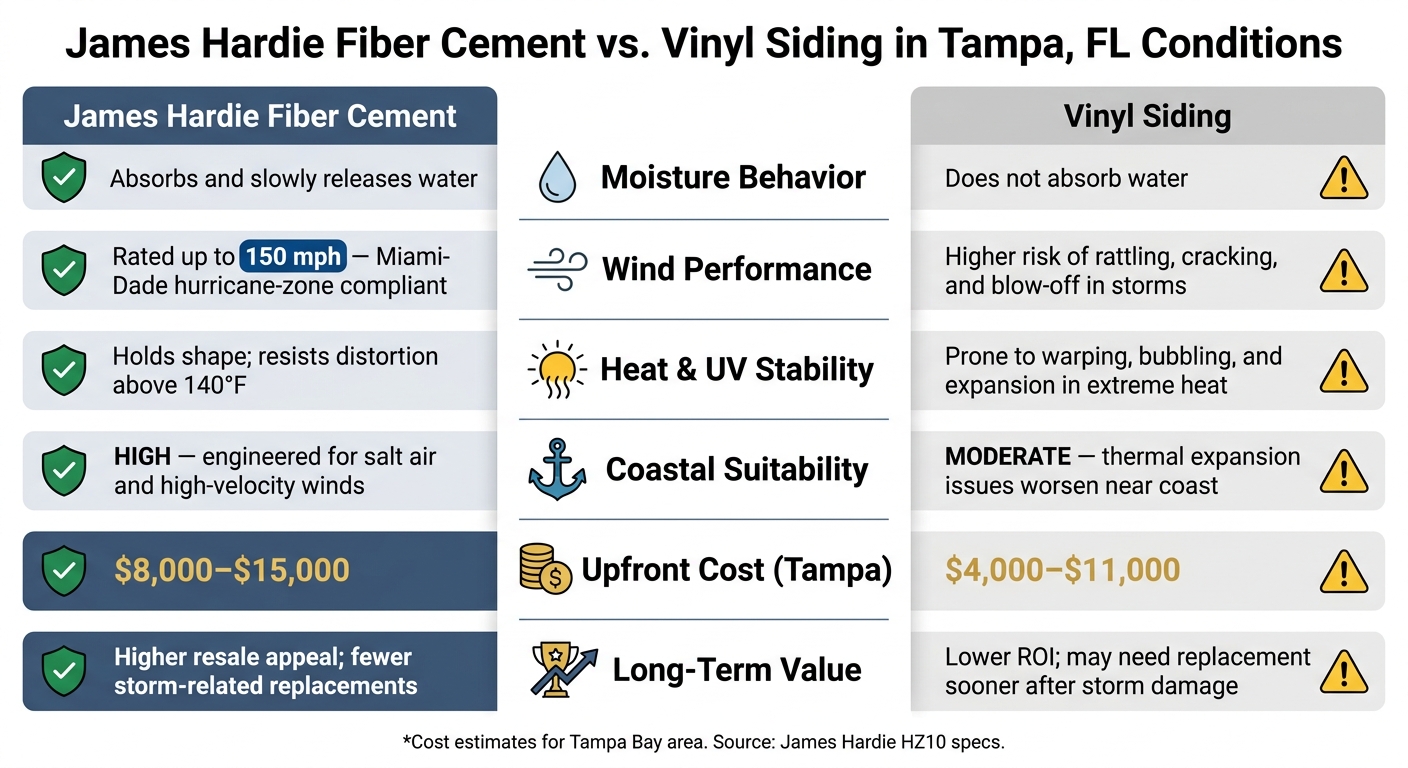
James Hardie Fiber Cement vs. Vinyl Siding in Tampa, FL
Once the wall is dry and ready for fastening, your siding choice starts to matter.
Vinyl costs less at the start. But Tampa weather changes the math. In rain, heat, humidity, and storm season, James Hardie fiber cement tends to make more sense over the long haul. Even after the rain clears and installation starts again, fiber cement remains the better match for Tampa Bay conditions.
Storm performance is a big reason why. Vinyl can rattle, crack, and even blow off when winds pick up. James Hardie fiber cement holds its shape and carries a wind rating up to 150 mph, which meets Miami-Dade hurricane-zone standards.
Heat is the other pressure point. Florida sun can push siding surface temperatures to 120–140°F. At that range, vinyl may warp, bubble, or distort. Fiber cement stays stable instead.
Then there’s the finish. James Hardie’s ColorPlus factory finish comes with a 15-year warranty, and the siding itself carries a 30-year limited warranty. That matters when your home takes sun and rain year after year.
Here’s how the two stack up in Tampa conditions.
Comparison table: James Hardie fiber cement vs. vinyl siding in Florida conditions
| Feature | James Hardie Fiber Cement (HZ10) | Vinyl Siding |
|---|---|---|
| Moisture behavior | Absorbs and slowly releases water | Does not absorb water |
| High-wind performance | Rated up to 150 mph; Miami-Dade hurricane-zone compliant | Higher risk of rattling, cracking, and blow-off in storm conditions |
| UV and heat stability | Holds its shape; resists distortion above 140°F | Prone to warping, bubbling, and expansion under extreme Florida heat |
| Coastal suitability | High; engineered for salt air and high-velocity winds | Moderate; thermal expansion issues worsen near the coast |
| Upfront cost (Tampa) | $8,000–$15,000 | $4,000–$11,000 |
| Long-term value | Higher resale appeal and fewer storm-related replacements | Lower ROI; may need replacement sooner after storm damage |
That upfront price gap looks clear on paper. But for Tampa Bay homes, especially in coastal neighborhoods or spots that take direct storm exposure, fiber cement often narrows that gap over time through fewer weather-related repairs and replacements.
What to do when rain interrupts your siding project
When rain stops the job, protecting the wall assembly takes priority over speed. Secure any loose materials immediately so they stay dry and don't shift in the wind.
Don't restart once the rain ends. A contractor should inspect the sheathing and water-resistive barrier first, then check moisture levels in the wall layers before work resumes. Wind creates the same obligation — if gusts make large panels unsafe to handle, crews pause until conditions are stable. Nothing gets caulked, painted, sealed, or fastened until the wall is dry and meets the manufacturer's moisture limits. Bayshore Exteriors follows that sequence on every siding remodel, because a rushed restart after rain is where most moisture callbacks originate.
FAQs
How long should siding wait after rain?
Wait until the siding and the wall assembly underneath are fully dry before you install anything. James Hardie products need to stay dry before installation. If the siding gets saturated, it can shrink at butt joints and lead to long-term performance problems.
Light rain might be manageable with temporary protection. But dry conditions are still the best choice. Wet installs can weaken sealants, hurt adhesive performance, and increase the risk of water intrusion.
How do contractors check if the wall is dry enough?
Contractors inspect the substrate and wrap to make sure they aren't wet or saturated before they cover them.
They also make sure moisture won't get trapped behind the siding. That means checking the water-resistive barrier and flashing are installed the right way, then covering materials with tarps or other protection if rain is on the way.
Will installing over wet walls void the warranty?
It can. If you install James Hardie fiber cement siding over wet walls or soaked materials, you can trap moisture inside the wall. That can lead to water intrusion and may void the product warranty.
To help protect that warranty, you need to install the wall assembly and water-resistive barrier the right way. They also need to meet James Hardie’s technical requirements, including proper drainage and weather-related installation rules.
Related Blog Posts
✔ START TODAY
Personal and targeted approach

✔ FAQ
Your Questions. Our Expertise.
How do I get an accurate price for my project?
Are you licensed and insured in Florida?
How long does a typical installation take?
Does your work come with a warranty?
Why do you recommend James Hardie siding for Florida?
What specific services do you provide?
✔ START TODAY
Ready to Get Started?
Trusted and reliable Hardie board siding services backed by expert craftsmanship and high performance materials. We help homeowners achieve a durable, low maintenance exterior that looks great and stands strong for years to come.
Book an Appointment
We have received your estimate request and will be reaching out to you shortly.
.webp)