
What a Roof Inspection Covers in Florida and What It Costs
A Florida roof inspection details defects, remaining life, and costs ($100–$400), and can determine insurance renewal and claim payouts.
Lorem ipsum dolor sit amet, consectetur adipiscing elit. Suspendisse varius enim in eros elementum tristique. Duis cursus, mi quis viverra ornare, eros dolor interdum nulla, ut commodo diam libero vitae erat. Aenean faucibus nibh et justo cursus id rutrum lorem imperdiet. Nunc ut sem vitae risus tristique posuere.
If your Florida roof is 15 years old or more, your insurer may ask for a roof inspection before renewal, and the report can affect both coverage and claim payout.
You need to know three things fast: a roof inspection is not the same as a 4-point inspection, the written report matters more than a quick look, and most basic Florida roof inspections cost about $100 to $400. If the report shows at least 5 years of remaining roof life, Florida law can help protect your renewal from an age-only denial.
Here’s the short answer:
- Who gets asked for one: Homeowners with older roofs, often at the 15- to 20-year mark
- What it checks: Decking, underlayment, flashing, penetrations, surface wear, leaks, and damage
- What insurers want: Photos, roof age, defects, license info, and estimated remaining life
- What it can change: Renewal status, repair deadlines, claim settlement type, and replacement timing
- What it costs: Usually $100 to $400, with higher prices for tile, metal, or insurer-focused reports
- Why it matters: Without solid proof, some carriers may move roof claims from replacement cost to actual cash value
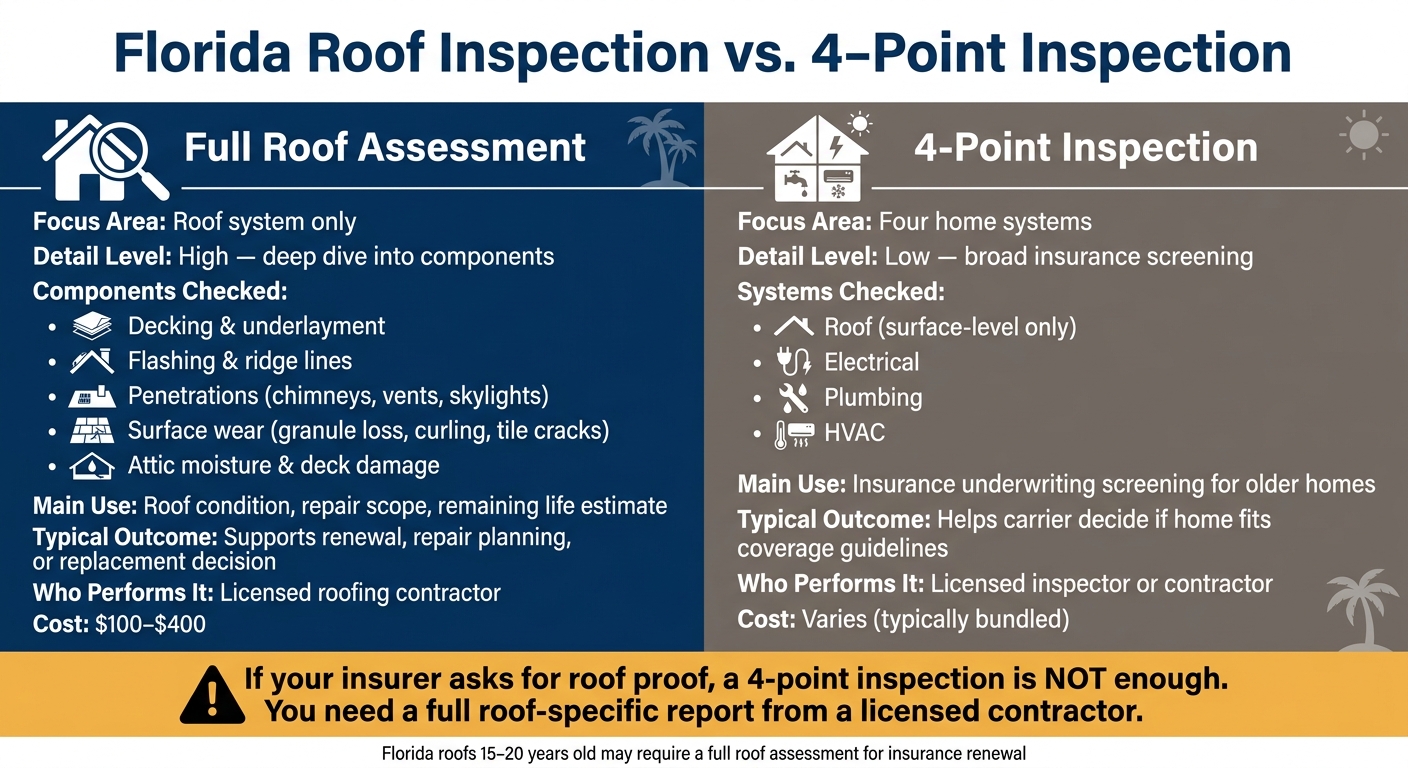
Florida Roof Inspection vs. 4-Point Inspection: Key Differences
Quick Comparison
| Inspection type | What it looks at | Detail level | Main use | Typical outcome |
|---|---|---|---|---|
| Roof inspection | Roof system only | Higher | Roof condition, repairs, remaining life | Supports renewal, repair scope, or replacement decision |
| 4-point inspection | Roof, electrical, plumbing, HVAC | Lower | Insurance screening for older homes | Helps carrier review the whole house |
Think a 4-point tells the whole roof story? It doesn’t. In other words: if your insurer asks for roof proof, you usually need a roof-specific report from a licensed contractor, not just a general form.
sbb-itb-85e0110
Florida Insurers Are Requiring Roof Inspections on Older Homes Before Renewal
Many Florida carriers now ask for a current roof report before renewal. That’s why a contractor’s written roof report carries more weight than a quick insurance form.
Citizens Property Insurance and the Roof Age Pressure Homeowners Face at 15 to 20 Years

Once an asphalt shingle roof hits 15 years, carriers can require a professional inspection as a condition of renewal. If that inspection shows at least 5 years of remaining useful life, the insurer generally must continue coverage.
But if you don’t have that proof, the carrier may send a non-renewal notice or change the roof claim settlement to actual cash value. That can shift a big chunk of cost back onto you.
Citizens Property Insurance also requires a 4-point inspection for homes older than 30 years. It also asks for documented proof of at least 5 years of remaining useful life for asphalt shingle roofs over 25 years old and tile and metal roofs over 50 years old.
Timing adds pressure. Insurers often send notice 60 to 90 days before the renewal date, so homeowners usually have less time to act than they think.
Once the carrier asks for proof, the next step comes down to the inspection itself and what that report needs to show.
A Roof Inspection Is Not the Same as a 4-Point Inspection
A 4-point inspection is a broad insurance screening tool. A full roof assessment is narrower and much more detailed.
The 4-point looks at four home systems: roof, electrical, plumbing, and HVAC. It produces a short report that helps the carrier decide whether the home fits underwriting guidelines.
A full roof assessment focuses only on the roof. A licensed roofing contractor checks deeper parts of the system, including the decking, underlayment, flashing, and material wear, to document damage, repair needs, and remaining life.
In other words: the 4-point helps an insurer screen the house, while the roof assessment helps show the roof’s actual condition.
That’s where the inspection becomes more than a deadline item. The report should reflect what the contractor actually saw on the roof system, not just a box-checking form.
What a Roof Assessment Covers
Once you know why insurers ask for a roof report, the next step is understanding what the contractor checks. A full roof assessment goes well beyond a quick insurance form. It documents the roof system piece by piece.
The contractor checks the decking, underlayment, and the structural layer below the surface for soft spots, sagging, and signs that the roof system is losing strength. In Florida, heat cycles, humidity, and storm exposure speed up this kind of wear. Water intrusion that reaches the decking often stays hidden until the damage is severe. Those findings help the insurer decide whether the roof system is still structurally sound or getting close to failure.
Flashing, ridge lines, and penetrations are where most Florida roof leaks start. The contractor checks seals and metal work around chimneys, vents, skylights, valleys, and roof edges. Those are the spots where water gets in when materials lift, crack, or pull apart under storm pressure.
Roof type matters here. On shingle roofs, the contractor looks for granule loss, curling, and storm lifting. On metal roofs, they check for fastener corrosion and seam separation. On tile roofs, they look for cracked or displaced tiles and worn mortar.
The written report records visible defects with photos, condition notes, estimated remaining life, and recommended repairs or replacement. Those findings become the report insurers use to judge renewal and repair needs.
If your roof is aging or the insurer asks for proof, schedule a professional roof assessment instead of climbing up there yourself.
What the Written Roof Report Includes and How Homeowners and Insurers Use It
Once the inspection is done, the written report becomes the part insurers actually read. It turns a site visit into a decision document for you and the carrier.
What an Insurer-Accepted Roof Report Should Contain
An insurer-accepted roof report should include the property address, inspection date, contractor license information, roof type, estimated age, visible defects by location, and remaining service life. It should also include dated photos of all roof slopes, penetrations, and any attic signs of deck damage or moisture intrusion.
That paperwork helps a carrier decide whether the roof still has enough useful life left for renewal. In other words: the service life estimate often carries a lot of weight in the renewal call.
Why a Full Roof Assessment Gives You More Than a 4-Point Inspection
The report matters more than the visit itself because it records the findings in a form insurers can use. Florida homeowners often mix up a 4-point inspection and a full roof assessment, but they do different jobs.
A 4-point inspection gives insurers a basic screening. A full roof assessment gives you repair-level detail.
That difference matters when renewal or repairs are on the line. A 4-point inspection may satisfy underwriting, while a full roof assessment can support repair planning and help build a stronger renewal file.
Those findings shape renewal outcomes, repair scope, and cost.
How Inspection Findings Affect Your Insurance Renewal, Repair Scope, and Cost in Hillsborough County
Once the report is done, the findings shape the next step.
What Favorable, Marginal, and Poor Inspection Findings Mean for Your Coverage
Insurers usually react to roof reports in three ways. Favorable reports tend to support renewal. Marginal reports often come with a repair deadline before coverage continues. Poor reports can lead to nonrenewal pressure or a request for full replacement.
That split matters. In many cases, repairs can clear up a marginal finding. But poor findings usually point to bigger work and higher cost. If you know where your roof stands before renewal season, you can act with time on your side.
How Hillsborough County Post-Storm Inspection and Permitting Rules Affect Roof Work
If a storm led to repairs in Hillsborough County, reroofing or structural work may need permits and a code-compliance review. That can affect timing, paperwork, and what your contractor can do next.
A roof report helps on both fronts. It gives your contractor the damage records needed for insurance and for permitting. In other words: the report is not just for your insurer. It also helps move the job through the local process.
What a Basic Florida Roof Assessment Costs: $100 to $400 Depending on Roof Type and Report Depth
A basic Florida roof assessment usually costs $100 to $400. Prices often run higher for tile roofs, metal roofs, or reports prepared for insurer review.
If your roof is getting close to the 15- to 20-year mark, or storm damage left you with doubts, get a professional assessment from a licensed roofing contractor like Bayshore Exteriors — not just someone willing to climb up and take a look.
FAQs
How long does a roof inspection take?
A professional roof assessment usually takes 45 to 90 minutes.
That time often covers a close exterior check of the roof surface, flashing, and penetrations, plus an interior attic review to look at ventilation and structural condition.
But some roofs need more time.
Larger or more complex roofs, including steep-pitch, tile, or metal systems, may take longer.
What if my roof report shows less than 5 years left?
If your roof inspection report shows less than five years of remaining useful life, you usually have four paths: replace the roof, switch insurance carriers, accept limited coverage, or ask your agent if recent repair records or an appeal could help you keep your current policy.
But first, get clear on the roof’s condition. Your next step is to schedule a professional roof assessment so you can get an accurate evaluation.
Who can perform a roof inspection for insurance?
In Florida, insurance companies want a formal written roof inspection report from a qualified professional. You do not have to hire the inspector your carrier suggests.
Eligible professionals include:
- licensed roofing contractors
- licensed home inspectors
- licensed engineers
Ask for a report that covers the roof’s condition, includes photos of the findings, and gives an estimate of the roof’s remaining useful life.
Related Blog Posts
✔ START TODAY
Personal and targeted approach

✔ FAQ
Your Questions. Our Expertise.
How do I get an accurate price for my project?
Are you licensed and insured in Florida?
How long does a typical installation take?
Does your work come with a warranty?
Why do you recommend James Hardie siding for Florida?
What specific services do you provide?
✔ START TODAY
Ready to Get Started?
Trusted and reliable Hardie board siding services backed by expert craftsmanship and high performance materials. We help homeowners achieve a durable, low maintenance exterior that looks great and stands strong for years to come.
Book an Appointment
We have received your estimate request and will be reaching out to you shortly.
.webp)