
Aluminum vs. Vinyl Impact Window Frames for Florida Homes
Frame choice hinges on wind load, opening size, salt-air exposure, and Florida approval—aluminum for strength, vinyl for thermal value.
Lorem ipsum dolor sit amet, consectetur adipiscing elit. Suspendisse varius enim in eros elementum tristique. Duis cursus, mi quis viverra ornare, eros dolor interdum nulla, ut commodo diam libero vitae erat. Aenean faucibus nibh et justo cursus id rutrum lorem imperdiet. Nunc ut sem vitae risus tristique posuere.
If your opening needs more than about DP70 or sits in a high-wind, high-salt spot, aluminum often wins. If your opening is standard size and you want lower cost plus lower heat transfer, vinyl often fits better.
Your frame choice in Hillsborough County usually comes down to four checks: wind load, opening size, salt-air exposure, and Florida Product Approval (FL#). The local design wind speed is 150 mph, and that can rule out vinyl on large or upper-floor openings. Vinyl costs less at about $750 to $1,400 per window and posts lower U-factors around 0.28 to 0.32. Standard aluminum costs about $900 to $1,800, handles much higher design pressures, and needs the right coating near the coast.
Before you compare brands or glass, focus on the frame:
- Aluminum: stronger for large spans, sliders, and high-pressure openings
- Vinyl: lower upfront cost, lower heat transfer, no salt corrosion
- Thermally broken aluminum: middle ground on strength and heat control, but at a higher price
- Coastal homes: need coated aluminum and stainless hardware if you choose metal frames
- Permits in Tampa: need FL# approval, not Miami-Dade NOA by itself
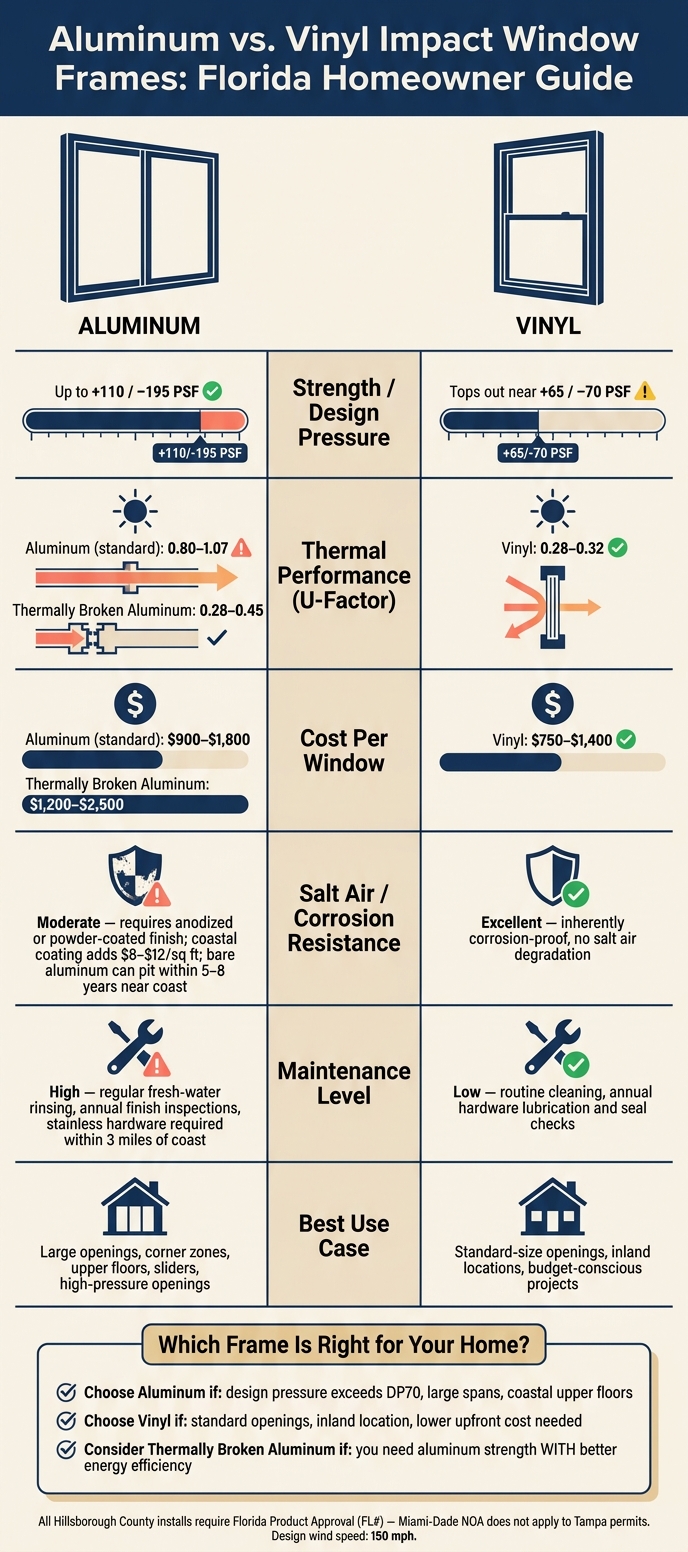
Aluminum vs. Vinyl Impact Windows: Florida Frame Comparison Guide
Impact Windows Vinyl or Aluminum. Which is Better? (PGT, Eastern Architectural Systems)

sbb-itb-85e0110
Quick Comparison
| Criteria | Aluminum | Vinyl |
|---|---|---|
| Strength / DP range | Higher, up to +110/-195 PSF | Lower, often tops out near +65/-70 PSF |
| Best use | Large openings, corner zones, upper floors, sliders | Standard-size openings |
| Heat transfer | Higher; standard U-factor about 0.80-1.07 | Lower; U-factor about 0.28-0.32 |
| Coastal salt air | Can pit without anodized or powder-coated finish | No corrosion from salt air |
| Maintenance | More rinsing and finish checks | Less frame upkeep, but still check hardware and seals |
| Cost per window | About $900-$1,800 | About $750-$1,400 |
| Tampa permit rule | Must match required FL# | Must match required FL# |
Think lower price settles it? It doesn't. In other words: your opening size, your location, and your permit requirements decide the short list fast.
Why Florida code and coastal conditions shape the aluminum-vs.-vinyl decision
In Hillsborough County, frame choice comes down to four things: wind load, heat, corrosion, and Florida Product Approval.
That sounds dry. But it decides what you can install, what will pass permit review, and what will hold up on your home. The comparison boils down to three practical issues: strength, heat, and durability.
Hillsborough County's 150 mph design wind speed drives frame strength requirements
Hillsborough County projects are engineered around a 150 mph design wind speed under the Florida Building Code and the ASCE 7 wind-load framework. That number sets the DP rating each window or door opening must meet.
Think vinyl works for every opening? Not always. Large spans, corner zones, and upper-floor openings often push past vinyl's DP range.
Aluminum handles those loads with less trouble and often becomes the only workable option for oversized openings.
Once load sets the size limit, coastal exposure becomes the next issue.
How salt air and UV exposure in South Tampa affect aluminum and vinyl frames differently
In coastal South Tampa, salt air hits aluminum and vinyl in different ways.
Bare aluminum can pit in coastal air. Anodized or powder-coated aluminum lasts much longer. Vinyl won't corrode in salt air, but heat and UV can still lead to expansion and warping over time.
Use stainless fasteners in coastal homes to limit corrosion.
That difference shows up most in South Tampa and Davis Islands, where salt exposure never lets up.
Florida Product Approval FL# governs Hillsborough County - Miami-Dade NOA does not apply to Tampa jobs
Hillsborough County requires Florida Product Approval, or FL#, for permitting. Miami-Dade NOA applies only in HVHZ counties.
When you review bids, ask for the FL# tied to the proposed window assembly. Then confirm that approval covers the design pressures required for your specific openings.
Approval won't pick the frame for you. But it can knock out one material for a given opening.
Aluminum frames offer greater strength; vinyl frames offer better thermal performance
Aluminum and vinyl solve different problems. Your best pick depends on opening size, storm exposure, and how hard your AC works for most of the year.
That usually comes down to three things: which frame can handle the load, which one keeps heat out, and which one makes sense over time.
| Performance Category | Aluminum Frame | Vinyl Frame |
|---|---|---|
| Max Design Pressure | Up to +110/−195 PSF | Maxes out at +65/−70 PSF |
| Thermal Insulation | U-factor 0.80–1.07 | U-factor 0.28–0.32 |
Aluminum frames handle large openings and higher design pressures better
Aluminum stays stiffer across wide spans, so it handles large openings and higher design pressures with less deflection. That matters most if your home has big picture windows, floor-to-ceiling glass, or corner glass layouts.
In Hyde Park, Davis Islands, and Palma Ceia, larger openings and upper-floor placements can push design pressure needs past what vinyl can handle. If an engineer’s calculation comes in above DP70 for a given opening, aluminum may be the only compliant choice under Florida Product Approval.
For smaller openings, the decision often shifts. Heat control starts to matter more.
Vinyl frames transfer less heat than aluminum in Tampa Bay's long cooling season
Aluminum moves heat much faster than vinyl. Here’s what that means in plain English: a standard aluminum frame can act like a thermal bridge, moving outdoor heat into an air-conditioned room.
Vinyl slows that heat flow with multi-chambered frame profiles. That gives it a U-factor of 0.28 to 0.32, compared with 0.80 to 1.07 for standard aluminum. Lower heat transfer can trim cooling load during Tampa’s long cooling season.
Thermally broken aluminum falls between standard aluminum and vinyl on efficiency and price
A thermal break uses a polymer separator inside the frame to cut heat flow. It interrupts the conductive path through the aluminum while keeping the frame’s structural rating in place.
The gain is measurable. A thermal break can cut heat transfer through an aluminum frame by 70% to 85%, bringing whole-window U-factors down to 0.28–0.45, which puts it close to vinyl’s range.
But the price moves up too:
- Thermally broken aluminum: $1,200 to $2,500 per window
- Standard aluminum: $900 to $1,800 per window
- Vinyl: $750 to $1,400 per window
If you need aluminum for larger spans or higher pressure ratings, thermally broken aluminum gives you a middle path. But if your openings stay within vinyl’s DP range, that added cost can be tough to defend.
Salt air durability, maintenance, and lifespan affect the true cost of each frame material
The quote only gets you so far. In coastal Tampa, finish life, upkeep, and replacement timing can change your total cost FAST. That’s why the bid matters, but so do maintenance demands and how soon the frame may need work or replacement.
Quick reference: coastal exposure changes both maintenance and replacement timing.
| Ownership Factor | Aluminum Frame | Vinyl Frame | Coastal Note for South Tampa and Davis Islands |
|---|---|---|---|
| Salt Air Resistance | Moderate; requires premium coating to prevent pitting | Excellent; inherently corrosion-proof | Untreated aluminum can show visible pitting within 5 to 8 years near the coast |
| Maintenance Needs | High; regular fresh-water rinsing and annual finish inspections | Low; routine cleaning plus annual hardware lubrication and seal checks | Salt buildup can clog aluminum weep holes and speed corrosion |
| Upfront Cost | Higher; typically 15%–30% more than vinyl | Lower baseline cost | Vinyl is the value leader for inland Hillsborough; aluminum is the common choice in coastal homes |
Untreated aluminum corrodes in coastal South Tampa; anodized or powder-coated aluminum holds up far longer
Near salt water, finish quality drives how long aluminum keeps its look. Bare aluminum pits fast in salt air, while anodized or powder-coated finishes last much longer. A factory-applied coastal-rated coating tends to last the longest.
However, standard AAMA 2604 finishes may not keep their warranty in coastal exposure conditions. That matters. Adding a high-performance coastal finish to an aluminum frame usually adds $8–$12 per square foot to the project cost.
Hardware matters just as much as frame finish. Standard galvanized or zinc-plated fasteners often fail before the frame does in salt air, so stainless steel hardware, in 304 or 316 grade, is the right spec for homes within about 3 miles of the coast.
Vinyl does not corrode, but it still requires maintenance for UV aging, thermal movement, and hardware
Vinyl skips the corrosion problem, but it doesn’t skip maintenance. You still need routine cleaning, hardware lubrication, and annual seal checks.
The bigger long-term issue is thermal movement. Vinyl expands and contracts at roughly 8 times the rate of glass, so the frame and glazing move at different speeds during Tampa temperature swings. Over time, that cycling can stress corner welds and affect seal integrity.
Darker vinyl colors bring more risk. In Florida sun, lower-quality vinyl can warp or discolor if it doesn’t include enough UV stabilizers.
Vinyl costs less upfront, but opening size and lifespan can shift 30-year ownership cost
Vinyl usually costs less upfront. On a multi-window project, that price gap can add up fast.
But two things can narrow that gap or even flip it. First, opening size: if your home has large spans or corner windows that push design pressure needs past what vinyl can handle, aluminum may be required. Second, coastal finish cost: aluminum specified the right way for a waterfront Davis Islands home comes with a higher upfront price, but a properly finished frame may last longer in that setting.
Vinyl can also cut cooling load, which may lower annual energy costs over Tampa’s long cooling season.
Choosing the right frame material for your Hillsborough County home
Once you've compared strength, heat control, and coastal wear, the final call comes down to opening size, exposure, and product approval.
Choose aluminum for large openings, sliders, corner zones, or higher design pressures. For standard openings where lower cost and better thermal performance matter most, vinyl is the stronger choice. A split setup often makes the most sense for mixed-load homes: aluminum on high-load openings and vinyl on standard windows. In South Tampa and Davis Islands, coated aluminum with stainless hardware is the minimum standard — untreated aluminum corrodes fast in coastal salt air.
Each order also needs to match the correct Florida Product Approval (FL#) for the exact opening, exposure, and design pressure on your home. A Miami-Dade NOA does not satisfy a Tampa permit. A properly scoped window installation sequences those approvals before anything gets ordered. Bayshore Exteriors matches every opening to its FL# as part of the estimate, so the permit package reflects the installed product before the job starts.
FAQs
How do I know my opening needs aluminum?
Your opening needs aluminum when its engineer-set wind-load requirement, or DP in psf, sits above what the proposed vinyl frame can handle.
Ask your contractor for the engineer-calculated DP for each opening. Then check the product’s Florida Product Approval (FL#) for your county. Hillsborough requires an FL#. Miami-Dade NOA applies only to HVHZ.
But high wind changes the math. In coastal areas or other high-wind spots, aluminum often ends up as the only frame material that can meet steep DP targets, especially at corners or upper-floor zones around 90+.
Does Miami-Dade NOA count for a Tampa permit?
No. A Miami-Dade NOA is not required for a Tampa permit.
Tampa permits follow Florida Product Approval (FL#), not the Miami-Dade standard. Hillsborough County does not require a Miami-Dade NOA. That rule applies only in the HVHZ counties of Miami-Dade and Broward.
However, Tampa may still accept a Miami-Dade NOA in some cases. Acceptance is not the same as a requirement.
You should also confirm that the product you choose meets your property's required design pressure ratings.
Is thermally broken aluminum worth the extra cost?
Yes. In most cases, thermal-break aluminum makes sense for homes with large floor-to-ceiling glass spans or south- and west-facing openings that take heavy sun.
A thermal break cuts heat transfer by 70–85%. That helps standard aluminum get close to vinyl-level U-factors, while still keeping the frame strength large openings often need in Hillsborough County.
That tradeoff matters. You keep the slim sight lines many homeowners want, but you also get better indoor comfort and stronger wind-load rigidity. For coastal homes, it’s often a premium pick when you need strength, narrower frames, and better control over heat coming through the glass.
Related Blog Posts
✔ START TODAY
Personal and targeted approach

✔ FAQ
Your Questions. Our Expertise.
How do I get an accurate price for my project?
Are you licensed and insured in Florida?
How long does a typical installation take?
Does your work come with a warranty?
Why do you recommend James Hardie siding for Florida?
What specific services do you provide?
✔ START TODAY
Ready to Get Started?
Trusted and reliable Hardie board siding services backed by expert craftsmanship and high performance materials. We help homeowners achieve a durable, low maintenance exterior that looks great and stands strong for years to come.
Book an Appointment
We have received your estimate request and will be reaching out to you shortly.
.webp)