
Flat Roofs in Florida: What Homeowners Need to Know
Flat roofs in Florida need 1/4 in per ft slope, the right membrane (TPO/EPDM/modified bitumen), regular drain checks and licensed repairs.
Lorem ipsum dolor sit amet, consectetur adipiscing elit. Suspendisse varius enim in eros elementum tristique. Duis cursus, mi quis viverra ornare, eros dolor interdum nulla, ut commodo diam libero vitae erat. Aenean faucibus nibh et justo cursus id rutrum lorem imperdiet. Nunc ut sem vitae risus tristique posuere.
Flat and low-slope roofs in Florida fail most often when water does not drain fast enough. If your home has a flat section over a garage, Florida room, or rear addition, you need three things: proper slope, the right membrane, and regular drain and flashing checks.
Tampa Bay gets more than 46 inches of rain a year, and storms can dump 2 to 4 inches in less than an hour. That means a flat roof cannot just “dry out later.” If water sits for 48 hours or more, you likely have a drainage problem, not just a surface issue.
Here’s the short answer:
- Your flat roof still needs slope, usually 1/4 inch per foot
- Ponding water points to trouble with drainage or roof shape
- Florida code may require overflow protection on some flat sections
- TPO, EPDM, and modified bitumen each handle heat, seams, and standing water differently
- You should clean drains, scuppers, and gutters at least twice a year, and more often after storms
- A licensed roofer should handle membrane repairs, flashing repairs, and drainage fixes
Quick Comparison
| Roof system | Best fit on homes | Seams | Main concern in Florida |
|---|---|---|---|
| TPO | Additions and low-slope sections | Heat-welded | Punctures, debris, flashing openings |
| EPDM | Flat sections with simpler layouts | Adhesive or tape-bonded | Heat, seam wear, repeat ponding |
| Modified bitumen | Garages, Florida rooms, smaller roof areas | Torch, self-adhered, or cold-applied laps | Lap seam wear if drainage is poor |
Think a flat roof is fine as long as it does not leak today? But... that misses the bigger issue. The main thing to check is whether water leaves the roof fast after rain, because in Florida, slow drainage usually turns into the next repair.
sbb-itb-85e0110
Why Florida Homes Have Flat and Low-Slope Roof Sections
If your South Tampa home has a flat section over the garage, a rear addition, or a Florida room, that usually happened on purpose. You’ll see this setup again and again on mid-century ranch homes and on homes with later add-ons, where the hard part is tying a new roof section into an older structure that sits at a different height.
In residential roofing, flat usually means low-slope, or 2:12 or less. Even then, the roof still needs a slight pitch - at least 1/4 inch per foot - so water can move to drains or scuppers before ponding starts. But when that slope gets too shallow, water sits. That’s the main issue.
Where Flat Roofs Appear on Florida Homes
You’ll usually find these roof sections over rear additions, enclosed porches, Florida rooms, and garages. Those spaces often don’t line up with the height of the original roof. A low-slope tie-in fixes that cleanly.
South Tampa’s mid-century ranch homes also use flat or low-slope sections as part of the original design. The long, horizontal look isn’t an accident. It’s part of the house style.
How Low-Slope Design Solves Layout Problems on Residential Rooflines
This isn’t just about looks. Low-slope sections also give homeowners a place for rooftop HVAC equipment and solar arrays while keeping the roofline simple.
When you add a Florida room or expand a garage, a low-slope tie-in helps the new section meet the old roof without forcing an awkward shape. In other words: it solves a layout problem without changing the home’s overall profile. But that setup only works if the roof sheds water fast during Florida rain.
Florida Rainfall and FBC Drainage Rules for Low-Slope Roofs
A low-slope roof only works when the drainage can handle Florida rain. Tampa Bay gets more than 46 inches of rain each year, and storm cells often dump water at 4 to 8 inches per hour, with short bursts topping 10 inches per hour. That kind of rain can flood a flat section fast.
That’s why Hillsborough County homes need drainage that meets code, not just a roof that sheds water most days.
Under the Florida Building Code, low-slope residential roofs need positive drainage and a minimum slope of 1/4 inch per foot. If the roof has parapets or perimeter walls, it also needs secondary overflow protection. If any flat section on your home may fall short, have a licensed roofing contractor inspect it.
What Ponding Water Does to a Flat Roof
Ponding water stays on the roof for 48 hours or more after rainfall. That’s not a minor issue. It points to a slope or drainage problem.
Standing water adds weight and wears out the membrane faster. Water weighs about 5.2 pounds per square foot per inch of depth, and that extra load builds up fast. It also speeds UV damage. If the same area keeps holding water, the roof needs attention.
Think the issue is just leftover surface water? Usually not. If ponding keeps coming back, the cause is often the roof’s slope or drainage layout.
FBC Requirements for Drains, Scuppers, Gutters, and Overflow Protection
When a re-roofing job involves a deck that doesn’t meet the slope rule, contractors can install tapered polyisocyanurate (polyiso) insulation to build the needed 1/4-inch-per-foot slope without changing the structural deck. In other words: they can fix drainage geometry above the deck instead of rebuilding the deck itself.
If parapet walls or perimeter curbs surround a flat roof area, the FBC requires secondary overflow protection. A common setup uses overflow scuppers placed 2 inches above the primary drain.
Drains, scuppers, and gutters also need regular cleaning. But gutters can still fail if they clog or if the sizing is off, so a flat section that drains through gutters needs close attention.
In South Tampa, palm fronds and small debris pile up fast. Clean drains and scuppers twice a year:
- Before hurricane season
- After hurricane season
Once drainage is set up the right way, membrane choice becomes the next big factor in roof performance.
TPO, EPDM, and Modified Bitumen: How Each Membrane Performs on Florida Residential Roofs
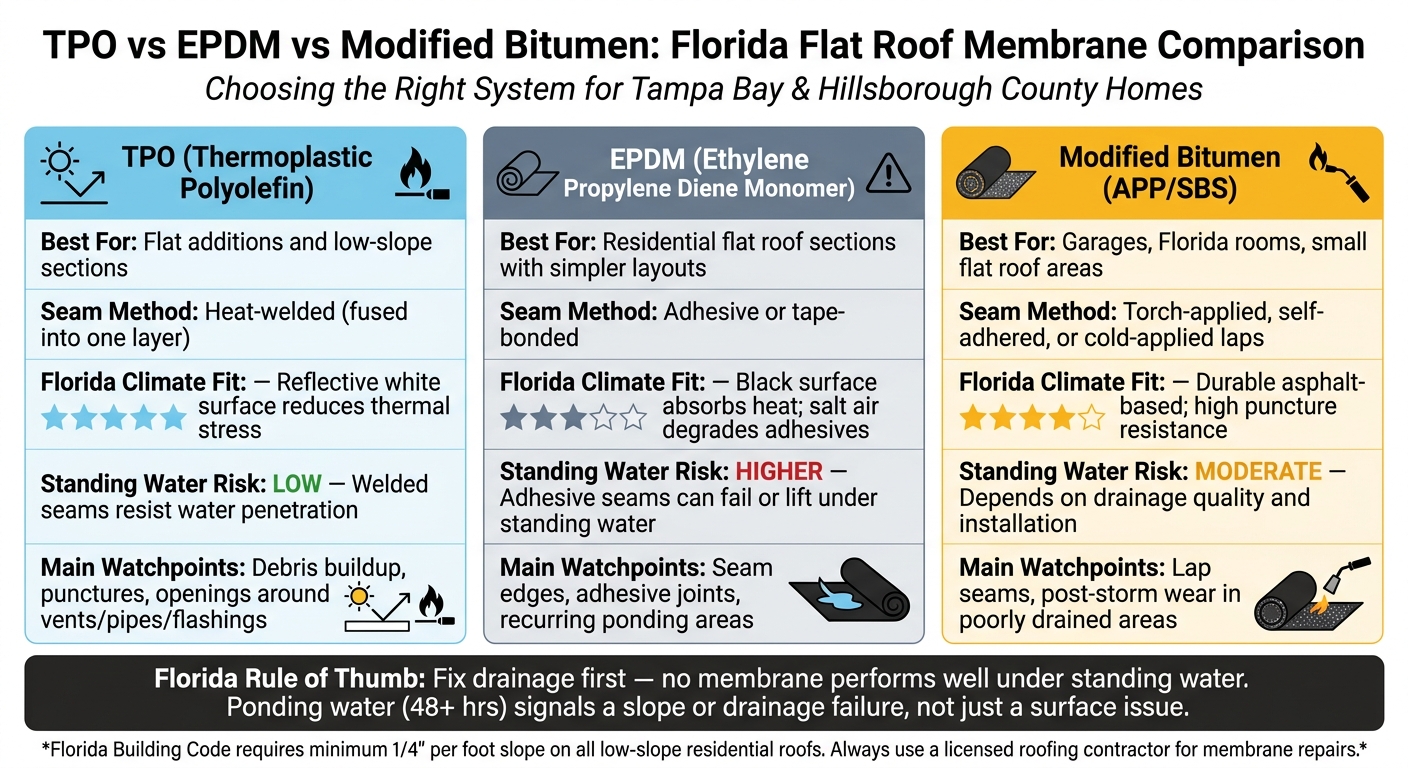
TPO vs EPDM vs Modified Bitumen: Florida Flat Roof Membrane Comparison
Once you fix drainage, the next call is the membrane itself. In Florida, that choice narrows fast. Heat, humidity, and hard rain put a lot of stress on flat and low-slope roofs, especially on homes in Hillsborough County.
The three systems most often used on residential flat roofs here are TPO (Thermoplastic Polyolefin), EPDM (Ethylene Propylene Diene Monomer), and modified bitumen. Each one handles heat, moisture, and standing water a little differently.
| System | Typical Residential Use | Seam Method | Florida Climate Fit | Risk from Standing Water | Maintenance Watchpoints |
|---|---|---|---|---|---|
| TPO | Flat additions and low-slope sections | Heat-welded seams | Strong Florida fit; reflective surface reduces thermal stress | Low - welded seams resist water penetration | Debris buildup, punctures, openings around vents, pipes, and flashings |
| EPDM | Residential flat roof sections | Adhesive or tape-bonded seams | Durable, but black surface absorbs heat and can accelerate adhesive degradation | Higher - adhesive seams can fail or cause seam swelling or edge lift under standing water | Seam edges, adhesive joints, recurring ponding areas |
| Modified Bitumen | Garages, Florida rooms, and small flat roof areas | Torch-applied, self-adhered, or cold-applied types | Durable asphalt-based option with high puncture resistance for smaller residential sections | Moderate - performance depends on proper drainage and installation quality | Lap seams and areas affected by post-storm wear |
Here’s how each membrane tends to perform on Florida homes.
TPO: Heat-Welded Seams on Residential Additions and Flat Sections
TPO works well in Florida for two main reasons: its white surface reflects heat, and its seams are heat-welded. That matters. A heat-welded seam fuses into one layer, which usually holds up better against leaks than seams that depend on adhesive.
In other words: TPO gives you a membrane that handles sun and water with fewer seam weak points. You still need to watch it, though. Debris buildup, punctures, and openings around vents, pipes, and flashings can still turn into leak spots.
EPDM Seams on Coastal Hillsborough County Homes
EPDM is a flexible rubber membrane, and that flexibility helps on many roof shapes. But... its seams rely on adhesives or tape, not heat welding. That changes the risk.
On coastal Hillsborough County homes, salt air can wear down EPDM seam edges and adhesive joints, especially in spots where water sits. The black surface also absorbs heat, which can speed up adhesive wear. For EPDM, the main trouble areas are usually seam edges, adhesive joints, and any place with repeat ponding.
Modified Bitumen on Garages, Florida Rooms, and Small Flat Roof Areas
Modified bitumen is an asphalt-based membrane with strong puncture resistance. That makes it a common pick for garages, Florida rooms, and other small flat roof sections. You’ll usually see it installed as torch-applied, self-adhered, or cold-applied material.
Think poor drainage is only a minor issue here? It isn’t. Lap seams usually fail first when water hangs around, so the installer’s work matters just as much as the product. Even a well-installed roof needs regular inspection, especially after storm season.
When seams fail or flashing lifts, you need a licensed roofing contractor for the repair.
Flat Roof Maintenance in Tampa Bay: Inspections, Drainage, and Licensed Repairs
Once you’ve got drainage and the membrane type sorted out, maintenance does the day-to-day work of keeping a flat roof in shape in Tampa Bay. Even a well-installed roof needs routine care here. Debris, algae, and slow drainage can turn into leaks fast, especially at seams and flashing.
Start with the basics: drains, seams, and flashing.
| Maintenance Task | Suggested Frequency | What to Check | Why It Matters in Tampa Bay |
|---|---|---|---|
| Roof Inspection | Twice yearly - spring (pre-season) and late fall (post-season); after any major storm | Seam condition, membrane surface, blistering, punctures, algae growth, flashing integrity, drain flow, signs of ponding | Storms put concentrated stress on seams and drainage systems on garages, Florida rooms, rear additions, and low-slope tie-ins; catching damage early prevents interior leaks |
| Drain, Scupper, and Gutter Cleaning | Quarterly minimum; after any significant tropical weather event | Blockages, debris buildup, flow rate, overflow protection function | Blocked drainage is the most common cause of ponding water on residential flat roofs in Florida |
| Flashing and Edge Inspection | Annually | Separation at walls, curbs, and penetrations; sealant condition | Flashing edges are a common water entry point on flat residential roofs |
| Ponding Water Check | After every significant rain event | Check whether water is gone within 48 hours after rain | Standing water that remains is a drainage problem that needs correction |
Warning Signs Homeowners Can Watch For
You can spot a lot from the ground. Ceiling stains after a storm, a musty smell near a flat-roof addition, or debris piling up around a scupper all point to trouble.
From a safe vantage point, you may also notice blistering on the membrane, seam edges that look lifted, or sections of the roof that dip. Those low spots matter. That’s where water sits instead of draining off.
If water still sits after 48 hours, you’re dealing with a drainage problem that needs correction. If the same signs come back after cleaning, the issue usually goes deeper. In other words: the slope or membrane likely needs a licensed roofer.
How Contractors Fix Persistent Drainage Problems
Think cleaning the drain should solve it? Sometimes it does. But if water keeps returning to the same spot, a contractor needs to check the roof slope.
One common fix is tapered insulation under the membrane to help move water to the drain. If water gathers near curbs or walls, contractors may install crickets, which are small angled sections that push water away from those areas.
But the goal isn’t to hide the symptom. The goal is to fix the slope. These repairs must meet Florida Building Code drainage rules, and they need to correct the drainage path, not just patch the spot where the leak showed up.
Why Membrane Repairs Must Be Done by a Licensed Roofing Contractor
TPO, EPDM, and modified bitumen are not simple patch jobs. Each system has its own manufacturer repair method, approved materials, and install rules. A licensed roofing contractor knows those requirements and carries legal responsibility for following them.
A DIY patch may look sealed from the top. However, that doesn’t mean it meets code. It can fail Florida Building Code rules, trigger a failed inspection, and void the manufacturer warranty.
There’s also the bigger issue. Bad patching often misses the cause of the leak. If the seam failure or drainage problem stays in place, moisture can keep building under the membrane and keep damaging the roof.
Use a licensed roofing contractor when the repair must meet current Florida Building Code standards.
Conclusion: Drainage, Membrane Fit, and Contractor Qualifications for Hillsborough County Flat Roofs
For Hillsborough County homes, flat roof performance comes down to three things: drainage, membrane fit, and maintenance. These roof sections solve real layout problems, and they hold up well when those three variables stay in order. The weak spot, almost every time, is poor drainage.
Florida Building Code requires positive drainage, and ponding water points to a slope or drainage failure — not a temporary condition the roof can absorb. Once drainage is sound, the membrane needs to match the roof's exposure. On coastal Hillsborough County homes, EPDM faces higher seam failure rates because salt air, humidity, and UV wear down adhesives faster than they do on inland roofs. The right material depends on the conditions and how the roof is used.
Clear drains and scuppers twice a year, and hire a licensed roofing contractor for any repairs beyond routine clearing. Bayshore Exteriors handles flat roof repairs across Hillsborough County with materials matched to coastal exposure. Improper patching can void manufacturer warranties and fail FBC inspection, so the repair method matters as much as the material choice.
In Florida, flat roofs perform well when water leaves fast, seams stay sound, and repairs follow code.
FAQs
How can I tell if my flat roof has a drainage problem?
Watch what your roof does after a rainstorm. The clearest warning sign is standing water that sits for more than 48 hours after the rain ends.
You should also check for clogged drains, gutters, or scuppers. Low or sagging areas matter too, since they often hold water longer than the rest of the roof.
Inside those ponding zones, look for trouble spots: mold, discoloration around penetrations, blistering, or membrane seams that have started to separate.
Which flat roof membrane lasts best in Florida weather?
For most Florida homes, TPO is the best all-around pick. Its white, reflective surface helps cut heat gain, and its heat-welded seams handle heavy rain well.
However, EPDM also makes sense if your roof gets a lot of shade or you care most about long-term wear. Whatever material you choose, hire a licensed roofing contractor for installation and repairs. That helps you avoid warranty problems and failed Florida code inspections.
When should I call a licensed roofer for a flat roof issue?
Call a licensed roofing contractor if you spot membrane damage that affects waterproofing. That includes punctures larger than 6 inches and major seam failures.
Persistent pooling or drainage problems also need a professional look. Ponding water does NOT fix itself, and over time it can lead to structural damage.
Plan a professional inspection every six months. Do not try DIY repairs. Bad patching can void manufacturer warranties and fail Florida Building Code inspections.
Related Blog Posts
✔ START TODAY
Personal and targeted approach

✔ FAQ
Your Questions. Our Expertise.
How do I get an accurate price for my project?
Are you licensed and insured in Florida?
How long does a typical installation take?
Does your work come with a warranty?
Why do you recommend James Hardie siding for Florida?
What specific services do you provide?
✔ START TODAY
Ready to Get Started?
Trusted and reliable Hardie board siding services backed by expert craftsmanship and high performance materials. We help homeowners achieve a durable, low maintenance exterior that looks great and stands strong for years to come.
Book an Appointment
We have received your estimate request and will be reaching out to you shortly.
.webp)