Roofing Scams Florida Homeowners Need to Know How to Spot
Red flags of Florida roofing scams: verify DBPR license, watch permits, avoid large deposits and deductible waivers.
Lorem ipsum dolor sit amet, consectetur adipiscing elit. Suspendisse varius enim in eros elementum tristique. Duis cursus, mi quis viverra ornare, eros dolor interdum nulla, ut commodo diam libero vitae erat. Aenean faucibus nibh et justo cursus id rutrum lorem imperdiet. Nunc ut sem vitae risus tristique posuere.
If a roofer pushes you to sign fast, asks for a big deposit, or tells you to pull the permit yourself, walk away.
Florida homeowners can cut scam risk with a short checklist: check the roofer’s DBPR license, match the business name to the contract, ask for insurance proof, and track the permit after any deposit over 10%. If no permit gets filed within 30 days, that is a major warning sign.
Here’s the short answer:
- Check the roofing contractor on MyFloridaLicense.com
- Make sure the license is active and the company name matches the paperwork
- Ask who pulls the permit, because it should be the contractor
- Watch for “free roof” talk, deductible waivers, or claim-control forms
- Read the contract for scope, permit duties, lien notice, and payment terms
- Keep records if you pay more than 10% upfront and watch the 30-day permit clock
Think a low quote means you found a deal? But... low bids often leave out tear-off, flashing, underlayment, decking repairs, or permit fees. Or put another way: the cheap number can cost you more later.
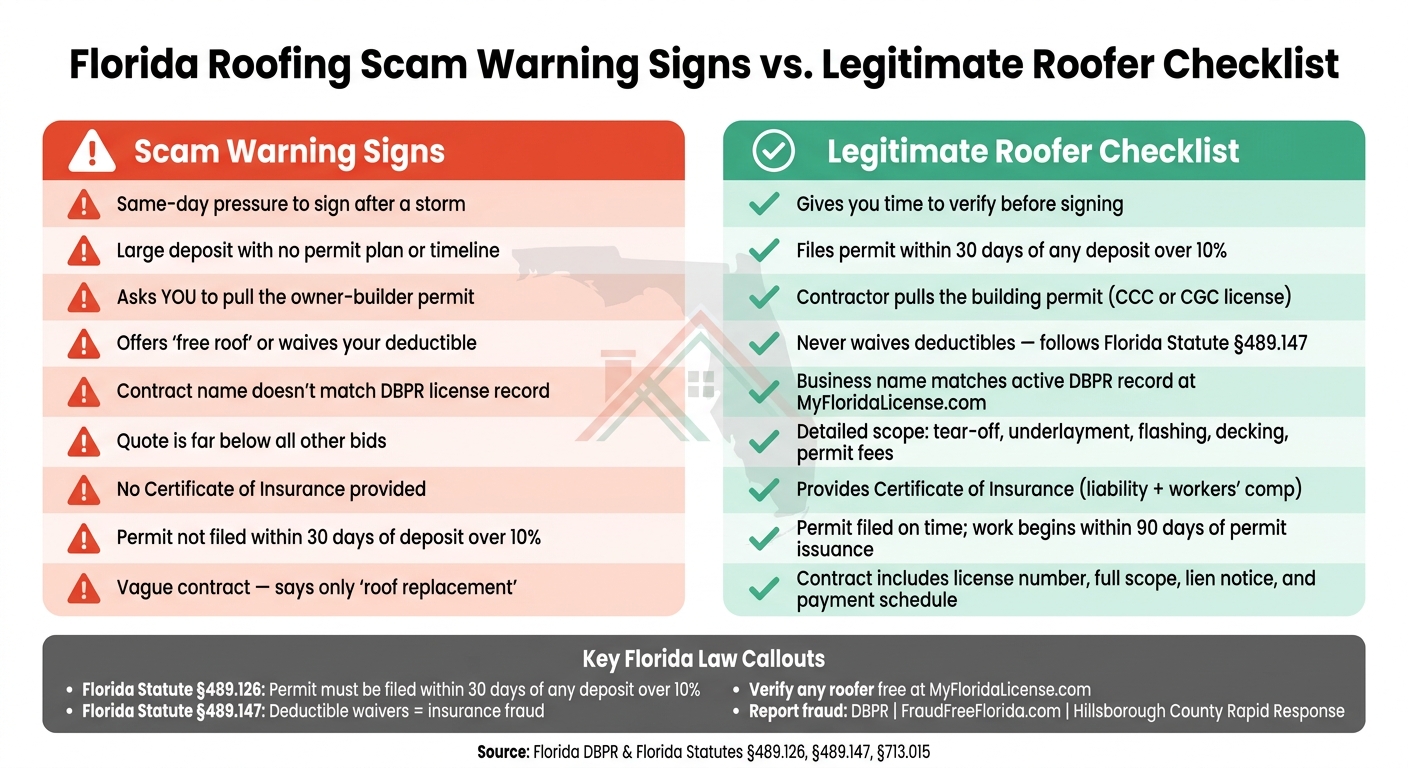
Florida Roofing Scam Warning Signs vs. What Legitimate Roofers Do
Florida homeowners need to be careful about persistent roofing scams, CFO says
sbb-itb-85e0110
Quick Comparison
| Scam sign | What you should do |
|---|---|
| Same-day pressure after a storm | Stop and check the license first |
| Big deposit with no permit plan | Track the date and watch for permit filing within 30 days |
| Contractor asks you to pull permit | Say no and move on |
| “Free roof” or deductible waiver | Treat it as a fraud warning |
| Contract names don’t match DBPR record | Do not sign |
| Quote is far below others | Check scope, permit fees, and insurance |
In other words: before you hand over a dollar, make sure the license, insurance, permit plan, and contract all line up.
Florida roofing scams typically start with storm chaser pressure and insurance promises
Storm chasers often hit South Tampa right after a storm. They use fear, urgency, and a polished pitch to get you to sign fast, sometimes the same day, before you’ve checked a single thing about their license or permit history.
That’s the play. Keep you moving before you can slow down and verify who they are.
Door-to-door roof offers rely on urgency, not documentation
These offers work because they create pressure first and leave proof for later. A contractor may say they spotted damage from the street, mention a crew working nearby, or insist you need to sign NOW to save your place.
But a legit roofer doesn’t need 20 minutes to close you.
If you sign before you verify the license, confirm insurance coverage, or review permit duties, you can end up stuck in a bad contract. In some cases, homeowners sign with contractors who never planned to finish the job at all.
Insurance-control language can shift the claim away from the homeowner
Watch for deductible waivers and “free roof” talk. Under Florida Statute §489.147, a contractor commits insurance fraud by knowingly or willfully paying, waiving, or rebating all or part of an insurance deductible. Florida law also bars contractors from offering rebates, gift cards, cash, or deductible waivers in exchange for an inspection or insurance claim.
Some contractors go a step further and slide in forms that try to take control of the insurance claim from you. For residential policies issued on or after January 1, 2023, these claim-assignment forms are generally void and unenforceable in Florida.
A proper roofing contract should tell you to contact your insurance company before you sign so you can verify coverage, deductibles, and policy terms. In other words: you should stay in control of the claim, not hand it over in the first meeting.
That leads to the next check: who owns the license, and who pulls the permit.
Transient roofer red flags are easy to miss in the first conversation
In Florida, the licensed contractor must pull the building permit, not the homeowner. If a roofer asks you to pull an owner-builder permit in your own name, treat that as a major red flag.
Here’s why. That move can shift legal and financial liability onto you for jobsite injuries or code problems. If the work goes bad, you may be the one left dealing with the fallout.
If the contractor won’t clearly tell you who pulls the permit, stop there. Verify the license next.
After the sales pitch, the next check is the contractor's active Florida license and permit record.
A legitimate Florida roofer can be verified through DBPR before any deposit is paid
After a contractor leaves your door, check the license online before you sign anything or hand over a deposit. Then confirm the license status in DBPR.
DBPR records should show a current, active CCC or CGC license
The Florida Department of Business and Professional Regulation, or DBPR, runs a free public search portal at MyFloridaLicense.com. You can look up a contractor by name or license number. For roofing work, the record should show an active CCC or CGC license.
When the record comes up, check a few things right away: the status should be active, the legal business name should match the bid and contract, and the file should show no disciplinary action, suspension, or revocation. That matters. A business tax receipt is not a state construction license.
Hillsborough County homeowners can also check local building department records to see the contractor's past roofing permit history. That gives you another way to spot whether the roofer has done this work before, or just talks a good game.
Permit responsibility and insurance proof separate licensed roofers from risky bids
In Hillsborough County, any roof replacement or repair over 100 square feet needs a permit. The contractor pulls that permit, not the homeowner.
Ask for a Certificate of Insurance that shows general liability and workers' compensation. Then verify it with the insurance carrier. If the roofer stalls, dodges the request, or tells you not to worry about it, that's a red flag.
Bids far below other roofing quotes usually signal missing permits, coverage, or scope
A price that comes in far below the other quotes often looks good at first. But... that's usually where trouble starts.
Low bids often leave out key parts of the job, including:
- tear-off
- underlayment
- flashing
- decking repairs
- ridge venting
- permit fees
When those items don't appear in the scope, or the contractor never pulls the permit, your final cost often ends up higher than it would have with a properly scoped bid from the start.
After that, read the contract line by line for the license holder's name, the full scope of work, permit details, and payment terms.
Florida roofing contracts and deposit law reveal scam patterns before work starts
Once the license check clears, the contract usually tells you what kind of job you're dealing with. A roofer can sound polished in person and still hand you paperwork full of problems. If the agreement feels vague, skips permit details, or fails to name the actual license holder, treat that as a warning sign.
A valid roofing contract must identify the license holder, scope, permits, and payment terms
A roofing contract should spell out the legal business name, license number, full scope of work, permit responsibility, total price, and payment schedule. That business name also needs to match the active DBPR record at MyFloridaLicense.com.
The scope matters more than many homeowners think. It should list tear-off, underlayment type, flashing, ventilation, decking repair allowance, and the roof covering type, whether that's asphalt shingles, metal, or tile.
Florida law also requires lien notice language under §713.015. That matters because unpaid subcontractors or suppliers can place a lien on the property. For insurance-related roof work, Florida Statute §489.147 requires a 14-point bold notice telling you to contact your insurance company before you sign.
There's also separate deductible-fraud disclosure language. If that notice is missing, you may be able to void the contract within 10 days of execution.
A quote that says only "roof replacement" is a red flag.
If the contract doesn't line up with the permit process, stop there.
Florida Statute 489.126 starts a 30-day permit clock after deposits above 10%
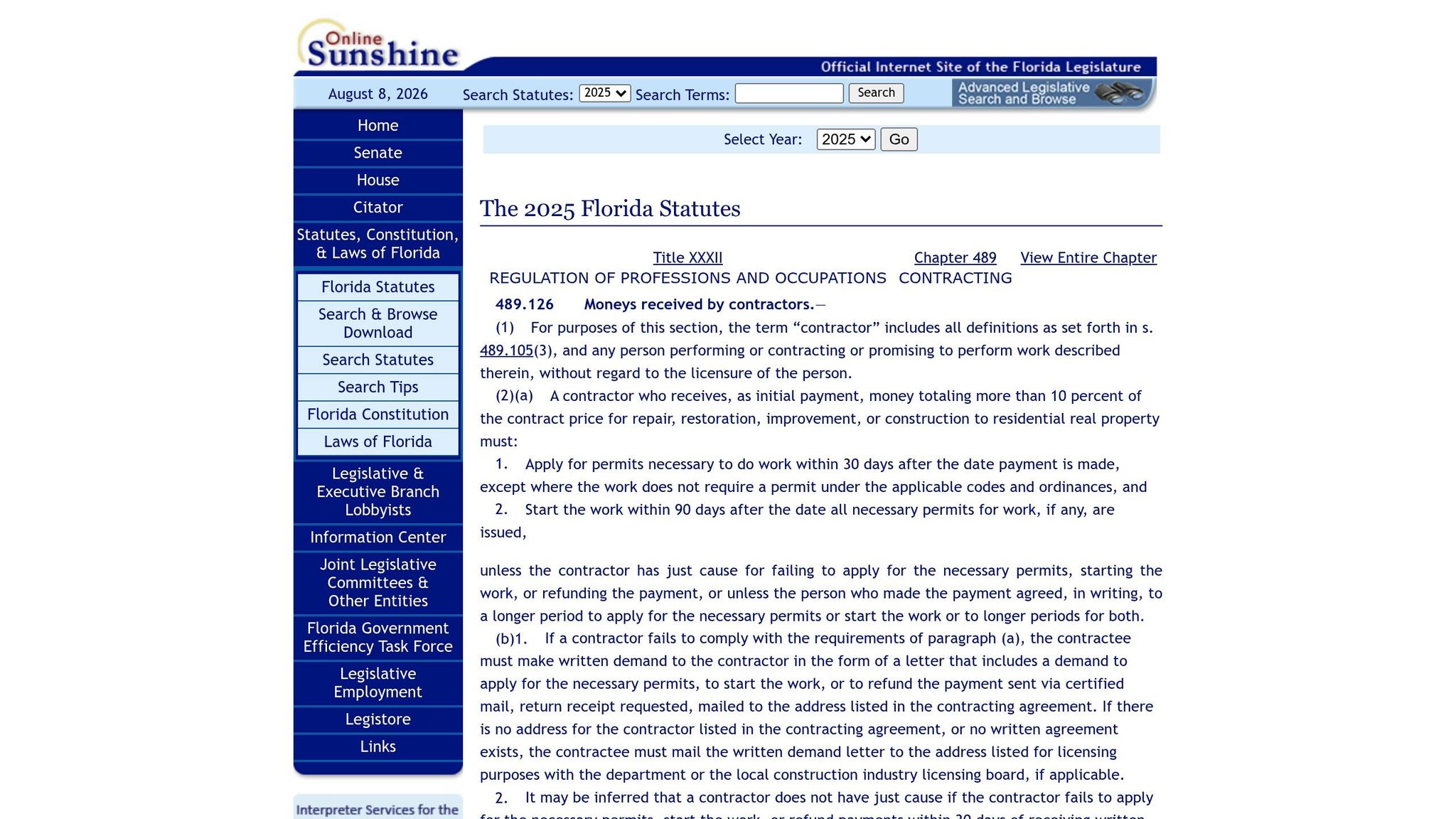
Many homeowners assume this law limits how much a roofer can collect upfront. It doesn't. Here's what it actually does: Section 489.126 requires permit filing within 30 days after any initial payment over 10%.
Once the permit is issued, the contractor must begin work within 90 days, unless a written agreement or documented just cause allows more time.
In other words: the second you pay a deposit above that 10% mark, the 30-day permit clock starts.
Large roofing deposits with no permit activity are a fraud warning sign
This is one of the clearest patterns in roofing scams. Storm chasers and unlicensed operators often collect large upfront deposits, then stall before filing any permit at all.
You should track a few things right away:
- Record the payment date.
- Check whether the permit was filed within 30 days.
- Keep the contract, proof of payment, and all messages.
If 30 days pass with no permit filing, contact the contractor in writing at once and demand proof of filing. Those records can help if you need to report unlicensed activity or file a claim.
The safest next step is a roofing quote from a contractor whose license, permit process, and contract terms can be checked locally
Most roofing scams start the same way: pressure first, proof later. Don't let a roofer rush you into a same-day signature. Before you pay anything, check that the contractor's license is active in DBPR, and walk away if they dodge permit questions or ask for more than 10% upfront without filing a permit within 30 days.
That 30-day window is the clearest signal the job is on track. If a deposit exceeded 10% and no permit appears within 30 days, start documenting everything and report it immediately to Hillsborough County Rapid Response, DBPR, or FraudFreeFlorida.com, based on where the job happened and where the fraud took place. If the money is gone and the permit is still missing, don't wait.
Hiring an unlicensed roofing contractor can hit you from more than one direction. The county can issue fines, Florida can pursue felony charges during a state of emergency, and you can lose access to the Homeowners' Construction Recovery Fund, which only covers homeowners who hired a licensed roofing contractor. Bayshore Exteriors carries an active CGC1536143 license, pulls permits before work starts, and provides contracts with the scope and timeline spelled out line by line.
A license check, a clear permit plan, and a contract you can read are your last filters before any deposit.
FAQs
How do I verify a Florida roofer’s license?
Use the Florida DBPR website or free mobile app to search by the contractor’s name, business name, or license number. Check that the license is active, then look at any disciplinary history or public complaints.
But... don’t stop at a business record.
An occupational license or corporate filing does not mean someone can work as a contractor. If you want to double-check, call the DBPR Customer Contact Center at 850-487-1395.
What should I do if a roofer asks me to pull the permit?
Stop there. Do not sign anything.
If a roofer asks you to pull the permit, treat that as a major red flag. In Florida, that often means the contractor may not hold a license, or they’re trying to shift legal and financial risk onto you.
Who do I report an unlicensed roofer to in Hillsborough County?
Report an unlicensed roofer to the Florida DBPR, which handles contractor licensing across the state. You can file a report by calling 1-866-532-1440, emailing ULA@myfloridalicense.com, or using the DBPR mobile app.
You can also contact Hillsborough County Rapid Response at 813-274-6600. If the issue involves permits, or you need to file a formal complaint about a specific job, contact your local building permitting office.
Related Blog Posts
✔ START TODAY
Personal and targeted approach

✔ FAQ
Your Questions. Our Expertise.
How do I get an accurate price for my project?
Are you licensed and insured in Florida?
How long does a typical installation take?
Does your work come with a warranty?
Why do you recommend James Hardie siding for Florida?
What specific services do you provide?
✔ START TODAY
Ready to Get Started?
Trusted and reliable Hardie board siding services backed by expert craftsmanship and high performance materials. We help homeowners achieve a durable, low maintenance exterior that looks great and stands strong for years to come.
Book an Appointment
We have received your estimate request and will be reaching out to you shortly.
.webp)