
Repair or Replace? How Florida Homeowners Decide on Their Roof
Age, Florida's 25% roofing rule, and insurance inspections determine whether a repair saves money or you must replace the roof.
Lorem ipsum dolor sit amet, consectetur adipiscing elit. Suspendisse varius enim in eros elementum tristique. Duis cursus, mi quis viverra ornare, eros dolor interdum nulla, ut commodo diam libero vitae erat. Aenean faucibus nibh et justo cursus id rutrum lorem imperdiet. Nunc ut sem vitae risus tristique posuere.
If your Florida roof is older than 15 years, damaged across more than 25% of the roof area, or close to renewal, replacement often makes more sense than repair.
You usually make this call by checking four things: roof age, damage size, insurance risk, and Florida code. A roof under 15 years old with small, isolated damage often supports a repair. But a roof over 20 years old, or one that crosses Florida’s 25% rule in a rolling 12-month period, often moves toward replacement.
Here’s the short version:
- Under 15 years old: repair often works if damage stays in one area
- 15 to 20 years old: repair may buy only 2 to 3 more years
- Over 20 years old: repair often acts as a short-term patch
- Over 25% damaged: code may push the job into full replacement
- Past 15 years: insurers may ask for proof of remaining roof life
- Older shingle roofs: private-market coverage can get harder to keep
- Roof certification or four-point report: often costs $200 to $400
- Deposit over 10%: Florida law sets permit and start-time rules after signing
Think a contractor’s repair quote settles the issue? Here’s what actually changes the math: code rules and insurance rules can turn a repairable roof into a roof you still should replace.
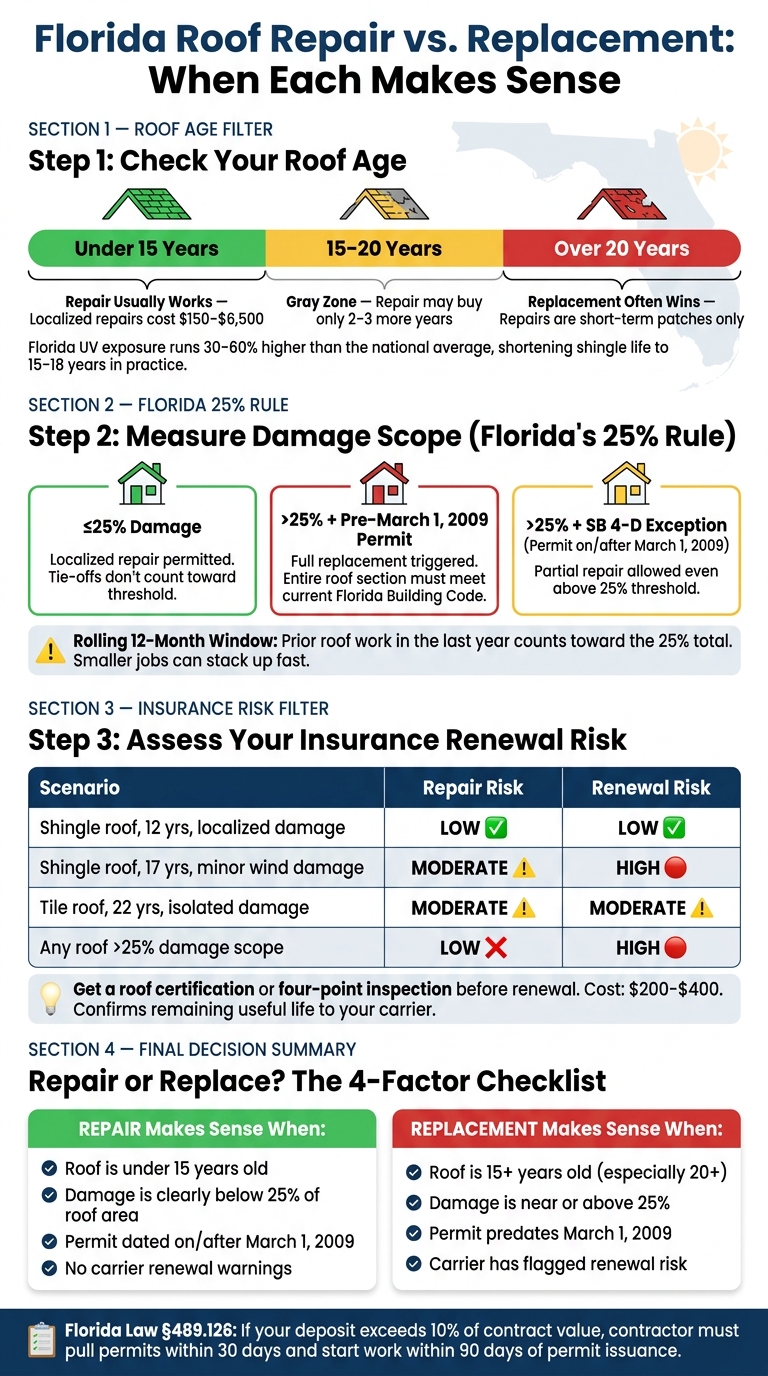
Florida Roof Repair vs. Replacement: Decision Guide by Age, Damage & Insurance
We Had to Replace Our Roof Early - Here's Why Florida's Insurance Rules Are Brutal
sbb-itb-85e0110
Quick Comparison
| Factor | Repair Usually Fits | Replacement Often Fits |
|---|---|---|
| Roof age | Under 15 years | 15+ years, especially 20+ |
| Damage scope | Under 25% | Near or above 25% |
| Roof permit date | On or after 03/01/2009 may allow larger partial work | Before 03/01/2009 can trigger full code upgrade |
| Insurance outlook | No renewal warning, good remaining life | Renewal risk, inspection issues, older shingles |
| Best use of money | When the roof still has years left | When repair adds little extra life |
That gives you the frame. The rest of the article shows where each line gets drawn, and when a small repair stops being the lower-cost move.
Roof Age Is Usually the First Filter After Damage Is Confirmed
Once you confirm storm or wear damage, roof age usually answers the first big question. Price matters, sure. But a 10-year-old roof and a 22-year-old roof can lead you in two different directions, even when the damage looks about the same.
Start with age. Then check repair scope and insurance risk.
In Central Florida, UV exposure runs 30% to 60% higher than the national average, and that speeds up shingle wear. Architectural shingles often hit practical end of life in 15 to 18 years. That’s a lot shorter than the 20- to 25-year lifespan many homeowners expect.
Tile roofs follow a different pattern. The tiles themselves may last 40 to 50 years, but the underlayment below them often fails in 15 to 20 years. When that happens, you may need a full tear-off and underlayment replacement.
The table below gives you a fast, age-based way to sort repair vs. replacement.
| Age Band | Typical Repair Outlook | Replacement Pressure | Insurance Concern |
|---|---|---|---|
| Under 15 Years | Generally favorable; localized repairs are cost-effective | Low; the roof usually still has serviceable life remaining | Age alone rarely blocks renewal. |
| 15 to 20 Years | "Close call" range; a repair may only buy 2–3 more years of life | Moderate to high; cost per remaining year often starts to favor replacement | Carriers may require proof of remaining useful life. |
| Over 20 Years | Short-term patch only; repairs rarely resolve systemic wear or underlayment failure | Critical; most systems are at or past effective end-of-life | Reinsurance risk rises sharply. |
Roofs Under 15 Years Old Usually Support a Repair if Damage Is Localized
If your roof is under 15 years old, repair usually makes sense when the damage stays in one area and the rest of the system still holds up well. That’s the sweet spot for fixing the problem without sinking money into a roof that’s already near the end.
Repair pricing in this age band usually falls somewhere between $150 and $6,500, depending on scope.
The 15-to-20-Year Range Is Where Cost-Per-Year and Insurance Pressure Change the Math
This is where things get tricky. A repair may still work from a construction standpoint, but it may only buy you two or three more years before the next issue shows up.
In other words: the question shifts from "Can this be repaired?" to "Is this worth paying for?"
Insurance pressure also starts to climb here. Carriers may ask for a professional inspection at the 15-year mark to confirm at least five years of remaining useful life before they renew coverage. If that inspection goes badly, a repair won’t fix the insurance issue.
Late-Life Roofs Often Turn a Small Repair Into a Short-Term Patch
Once a roof passes 20 years, the case for repair gets weak fast. Underlayment failure often drives the decision. That means the visible leak or missing section may be only part of the problem.
But here’s the harder part. Most private carriers in 2026 decline to write new policies on asphalt shingle roofs older than 15 to 17 years. Homeowners in that range often end up with Citizens Property Insurance, sometimes paying $2,500 to $4,500 more per year than they would in the private market.
So yes, a repair might stop the leak today. It usually does NOT change the renewal risk.
If age doesn’t settle the decision, Florida’s 25% roof-area rule usually does.
The 25% Rule: When Florida Building Code Turns a Repair Into a Full Replacement Project
Florida uses a rolling 12-month 25% threshold for roof covering work. The measurement applies to the total roof area or a roof section. If repair, replacement, or recovery goes past that mark, the whole roof system or roof section must meet current code, unless the SB 4-D exception applies.
That rule is separate from Florida's 25% window rule. It applies ONLY to roof covering work. And after roof age, it's the next filter that shapes what happens.
| Damage Scope | Code Result | Likely Result |
|---|---|---|
| ≤ 25% | Repair permitted | Localized repair; lower immediate cost |
| > 25% - Pre-March 1, 2009 roof | Full replacement triggered | Full replacement required; higher out-of-pocket cost without Ordinance and Law coverage |
| > 25% - SB 4-D exception applies | Localized repair permitted | Partial repair allowed despite the larger scope |
Damage at 25% or Less Usually Stays Localized
If the scope stays at 25% or below, the job can usually stay limited to the damaged area plus the tie-off work needed to connect new material to the old roof. Tie-offs do not count toward the 25% threshold.
That doesn't mean repair is always the best money move. It means the code does not force a full replacement.
Damage Above 25% Can Trigger Full Florida Code Requirements for the Roof System
Think a patch stays a patch no matter what? Here's what actually happens. On older roofs, scope matters more than the size of one damaged spot.
Once the work goes above 25%, pre-March 1, 2009 roofs can trigger full replacement. In other words: the whole roof section must meet the current Florida Building Code, not just the part that took the hit.
But there's one main carveout. If your roof was permitted and closed out on or after March 1, 2009, SB 4-D says only the repaired portion must meet current code, even when the repair scope goes above 25%.
Why the Prior 12 Months Matter
The 25% threshold works on a rolling 12-month window. That means earlier roof work finished during the past year counts toward the next repair scope, so smaller jobs can stack up faster than most homeowners expect.
A second repair can look minor on its own. However, combined with prior work, it can push the total over the line.
Before you start a new repair, review every roof job finished in the last 12 months. Even if code allows repair, insurance can still view the roof as a renewal risk.
Code compliance is only part of the call. Insurance can still change the outcome.
Insurance Rules Can Make a Repair Possible on Paper but Risky at Renewal
Code may allow a repair. But your insurer can still make replacement the safer move over time.
That’s the part many homeowners miss. A carrier can approve a repair today, pay the claim, and then send a non-renewal notice before the policy ends. In Florida, claim payment and renewal are two separate calls.
Citizens and Private Carriers Treat Roof Age and Remaining Useful Life as Separate Filters
Under §627.7011, roofs under 15 years old are harder to non-renew based on age alone. Once a roof passes 15 years, private carriers can ask for an inspection and proof that the roof still has life left, while Citizens follows a looser age standard.
That gap matters. A roof can look repairable in the claim file and still look weak at renewal.
A carrier may also approve the repair but move the policy toward actual cash value at renewal. In other words: the roof may still count for less on paper, even after the work is done.
What Adjusters Look at on a Roof Claim
Adjusters and underwriters are not doing the same job.
Adjusters price covered damage. Underwriters decide if the roof still fits the carrier’s rules. However, a repair approval does not end the story. The claim file may come back up at renewal, and an underwriter may see a repaired section plus broad wear or deterioration and flag the roof as a risk.
A Repaired Older Roof May Still Face Non-Renewal After the Claim Closes
Timing catches people off guard more than anything else.
In Florida, non-renewal notices often show up 60 to 90 days before the policy expires. That does not give you much time to line up a contractor, gather reports, and try to work through your options before coverage runs out.
Use the chart below to separate the claim result from the renewal risk.
| Roof Scenario | Likely Repair Posture | Renewal/Re-insurability Concern | Why Replacement May Still Be Chosen |
|---|---|---|---|
| Shingle roof, 12 years old, localized damage | High; likely approved if the damage stays under 25% of the roof area | Low; still within the 15-year rule under §627.7011 | Only if the homeowner wants to get ahead of future renewal pressure |
| Shingle roof, 17 years old, minor wind damage | Possible, but the carrier may argue wear and tear or require inspection | High; the carrier may demand proof of 5 years of remaining life or non-renew | To avoid being pushed out of the private market and into Citizens |
| Tile roof, 22 years old, isolated damage | Moderate; localized repair may be possible | Moderate; underlayment failure is a major underwriting risk at this age | Because tile appearance can hide underlayment failure |
| Any roof where repair scope exceeds 25% of the total roof area | Low; may trigger full replacement under Florida Building Code | High; a patched roof with widespread damage rarely passes a four-point inspection | Because code and scope make partial repair hard to justify |
If your roof is already past 15 years, get a roof certification or four-point inspection before your renewal date. That usually costs $200 to $400.
That report gives you a clearer read on remaining useful life. Or put another way: you’ll know whether a repair can still keep you insured, or whether replacement is the safer call.
The Decision Framework: Repair or Replace, and What Florida Law Requires After You Sign
Once you’ve looked at age, damage scope, and renewal risk, the choice usually gets pretty plain. Put those three filters together. They tell you whether a repair still makes sense or whether you’re about to spend money on a roof that’s already near the end.
Repair Usually Wins When Age, Damage Scope, and Renewal Risk All Stay in Favorable Range
Repair usually makes sense when the roof is under 15 years old, the damage stays localized and well below 25% of the roof area, and the carrier hasn’t flagged the roof for renewal trouble. When all three line up, repair is usually the lower-cost and lower-risk move.
Replacement Usually Wins When Code, Insurance, or Remaining Life Make Another Repair Hard to Justify
Replacement usually makes more sense when the roof is 15 years old or older, damage sits near or above 25%, or the permit predates March 1, 2009. In that situation, another repair often costs money without adding much usable roof life.
| Factor | Repair Is Rational | Replacement Is Safer |
|---|---|---|
| Roof Age | Under 15 years | 15 years or older |
| Permit Date | Permitted and closed out on or after March 1, 2009 | Pre-March 1, 2009 |
| Damage Scope | Clearly below 25% | Near or above 25% |
| Renewal Risk | Meets carrier remaining-life standard | Fails carrier remaining-life standard |
What §489.126 Requires Once a Deposit Exceeds 10% of the Contract Value
If replacement is the answer, Florida law sets the pace after you pay a deposit. Once a deposit exceeds 10% of the total contract price, Florida Statute §489.126 requires the contractor to pull permits within 30 days and start work within 90 days after permit issuance. That rule addresses permit timing and job scheduling, not a cap on deposit amounts.
When the filters point in different directions, a licensed roofing contractor inspection and permit review usually settle it. That review should confirm both the physical scope and whether any existing permit or code item affects the replacement timeline. Bayshore Exteriors covers both as part of every Tampa Bay roofing estimate.
FAQs
Does the 25% rule apply to the whole roof or one section?
The 25% rule applies to the total roof area or, in some cases, to a specific roof section.
That distinction matters. A home with multiple roof sections doesn’t always trigger the rule across the whole roof.
If one section takes the damage, the 25% limit may apply to that section alone. If that section goes over 25%, the code upgrade usually applies to that section, not the entire roof.
But if damage shows up in more than one area, inspectors may look at the total combined damage instead. In other words: one damaged section can stay isolated, but damage across several sections can change the scope fast.
Can my insurer non-renew me even if it approves the repair?
Yes. An insurer can still non-renew your policy after approving a repair.
Carriers often inspect roofs 15 years or older. If the roof has less than five years of remaining useful life, shows a pattern of repeated repairs, or fails a four-point inspection during renewal underwriting, the carrier may decline to renew coverage.
What should I check before signing a roof replacement contract?
Before you sign anything, make sure your contractor has documented the 25% Florida code threshold, reviewed any repairs completed in the past 12 months, and confirmed whether the job triggers a full replacement under current code.
You should also confirm that the contractor holds a current Florida Certified Roofing Contractor (CCC) license and knows §489.126. If your deposit is more than 10% of the contract price, the contractor must use those funds to pull the required permit.
Related Blog Posts
✔ START TODAY
Personal and targeted approach

✔ FAQ
Your Questions. Our Expertise.
How do I get an accurate price for my project?
Are you licensed and insured in Florida?
How long does a typical installation take?
Does your work come with a warranty?
Why do you recommend James Hardie siding for Florida?
What specific services do you provide?
✔ START TODAY
Ready to Get Started?
Trusted and reliable Hardie board siding services backed by expert craftsmanship and high performance materials. We help homeowners achieve a durable, low maintenance exterior that looks great and stands strong for years to come.
Book an Appointment
We have received your estimate request and will be reaching out to you shortly.
.webp)