
Siding Repair or Replacement? How Tampa Bay Homeowners Decide
When to repair or replace siding in Tampa Bay: weigh damage scope, moisture risk, color match, and total cost.
Lorem ipsum dolor sit amet, consectetur adipiscing elit. Suspendisse varius enim in eros elementum tristique. Duis cursus, mi quis viverra ornare, eros dolor interdum nulla, ut commodo diam libero vitae erat. Aenean faucibus nibh et justo cursus id rutrum lorem imperdiet. Nunc ut sem vitae risus tristique posuere.
If siding damage stays under about 20% to 30% of your exterior, repair usually costs less. But if moisture sits behind the wall, the color no longer matches after 3 to 5 years of Florida sun, or repair costs climb toward 30% to 40% of a full re-side, replacement often gives you the better long-term result.
Here’s the short answer: you should repair siding when the damage is small, the wall behind it stays dry, and a siding contractor can still match the panel. You should replace siding when damage spreads across more than one wall, repeat fixes keep stacking up, or the house already has older siding near the end of its service life.
Before you decide, focus on four things:
- Damage scope: One section often points to repair. Multiple walls often point to replacement.
- Moisture risk: Hidden water can turn a small patch into sheathing, framing, or mold work.
- Color match: In Tampa Bay, sun and humidity can make new panels stand out after only 3 to 5 years.
- Total cost: A repair might cost $300 to $1,500, while full replacement often runs $8,000 to $20,000.
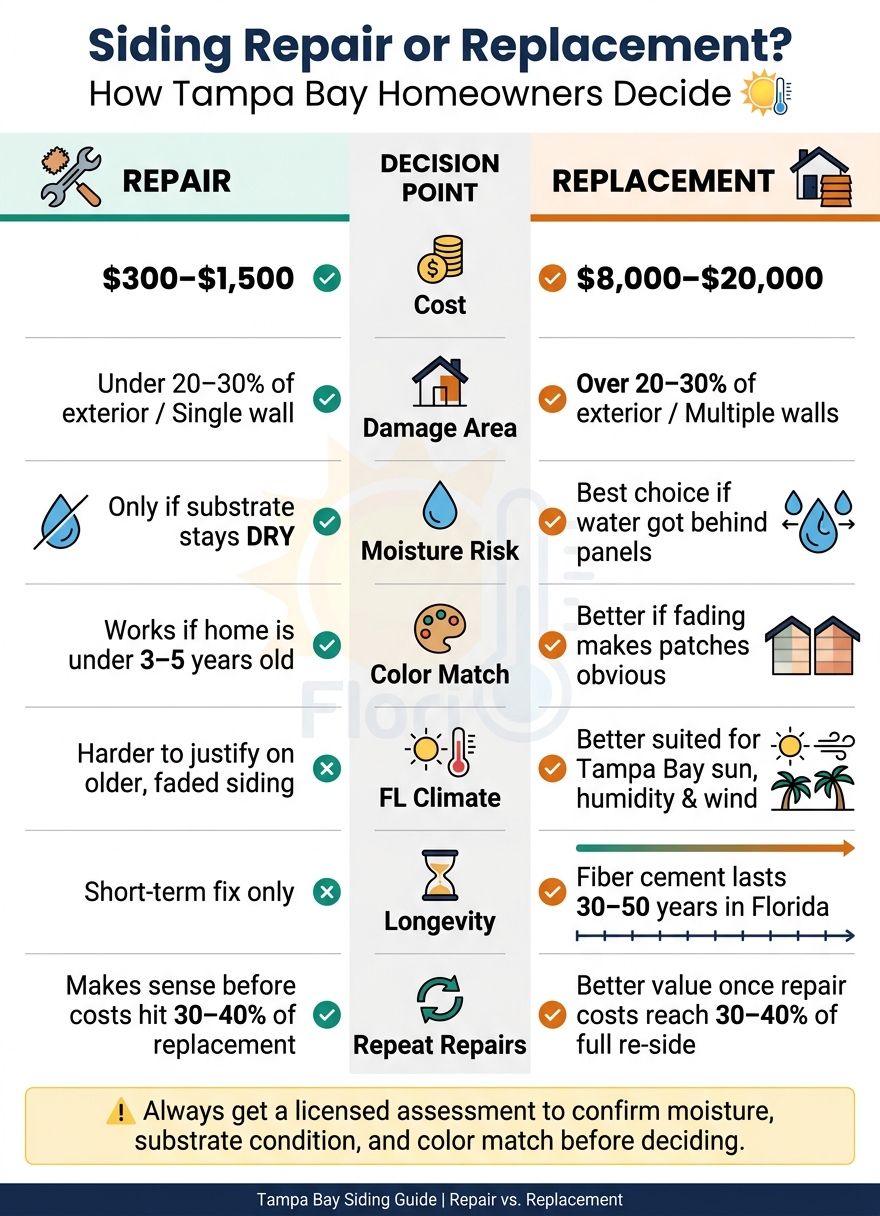
Siding Repair vs. Replacement: Tampa Bay Homeowner Decision Guide
Should You Repair or Replace Your Home Siding?
sbb-itb-85e0110
Quick Comparison
| Decision Point | Repair | Replacement |
|---|---|---|
| Best for | Small, isolated damage | Large damage, older siding, repeat failures |
| Typical cost | $300 to $1,500 | $8,000 to $20,000 |
| Damage range | Under 20% to 30% of exterior | More than 20% to 30%, or damage on multiple walls |
| Moisture issue | Works only if substrate stays dry | Better choice if water got behind siding |
| Color match | Works if panels still blend | Better choice if fading makes patches obvious |
| Long-term value | Lower up front | Often lower total cost when repairs keep repeating |
| Florida climate impact | Harder to justify on older faded siding | Often makes more sense for homes hit by sun, humidity, and wind |
| Material outlook | Short-term fix | Fiber cement can last 30 to 50 years in Florida |
Think a small repair always saves money? Here's what actually happens: once matching, permits, repeat labor, and moisture risk enter the job, the cheaper option on day one can cost more over time. The rest of this article breaks down where that line usually falls for Tampa Bay homeowners.
When Repair Is the Right Financial Call
Repair usually makes more financial sense when damage affects less than 20%–30% of the exterior and the rest of the siding system stays in good shape. If one panel cracks after a branch falls or one section comes loose after a windstorm, that points to an isolated hit, not house-wide siding failure.
That difference matters. A small, contained problem often calls for a repair. A larger pattern of damage usually means the bill is only getting postponed.
Limited Repairs Keep Labor, Material, and Tear-Off Costs Low
Replacing a few James Hardie panels cuts out the costliest parts of a full project: full-house tear-off, disposal fees, trim reset, and repainting on every elevation. You keep labor hours down, and your home stays less disrupted.
A repair makes the most sense when a licensed siding contractor confirms that the substrate, flashing, and water-resistive barrier behind the damaged area still remain intact. In other words: if those parts are dry and undamaged, you're replacing the surface, not rebuilding what sits underneath.
But if the substrate is wet, the math changes. A patch doesn't fix the actual problem. It delays it, and the final bill often grows. If the damaged section is still isolated and dry, repair keeps its cost edge.
Repair Only Works When the Right Panels Are Available and the Match Zone Is Small
A low-cost repair can still turn into a poor call if the new panels don't match the rest of the house. With James Hardie fiber cement, the exact profile and texture still need to be available, and the patched area needs to blend in without forcing a much larger repaint.
| Option | Upfront Cost | Scope of Labor | Hidden Moisture Risk | Need for Repainting |
|---|---|---|---|---|
| Limited Repair | $300–$1,500 | Isolated panel or trim replacement; no full tear-off | High if the substrate isn't confirmed dry before work begins | Possible if color match requires blending across a wider area |
| Full Replacement | $8,000–$20,000 | Full tear-off, new moisture barrier, trim reset, and repainting | Low; new moisture barriers and flashing included | Included; uniform color and profile across all walls |
When damage spreads past one wall, or the patched area stands out, replacement starts to make more sense on paper.
When Replacement Costs Less Than Repeated Repairs
Replacement starts to make more sense when repeat visits, hard-to-match boards, and hidden moisture drive repair costs to 30%–40% of a new siding quote. At that point, you’re not just paying for a patch. You’re deciding whether that patch still shields your home for less money overall.
Think a smaller fix always costs less? Not once the same wall keeps failing. Or put another way: if you keep paying to fix symptoms, the total can creep up fast.
Damage Across Multiple Walls Changes the Cost Math
Each repair visit brings its own setup costs. That includes mobilization, permits, and inspections. In Hillsborough County, siding work over 100 square feet needs a building permit, which runs $150–$400.
A full replacement rolls those costs into one job instead of repeating them across separate visits. But moisture is where the math gets ugly. If water gets behind failed siding, one mold remediation job can cost $2,500 to $7,000. That turns repeat patching into a growing liability, not a money-saver.
| Scenario | Why Repair Becomes Less Efficient | Why Replacement Gains Value |
|---|---|---|
| Recurring moisture intrusion | Patching fixes only the area you can see; failed flashing or housewrap keeps damaging the substrate | Allows full substrate inspection and installation of a code-compliant moisture barrier |
| Multiple elevations affected | Repeat mobilization fees and permit costs add up with each separate trip | Lower per-square-foot labor cost across the full job; one permit and inspection cycle covers the whole home |
Once damage, age, or moisture show up on more than one wall, replacement stops looking like the bigger job. It starts looking like the cheaper reset.
Older Installations Often Cross Into Replacement Territory
Older fiber cement installations near the end of their service life often cost less to replace than to keep patching. Here’s why: every repair adds labor, but it doesn’t reset the wall assembly.
In Florida, that tipping point comes sooner. Heat and humidity shorten how long repairs tend to hold, so homeowners often hit replacement territory earlier than they expect.
How Florida's Climate Affects the Repair vs. Replacement Decision
When siding already sits near the end of its lifespan, Tampa Bay weather speeds up the call. Heat, humidity, and sun shrink the window for a cost-effective repair. Damage that might stay manageable in a cooler place can hit replacement territory much faster here.
After 3–5 Years of Florida Sun, Repair Panels Are Hard to Match
Even if a repair panel comes in the same factory color, a home that's more than 3–5 years old can still end up with a visible patch. The original siding has already weathered, and the color shift shows up fast.
South- and west-facing walls usually look worse first. They take more direct sun, so those sides fade faster than north-facing walls.
Factory finishes help. But Florida sun still leaves its mark over time. Coastal air can also loosen fasteners sooner, which pushes older siding closer to replacement.
At that point, the math changes. Once the patched area gets bigger or easier to spot, the repair stops protecting home value.
Delaying Repairs in Florida's Humidity Raises the Total Cost
Florida gets about 54 inches of rain each year. In Tampa Bay, high humidity makes it easier for moisture to slip behind a cracked or loose panel.
That’s where small damage turns into a bigger job. Water can reach the sheathing, framing, and insulation, which means you're no longer dealing with a surface fix. You're dealing with substrate repair.
In other words: waiting can move the project out of the repair category entirely.
Why Fiber Cement Outperforms Vinyl When Homeowners Are Deciding What to Reinvest In
Material choice matters here because it changes whether another repair makes sense. If you're weighing vinyl against a lower-cost path, the long-term numbers in Tampa Bay still lean toward James Hardie fiber cement.
Vinyl siding in Florida usually lasts 15–22 years. James Hardie fiber cement can last 30–50 years in the same climate. That longer lifespan means fewer repeat decisions over the life of the home.
| Factor | Vinyl Siding in Tampa Bay | James Hardie Fiber Cement in Tampa Bay | Why It Matters for Repair or Replacement Decisions |
|---|---|---|---|
| UV Resistance | Fades and becomes brittle within 7–10 years | ColorPlus finish resists UV; 15-year finish warranty | UV damage makes matching repaired panels almost impossible after 3–5 years on weathered Florida siding |
| Humidity/Moisture | Can trap moisture behind panels; prone to warping in high heat | Non-porous; resists biological growth; does not warp or rot | Trapped humidity can lead to hidden structural rot, pushing the job from repair into replacement |
| Lifespan | 15–22 years in Florida | 30–50 years with minimal maintenance | A longer reinvestment cycle means fewer repair decisions over time |
For Tampa Bay homes, fiber cement makes more sense as a reinvestment. It stands up better to sun, humidity, salt air, and wind.
But don't guess. Before you commit, get a licensed assessment to confirm panel scope, moisture exposure, and whether a color match is still realistic.
What a Licensed Assessment Should Cover Before You Commit to Repair or Replacement
Once hidden moisture and matching start changing the repair math, the next move is a licensed assessment. Before you approve a repair or full replacement, a licensed contractor should price the job after checking the repair scope, hidden moisture, substrate condition, and color match.
The Assessment Should Cover Panel Scope, Moisture Exposure, and Substrate Condition
The assessment should confirm whether moisture has reached the sheathing or framing and whether the substrate still holds up. The contractor should also price any trim, flashing, or seal work needed to finish the repair.
But if the wall assembly is compromised, the quote should move from repair pricing to replacement pricing.
The Assessment Should Confirm Whether a Color Match Is Realistic
Color match is a separate cost issue from structural repair. The assessment should confirm whether the replacement panel is still available in the same profile and finish.
After 3–5 years, an obvious patch can force larger repainting or push you toward full replacement. In other words: if the match will stand out, the repair may stop being the lower-cost option.
Conclusion: Repair Works for Limited Damage, but Replacement Wins When Matching, Moisture, and Age Drive Up Total Cost
Once you weigh scope, moisture, age, and color match together, the choice tends to get clear fast.
Repair makes sense for isolated damage when the substrate stays dry and a usable color match is still available. A targeted fix, often $200 to $1,500, can protect the wall system without paying for a full re-side. Replacement makes more sense when damage spreads, the finish no longer blends, or repair costs start creeping toward replacement territory. A licensed siding remodeling assessment that finds moisture behind the panels changes the calculation immediately — patching at that point usually just delays the larger bill.
The color-match problem shows up sooner than most homeowners expect. In Florida, after only 3–5 years of sun exposure, a new panel can look noticeably different from the surrounding ones. That gap widens as the existing finish continues to fade.
A full fiber cement replacement also changes the long-term math. James Hardie panels can last 30–50+ years in Florida conditions, so when moisture, fading, and age stack up at once, replacement often returns the better value over time. Bayshore Exteriors carries that assessment into every estimate, which is where repair-versus-replace decisions tend to resolve fastest.
If those factors still point in different directions, get a licensed assessment before you commit.
FAQs
Can I replace siding on just one wall?
Yes, you often can repair or replace just one wall if the damage stays limited to that area and the rest of the siding and wall assembly remain in good shape.
But don’t guess. Start with a licensed assessment. In Tampa Bay, harsh sun can fade existing fiber cement enough that new panels may stand out when the siding is more than 3 to 5 years old. Humid weather can also make hidden moisture damage worse, especially behind the wall where you can’t see it.
If the damage shows up in more than one area, or the siding sits near the end of its lifespan, a full replacement usually makes more sense for your budget and your home. Or put another way: a small repair works best when the problem is actually small.
Will new James Hardie siding match my existing color?
Probably not if your siding is more than 3–5 years old. Florida sun wears down color over time, so new James Hardie repair panels usually won’t match the faded panels exactly.
If you want a seamless look, contractors often suggest replacing siding across a full wall or on a less-visible side of the home instead of patching a few panels. But appearance isn’t the only issue.
A licensed assessment should also confirm that the product is still available and that the existing substrate remains sound before any repair starts.
What does a licensed siding assessment include?
A licensed siding assessment should do more than a quick walk-around. It needs to cover every side of the home and check for hidden moisture, sheathing damage, and trouble spots around the trim, soffit, fascia, water-resistive barrier, fastener patterns, and clearances.
It should also confirm whether matching repair materials are still available. That matters because siding older than 3 to 5 years often gets tough to match under Florida sun. You should also get photos, a written scope, and a clear repair-versus-replacement recommendation.
Related Blog Posts
✔ START TODAY
Personal and targeted approach

✔ FAQ
Your Questions. Our Expertise.
How do I get an accurate price for my project?
Are you licensed and insured in Florida?
How long does a typical installation take?
Does your work come with a warranty?
Why do you recommend James Hardie siding for Florida?
What specific services do you provide?
✔ START TODAY
Ready to Get Started?
Trusted and reliable Hardie board siding services backed by expert craftsmanship and high performance materials. We help homeowners achieve a durable, low maintenance exterior that looks great and stands strong for years to come.
Book an Appointment
We have received your estimate request and will be reaching out to you shortly.
.webp)