
Standing Seam Metal Roofs in Florida: Is It Right for You?
Standing seam benefits for Tampa Bay homes: hidden fasteners, Galvalume+PVDF for salt air, 150 mph wind ratings, and HOA limits.
Lorem ipsum dolor sit amet, consectetur adipiscing elit. Suspendisse varius enim in eros elementum tristique. Duis cursus, mi quis viverra ornare, eros dolor interdum nulla, ut commodo diam libero vitae erat. Aenean faucibus nibh et justo cursus id rutrum lorem imperdiet. Nunc ut sem vitae risus tristique posuere.
If your home sits near Tampa Bay, a standing seam metal roof often makes more sense than an exposed-fastener metal roof. The main reasons are clear: fewer leak points, better resistance to salt air, and tested wind performance for Hillsborough County’s 150 mph design wind speed.
If you’re weighing this roof type, focus on four things:
- Fasteners: Standing seam hides screws under raised seams, so your roof face has fewer water-entry points.
- Wind: Your roof system still needs a tested assembly, with the right clip spacing at edges and corners.
- Salt air: Galvalume panels with a PVDF finish usually last longer near the bay than painted face-fastened panels.
- HOA rules: Since HB 293 took effect on May 28, 2024, Florida HOAs cannot ban metal roofs outright, but they can still control color, profile, trim, and sheen.
Think any metal roof works the same in Florida? But that’s where many homeowners get burned. In other words: the panel style, coating, fastener layout, and approval rules all shape whether standing seam fits your home.
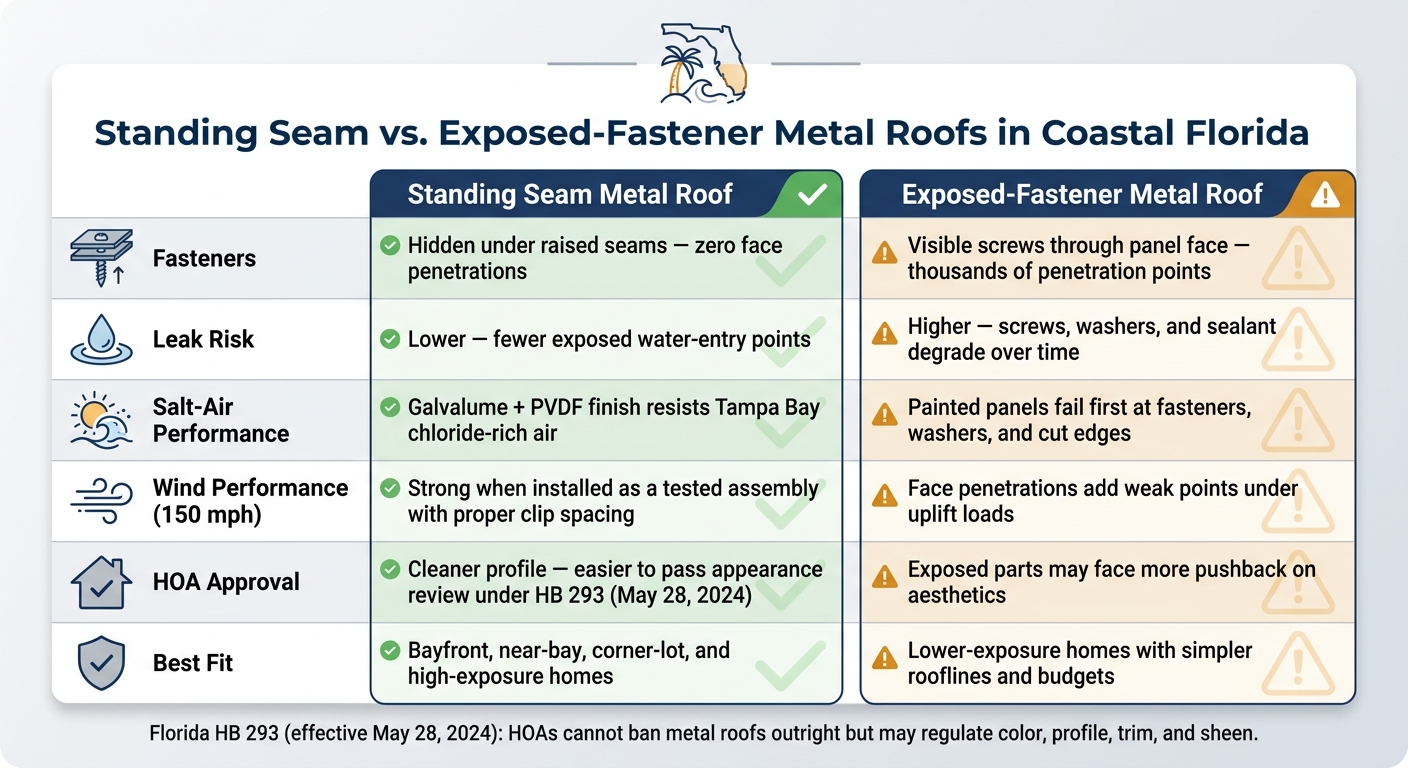
Standing Seam vs. Exposed-Fastener Metal Roofs in Coastal Florida
Standing Seam Metal Roof Details
sbb-itb-85e0110
Quick Comparison
| Factor | Standing Seam Metal Roof | Exposed-Fastener Metal Roof |
|---|---|---|
| Fasteners | Hidden under seams | Visible through panel face |
| Leak risk | Lower due to fewer exposed penetrations | Higher at screws and washers |
| Salt-air performance | Better near the bay, especially with Galvalume + PVDF | More wear at fasteners and cut edges |
| Wind performance | Strong when installed as a tested assembly | Depends on system, but face penetrations add weak points |
| HOA appearance review | Often easier due to cleaner lines | Can face more pushback on look |
| Best fit | Bayfront, near-bay, and exposed homes | Lower-exposure homes with simpler needs |
If you’re deciding between roof types in South Tampa, Davis Islands, Hyde Park, Palma Ceia, or Ballast Point, the key question is not whether metal works. It’s whether this metal system fits your wind exposure, salt-air exposure, roof shape, and HOA rules.
How standing seam panels remove the fastener failure points common in coastal Florida
In coastal Florida, roof trouble often starts at the fastener holes. Humidity, wind-driven rain, and salt air keep working on every exposed screw day after day. So where a roof gets punctured matters just as much as the metal itself.
What a standing seam panel system is and how the interlocking seam works
A standing seam panel system locks panels together at raised seams. Roof installers secure the panels with concealed clips and hidden fasteners under those seams, not through the flat face of the panel.
That setup keeps the panel surface unpunctured. Fewer holes means fewer ways for moisture to get in.
Why exposed fastener roofs create more corrosion and leak points in salt air
Exposed fastener roofs work the opposite way. Installers drive screws straight through the panel face, which creates thousands of spots where water can enter.
Then Florida weather starts doing its thing. Strong UV exposure and constant thermal cycling wear down the washer seals and sealant around those screws. Over time, those parts dry out, crack, and fail.
Near the shoreline, salt-heavy air makes the problem worse by speeding up corrosion at each penetration point.
That hidden-fastener layout also helps the panels stay locked together in high wind, which matters next in Hillsborough County.
Hillsborough County's 150 mph design wind speed: why panel engagement and clip spacing matter
Wind resistance is the other half of the standing seam advantage. But in Hillsborough County, performance comes down to the tested assembly, not the product label. Under the Florida Building Code 8th Edition, residential roofs must be engineered for 150 mph design wind speed.
How standing seam engagement performs under 150 mph design wind loads
Wind creates uplift that tries to pull panels off the roof. That means the raised seams and concealed clips have to work together with the panel profile, clip spacing, substrate, and attachment pattern.
Here's the thing: those parts don't work in isolation. If one part of the assembly falls short, the whole system can lose strength where it matters most.
Roof edges take the hardest hit. Corners, eaves, and ridges need tighter engineering than the roof field because uplift loads hit those areas harder.
Which Tampa Bay roof shapes and exposures benefit most from this uplift performance
Some Tampa Bay homes need this kind of uplift performance more than others. The best candidates are waterfront, bay-facing, and corner-lot homes with complex rooflines.
Why those homes? Because edges, ridges, and eaves see the highest uplift, and those roof shapes often create more of them. Or put another way: the more exposed and broken-up the roof is, the more those edge details matter.
For high-uplift areas, ask for the tested assembly report and the clip-spacing schedule for edges and corners.
Why Galvalume standing seam panels hold up better in Tampa Bay salt air than painted exposed fastener panels
In Tampa Bay, corrosion resistance matters just as much as wind resistance. Once you’ve handled wind uplift, the next issue is simpler: how well does the roof deal with salt air year after year?
Here’s the practical difference:
| Galvalume Standing Seam | Painted Exposed Fastener Panel | |
|---|---|---|
| Material/coating | Aluminum-zinc alloy coating on steel | Painted panel system |
| Fastener exposure | Concealed-fastener assembly | Exposed fastener assembly |
| Coastal performance | Resists corrosion better in Tampa Bay salt air | More prone to fail sooner at fasteners |
Why Galvalume and PVDF finishes hold up better in humid, chloride-rich air
Galvalume standing seam panels start with an aluminum-zinc alloy coating over steel. That coating helps the panel hold up better when Tampa Bay’s humid, chloride-rich air sits on the roof day after day.
Many standing seam panels also use a PVDF finish over Galvalume. That extra finish gives the roof more weather and UV durability in Tampa Bay’s coastal climate.
Why painted face-fastened panels often fail first at screws, washers, and cut edges
Painted exposed-fastener panels have a weak spot right out in the open: the fasteners. In salt air, these systems often fail first at screws, washers, and cut edges.
But standing seam hides those fasteners beneath the panel assembly. Or put another way: fewer exposed points usually means fewer early corrosion problems where the system gets pierced or trimmed.
That makes standing seam a better fit for homes where the roof stays visible and exposed, which leads to HOA rules and neighborhood compatibility.
Standing seam on South Tampa and Hillsborough County homes: neighborhood fit and HOA rules
After wind and salt-air performance, the next filter is fit: roof shape and HOA rules. In other words: even if standing seam performs well, it still has to look right on the house and pass review from the neighborhood board.
Which South Tampa and Hillsborough County homes are the best fits for standing seam
Bayfront and near-bay properties are the clearest match because they get the most from concealed fasteners. Those homes take the brunt of salt air, street exposure, and weather off the water.
Coastal contemporary homes also pair well with standing seam. The clean, vertical seam lines tend to match the look of newer construction in high-exposure parts of South Tampa and Hillsborough County.
Bungalows and historic-style homes can work too. But the seam profile and finish need to line up with the facade, or the roof can look out of place fast.
The same details that matter in coastal exposure also matter in HOA review. That’s where many homeowners hit the next checkpoint.
What HB 293 changed for HOA approval of metal roofs in Florida
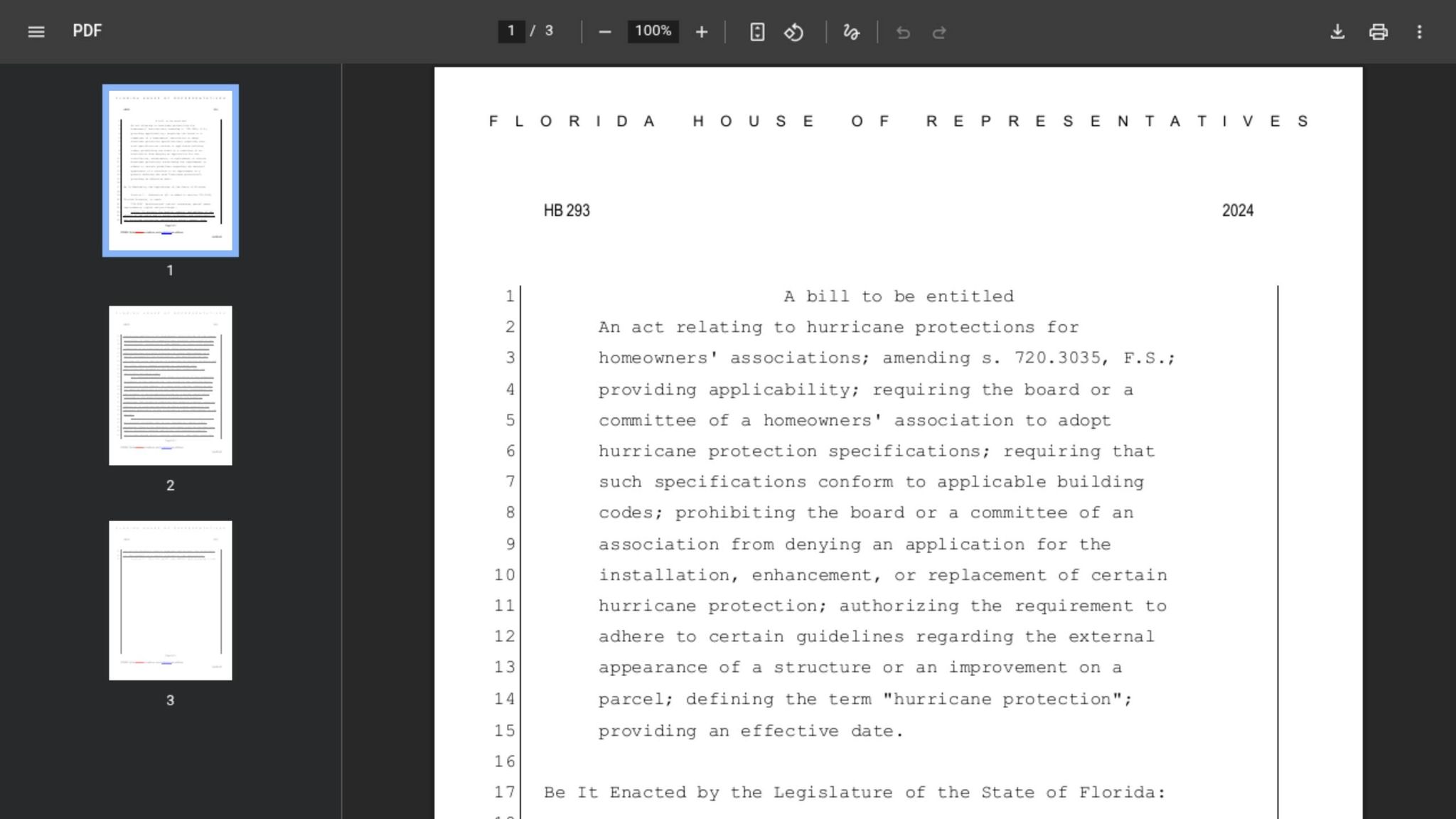
If your home sits in an HOA, Florida law now puts limits on what the board can do. HB 293, signed on May 28, 2024, stops HOAs from banning metal roofs outright.
Under Chapter 720, Florida Statutes, HOAs can still regulate appearance: color, profile, trim, and sheen. They cannot, however, reject a metal roof application on the grounds of material type alone. Standing seam often moves through HOA review more easily than other metal panel profiles; its clean lines and fewer exposed parts tend to fit appearance rules with less friction. Roofers who know local HOA standards can match the profile and color to the community's recorded requirements before the submittal goes in. Bayshore Exteriors specs metal roof profiles with HOA review in mind from the start.
FAQs
How close to Tampa Bay does salt air become a major roofing concern?
Salt air becomes a major roofing concern when your home sits 3 to 5 miles from the coast. In that range, humidity and salt deposits can speed up corrosion.
Think inland-friendly Galvalume-coated steel will hold up the same near the water? Not always. In this higher-exposure zone, aluminum often makes more sense, while steel needs protective coatings and careful fastener selection to help prevent premature corrosion.
What should I ask for to verify a standing seam roof is tested for 150 mph wind loads?
Ask for the manufacturer’s current Florida Product Approval (FL#) or, if you’re in HVHZ, a Miami-Dade NOA.
Then check that the approval lines up with your project details: panel gauge, clip type, fastener spacing, roof deck substrate, and the uplift pressure tables required by the 8th Edition Florida Building Code.
Can my HOA reject a standing seam metal roof based on color or profile?
Yes. Under Florida law, an HOA can enforce reasonable roof rules for color and style when those rules match the community’s architectural standards or unified building scheme.
HB 293 (2024) does not let HOAs ban metal roofs outright. But they can still control how a roof looks under their published guidelines. Check your community’s covenants before you choose a roof.
Related Blog Posts
✔ START TODAY
Personal and targeted approach

✔ FAQ
Your Questions. Our Expertise.
How do I get an accurate price for my project?
Are you licensed and insured in Florida?
How long does a typical installation take?
Does your work come with a warranty?
Why do you recommend James Hardie siding for Florida?
What specific services do you provide?
✔ START TODAY
Ready to Get Started?
Trusted and reliable Hardie board siding services backed by expert craftsmanship and high performance materials. We help homeowners achieve a durable, low maintenance exterior that looks great and stands strong for years to come.
Book an Appointment
We have received your estimate request and will be reaching out to you shortly.
.webp)