
Are Impact Windows Required in Florida? A Tampa Bay Guide
Tampa Bay homes are subject to code-based wind-borne debris rules that determine whether impact windows or approved shutters are required.
Lorem ipsum dolor sit amet, consectetur adipiscing elit. Suspendisse varius enim in eros elementum tristique. Duis cursus, mi quis viverra ornare, eros dolor interdum nulla, ut commodo diam libero vitae erat. Aenean faucibus nibh et justo cursus id rutrum lorem imperdiet. Nunc ut sem vitae risus tristique posuere.
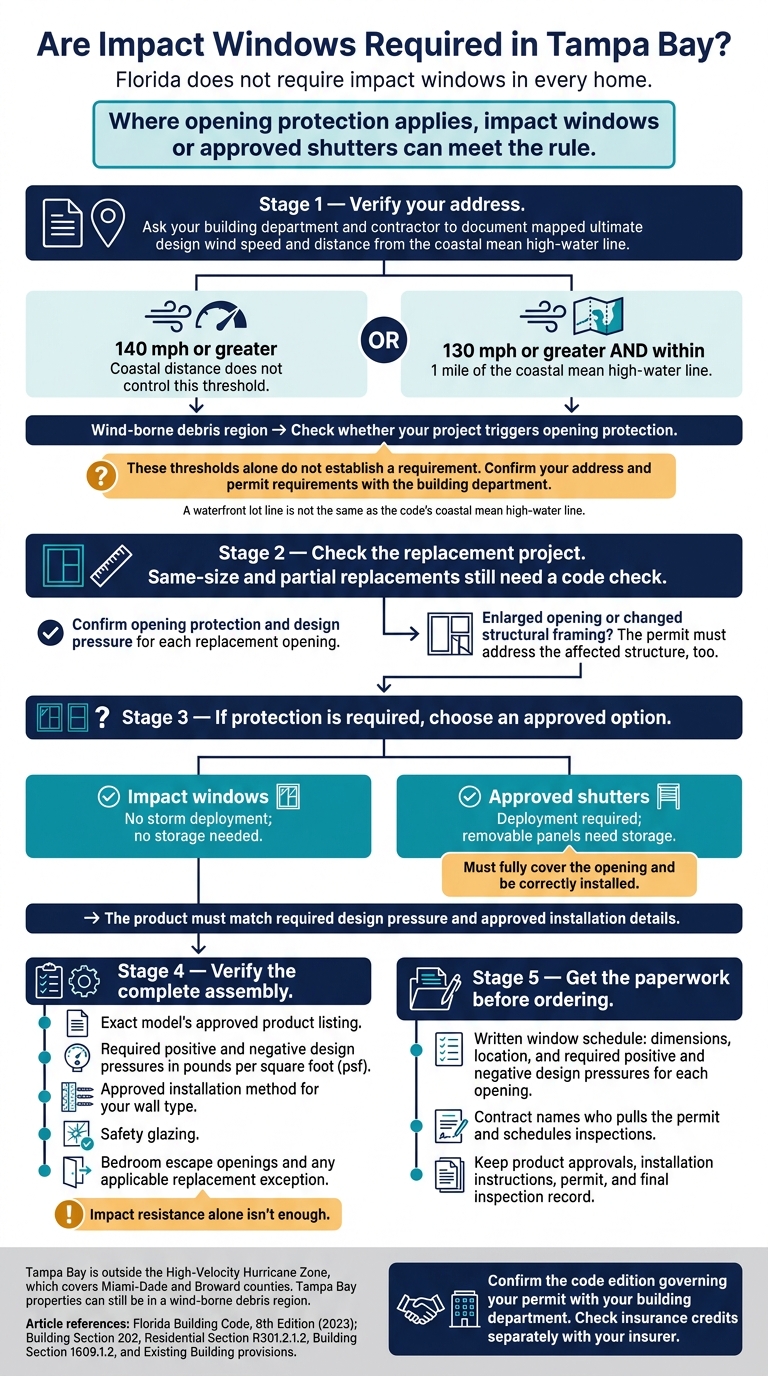
Florida does not require impact windows in every home. For your Tampa Bay project, check your address’s wind-borne debris status and permit requirements before ordering. Where opening protection applies, impact windows or approved shutters can meet the rule.
Your property may fall within a wind-borne debris region at 140 mph design wind speeds, or at 130 mph within 1 mile of the coastal mean high-water line. Tampa Bay sits outside the High-Velocity Hurricane Zone, which covers Miami-Dade and Broward counties.
Before replacing windows, confirm these details:
- Replacement rules: Same-size and partial replacements still need a code check.
- Protection choice: Impact windows need no storm deployment; shutters require deployment and may need storage.
- Product fit: Verify design pressure, product approval, installation details, safety glazing, and bedroom escape requirements.
- Contractor paperwork: Get a window schedule, permit responsibilities, and inspection records in writing.
Confirm the code edition governing your permit with your building department. A licensed contractor handling impact window installation in Tampa Bay can document the code requirements and permit responsibilities for your specific address before the project starts. Check impact window insurance discounts in Florida separately with your insurer; credit eligibility depends on your product, installation documentation, and carrier.
Are Impact Windows Required in Tampa Bay?
Where Wind-Borne Debris Rules Apply in Tampa Bay
Your address, not your neighborhood name, determines the code requirement. It determines whether your Tampa Bay home needs impact windows or another approved opening-protection system. The Florida Building Code, 8th Edition (2023), Building Section 202 bases wind-borne debris rules on mapped wind speeds and distance from the coastal mean high-water line.
How the Code Defines a Wind-Borne Debris Region
“Wind-borne debris region: Portions of hurricane-prone regions that are within 1 mile of the coastal mean high-water line where the ultimate design wind speed, $V_{ult}$, is 130 mph or greater; or in areas where the ultimate design wind speed, $V_{ult}$, is 140 mph or greater.” - Florida Building Code, 8th Edition, Building Section 202.
At a design wind speed of 140 mph or greater, distance from the coast does not control the rule. If your property falls within this region, you must then check whether your window project triggers the opening-protection requirement.
How to Check a South Tampa Property
For your South Tampa home, ask the building department and your contractor to document the mapped wind speed and distance from the coastal mean high-water line. Ask them to connect those findings to the opening-protection rule for your address.
A waterfront lot line is not the same as the code’s coastal mean high-water line. Verify these details before deciding whether your project requires impact windows or another approved opening-protection system.
Tampa Bay Is Outside the High-Velocity Hurricane Zone
Tampa Bay is outside the High-Velocity Hurricane Zone, which applies only to Miami-Dade and Broward counties. But Tampa Bay homes can still fall within a wind-borne debris region and need opening protection under the Florida Building Code, 8th Edition. That designation helps determine whether a replacement project triggers the requirement.
sbb-itb-85e0110
When Window Replacement Requires Opening Protection
For Tampa Bay addresses in a wind-borne debris region, window replacement triggers a code check. Replacement permits follow the Florida Building Code, Existing Building, 8th Edition (2023), and the new window must meet current opening-protection rules.
Same-Size Replacements, Partial Projects, and Enlarged Openings
Replacing a window with the same size doesn't skip code review. Each replacement opening still needs a check for protection and design pressure, even during a partial replacement project.
If your contractor enlarges an opening or changes structural framing, the permit must address the affected structure, too. It cannot cover just the window assembly.
Approved shutters can meet the protection requirement when they fully cover the opening and your contractor installs them correctly. Your opening-protection options are impact windows or approved shutters.
Other Code Requirements for Replacement Windows
Impact resistance alone isn't enough. Your replacement assembly must also meet the opening’s required design pressure.
Ask your contractor to document the approved product listing for your exact model and the approved installation method for your wall type. For approval-document details, see Impact Window Approvals: Tampa, FL vs. Miami-Dade NOA.
Your contractor must also verify safety glazing and bedroom escape openings. Matching the old frame dimensions doesn't establish compliance, so have your contractor confirm any applicable replacement exception before ordering.
With those requirements identified, you can compare impact windows and approved shutters for opening protection.
Meeting Code With Impact Windows or Approved Shutters
When your home requires opening protection, impact windows or approved shutters can meet the requirement. Florida Building Code, 8th Edition (2023), Residential Section R301.2.1.2 and Building Section 1609.1.2 allow both options. Your chosen product must match the opening’s required design pressure and approved installation details.
| Decision factor | Impact windows | Approved hurricane shutters |
|---|---|---|
| Protection | Always in place. | Attached shutters stay in place; storm panels are removable. |
| Storm preparation | No deployment needed. | You must deploy them before a storm. |
| Daily visibility and ventilation | Normal visibility and window operation. | Deployed shutters reduce visibility and ventilation. |
| Maintenance and storage | Standard cleaning; no storage needed. | Panels need storage; mechanical types need periodic care. |
| Appearance | Standard window appearance. | Tracks, housings, or mounting hardware may remain visible. |
| Installation requirements | Approved anchoring and flashing details. | Approved attachment details and supporting structure. |
| Code approval documentation | Approved product documentation and a design pressure match. | Approved product documentation and a design pressure match. |
| Full-window replacement | Combines window replacement with impact protection. | Adds separate protection for non-impact replacement windows. |
Noise control, security, and water resistance depend on the product and installation. For a closer comparison, see Impact Windows vs. Hurricane Shutters: What Tampa Homes Need.
Before you hire a contractor, confirm the exact product approval and installation plan for your permit.
What to Confirm Before Hiring a Tampa Window Contractor
Before you sign, confirm the permit process with your city or county building department and check your address’s wind-borne debris status and required opening protection.
Ask for a written window schedule to support your permit application. It should list each opening’s dimensions, location, and required positive and negative design pressures in pounds per square foot (psf).
Your contract should name who pulls the permit and schedules inspections. Request copies of the window schedule, product approvals, installation instructions, permit, and final inspection record.
Keep insurance separate from code compliance. Ask a wind-mitigation inspector which documents apply, then confirm with your insurer whether your project qualifies for any credit. Before you order, request a property-specific scope review from Bayshore Exteriors. Their Tampa Bay impact window installation process covers code verification, protection options, and permit responsibilities.
Confirm Before You Order
The code, permit, and insurance decisions for a Tampa Bay window replacement come before the installation schedule. An address-specific check of wind-borne debris status, design pressure requirements, and permit responsibilities is the first step, not a formality after the product is chosen.
Tampa Bay impact window quote guide covers the written scope items your contract should include before any product is ordered. Bayshore Exteriors (CGC1536143) serves South Tampa, Davis Islands, Hyde Park, Palma Ceia, Ballast Point, and the broader Hillsborough County service area, with code verification, permit handling, and final inspection documentation included on every impact window project.
FAQs
Can I reuse existing shutters when replacing windows?
You can reuse existing shutters if you’ve maintained them properly and they have approval under the Florida Building Code, 8th Edition. They must carry certification for ASTM E1886 and E1996 impact tests or, in some cases, Miami-Dade testing protocols.
Check with your local building official before reusing your shutters. Confirm that your system still meets the requirements for your home’s current design wind speed and window configuration.
Must I upgrade every window if I replace just one?
No, generally not, unless your project meets certain thresholds. Under the Florida Building Code, 8th Edition, impact-protection requirements generally apply when you replace a certain share of the glazed opening area within 12 months, often cited as the 25 percent rule.
Check with your local building department before starting. Your local building official determines how to interpret and enforce these requirements.
How do I verify my home's wind-borne debris status?
Your local building department has the final say for your address, so check there first. Under the Florida Building Code 8th Edition, the Wind-Borne Debris Region includes locations that meet either condition:
- Within 1 mile of the mean high-water line, with ultimate design wind speeds of at least 130 mph.
- Anywhere with ultimate design wind speeds of at least 140 mph.
Hillsborough County’s region lies mainly in the southern and western areas nearest Tampa Bay.
Related Blog Posts
✔ START TODAY
Personal and targeted approach

✔ FAQ
Your Questions. Our Expertise.
How do I get an accurate price for my project?
Are you licensed and insured in Florida?
How long does a typical installation take?
Does your work come with a warranty?
Why do you recommend James Hardie siding for Florida?
What specific services do you provide?
✔ START TODAY
Ready to Get Started?
Trusted and reliable Hardie board siding services backed by expert craftsmanship and high performance materials. We help homeowners achieve a durable, low maintenance exterior that looks great and stands strong for years to come.
Book an Appointment
We have received your estimate request and will be reaching out to you shortly.