
Getting an Impact Window Quote in Tampa Bay: What to Look For
Checklist for Tampa Bay impact window quotes: verify FL#, permit handling, full-frame vs insert, install scope, warranties, and CGC license.
Lorem ipsum dolor sit amet, consectetur adipiscing elit. Suspendisse varius enim in eros elementum tristique. Duis cursus, mi quis viverra ornare, eros dolor interdum nulla, ut commodo diam libero vitae erat. Aenean faucibus nibh et justo cursus id rutrum lorem imperdiet. Nunc ut sem vitae risus tristique posuere.
If your quote does not list the exact openings, the FL# product approval, permit details, install scope, warranty terms, and the contractor’s CGC license, do not sign it.
In Tampa Bay, homes sit in a 140 mph design wind speed zone, so your quote needs more than a price. You need proof that the windows or doors match code, that the contractor will pull and close the permit, and that finish work, repairs, and warranty terms appear in writing. If any of that is missing, you may face change orders, permit trouble, or problems when an insurer asks for opening protection documents.
Before you move ahead, check these points:
- Scope: every window and door listed by type and location
- Install method: full-frame or insert replacement named in writing
- Repairs and exclusions: stucco, trim, sill repair, rot, and disposal spelled out
- Product approval: exact FL# tied to the product on the quote
- Permit details: who pulls it, who schedules inspections, and whether fees are included
- Install scope: anchors, sealing, flashing, weatherproofing, and finish work listed
- Warranty terms: product coverage and workmanship coverage kept separate
- License check: legal business name and CGC license number match DBPR records
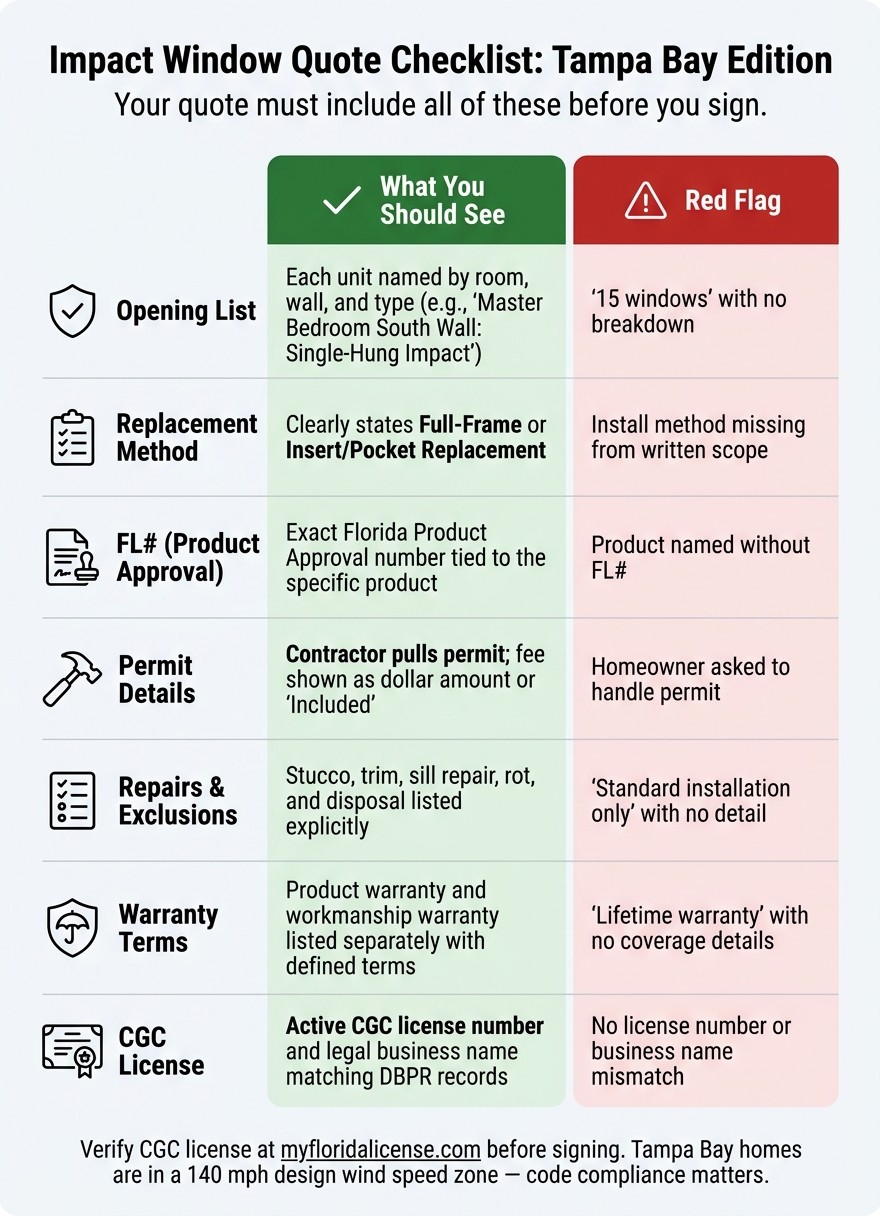
Impact Window Quote Checklist: What to Look For vs. Red Flags in Tampa Bay
Quick Comparison
| Quote Item | What you should see | Red flag |
|---|---|---|
| Opening list | Each unit named by room, wall, and type | “15 windows” with no breakdown |
| Replacement method | Full-frame or insert | Install method missing |
| FL# | Exact Florida Product Approval number | Product named without FL# |
| Permit | Contractor pulls permit; fee shown or marked included | Homeowner asked to handle permit |
| Repairs | Stucco, trim, sill, disposal listed | “Standard installation” only |
| Warranty | Product and labor terms listed apart | “Lifetime warranty” with no details |
| License | Active CGC number and matching legal name | No license number or name mismatch |
Think the lowest number on the page tells you enough? But... it doesn’t. The quote that costs less up front can leave out work, fees, and paperwork you will need later.
sbb-itb-85e0110
The Scope Section Should Match the Exact Openings in Your Home
The scope section should show exactly what the contractor plans to replace. Walk through your home and match each listed opening to the actual window or door. If anything looks off, fix it before you sign.
Older Tampa Bay homes often mix opening types and finish conditions. One house might have fixed picture windows, single-hung units, and a sliding glass door, and each one needs its own product choice and install method.
Windows and Doors Should Be Listed by Type and Location
Each opening should be listed by type and location: single-hung, horizontal roller, fixed, picture, or sliding glass door, tied to a specific room or wall. "Master Bedroom South Wall: (1) Single-Hung Impact" gives you something you can check. A line that says "15 windows" doesn't.
Here's the point: the more specific the line item, the easier it is to catch mistakes before materials get ordered.
The Quote Should State Whether the Job Is Full-Frame or Insert Replacement
A full-frame replacement removes the entire existing frame and trim. That usually leads to more stucco work and more interior finish work.
An insert replacement also goes by pocket or retrofit install. It places a new unit inside the existing frame. The quote should say Full-Frame or Insert Replacement in plain writing. It should not live only in the salesperson's notes.
In other words: if the install method isn't in the written scope, you don't have much to point to later.
Known Site Conditions and Exclusions Should Be Written Into the Quote
A quote that says "installation included" does not automatically include stucco patching, interior trim touch-up, or sill repair. Those items should show up as named line items or named exclusions.
That matters more than most homeowners think. Hidden rot, substrate damage, and no-damage assumptions often turn into change orders if nobody spells them out up front.
Make sure the quote covers points like these:
- Any no-damage assumption
- How the contractor will bill hidden rot or substrate damage
- Whether disposal is included, and whether it appears as a separate line
Use the table below to check the quote against your home, one line at a time:
| Scope Field | What to Confirm |
|---|---|
| Opening Count | Total units match the physical count in your home |
| Opening Type | Specific style listed (e.g., Single-Hung, Horizontal Roller, SGD) |
| Room/Location | Each unit assigned to a room and wall (e.g., "Kitchen North Wall") |
| Replacement Method | Clearly states Full-Frame or Insert/Pocket |
| Included Repairs | Stucco patching, interior trim, sill repair named explicitly |
| Debris Removal | Old frames, glass, and shutters hauled away and disposed of |
| Exclusions | Items not covered listed in writing (e.g., "Rot repair billed separately") |
Once the openings and replacement method are clear, check the Florida Product Approval and permit details next.
Florida Product Approval and Hillsborough County Permitting Should Appear on the Quote
After you confirm the scope, check two things on the quote: the FL# and who handles the permit. Those details shape permit approval, inspections, and insurance paperwork.
The FL# Should Match the Exact Product Listed on the Quote
The Florida Product Approval (FL#) comes from the Florida Department of Business and Professional Regulation (DBPR). It shows that a specific product meets Florida rules for wind, impact, and energy performance. In Hillsborough County, the FL# goes into the permit application, and county inspectors use it to check that the installed units match the approved plans.
Here’s where people get tripped up. The FL# has to match the exact product setup shown on the quote. A manufacturer can carry separate approvals for impact and non-impact versions of the same series, and Design Pressure ratings can shift based on window size. If a quote names a product in general terms but leaves out the FL#, you can’t confirm the exact unit.
The FL# also backs up the wind mitigation form used for insurance credits.
Hillsborough County Permit Fees and Permit Responsibility Should Be Clearly Stated
The contractor should pull the permit and manage filing, inspections, and close-out. If a permit stays open, it can create problems during a home sale and block insurance credits.
Permit fees should show up as a separate line item or appear in writing as Included.
Use the table below to check that the quote covers each approval and permitting detail before you move ahead:
| Verification Field | What to Confirm |
|---|---|
| Product Manufacturer | Exact manufacturer name |
| Series / Model | Exact series/model |
| Glass Package | Details on laminated glass, Low-E coating, and tint |
| FL# Shown | Full Florida Product Approval number for the exact configuration |
| Permit Fee Line Item | Stated as a specific dollar amount or "Included" |
| Permit Pulled By | Must state "Contractor" or "Licensed Installer" |
| Inspection Coordination | Written commitment to schedule pre-install and final inspections |
Next, check installation scope, warranty terms, and the CGC license number.
Installation Scope, Warranty Terms, and License Details Should Be Easy to Read and Verify
A quote can show the right product and FL# and still leave you exposed. The weak spot is often the install scope. Once the order goes through, the work on-site and who owns each part of it comes down to what the quote says before you sign.
Installation Line Items Should Cover Removal, Fastening, Sealing, and Finish Work
Once the product and permit details check out, read the install scope line by line. Each task that affects cost or responsibility should appear in plain language.
The scope should spell out the install work: fastening, sealing, flashing, weatherproofing, and finish work. It should also name the installation method, whether that means full-frame or insert, plus anchor types and spacing, how anchors connect to the wall framing, and perimeter sealing, flashing, and weatherproofing to code.
But... watch for vague wording. If the quote says only "standard installation", treat that as a warning sign. That kind of wording can leave finish work out of the price.
Your quote should also say whether interior and exterior finish repair is included.
Warranty Language Should Separate Product Coverage From Workmanship Coverage
A clear quote separates the manufacturer's product warranty from the installer's workmanship warranty. Those are not the same thing.
Product warranty covers the window parts. Workmanship warranty covers installation mistakes. If a quote promises a "lifetime warranty" but does not define coverage, exclusions, or service calls, the warranty language is incomplete.
Ask about registration too. Some manufacturers require homeowner registration within 30 days of installation for the warranty to stay in force. You should also confirm who handles a claim and whether the manufacturer's coverage includes labor.
In other words: don't stop at the word "lifetime." You need the fine print in plain English.
The CGC License Number Should Match the Company Doing the Work
After the warranty section, check the company behind the quote. The quote should list the contractor's Florida Certified General Contractor (CGC) license number and legal business name, and both should match DBPR records.
You can verify that at myfloridalicense.com before signing. If the license is inactive, or the business name does not match, that's a major red flag. Match the license number and legal name to DBPR records before you sign.
| Quote Field | What to Confirm |
|---|---|
| Fastening/sealing included | Specifies anchor types, spacing, flashing, and perimeter weatherproofing to code |
| Interior finish included | Covers finish repair around the new frame |
| Exterior patching included | Covers exterior finish repair |
| Manufacturer warranty | Lists coverage for glass, frames, and hardware components |
| Workmanship warranty | Defines labor coverage period, exclusions, and service-call process |
| CGC license number | Active Florida license verifiable at myfloridalicense.com |
| Legal business name | Matches the entity registered with the Florida DBPR |
Comparing Quotes Line by Line Shows Where Approvals, Fees, and Warranty Terms Are Missing
Once you’ve checked scope, approvals, permits, warranties, and license details, put each quote next to the others and compare them line by line. Use the same fields for each one. That’s how missing fees, skipped permit details, or thin warranty terms show up fast.
Here’s the point: if one contractor leaves a cell blank, that item isn’t clear yet. And if it isn’t clear on the quote, it can turn into a change order later.
| Field | Contractor A | Contractor B | What to Confirm |
|---|---|---|---|
| Contractor legal name | Must match the licensed legal entity | ||
| CGC license # | Must match the company on record | ||
| Opening count | Must match every window and door in your home | ||
| Opening types | Listed by style and location | ||
| FL# listed | Exact FL# for the installed product | ||
| Permit fee shown | Shown as a separate line item or included | ||
| Permit pulled by | Contractor named as permit puller | ||
| Installation scope | Shows removal, fastening, sealing, flashing, and finish work | ||
| Manufacturer warranty | Written product coverage for glass, frames, and hardware | ||
| Workmanship warranty | Separate workmanship coverage with a defined term and exclusions | ||
| Exclusions | Stated in writing | ||
| Notes | Site conditions, access issues, or deferred items |
Any blank cell is a missing requirement.
FAQs
Why does the FL# matter on my quote?
The Florida Product Approval number (FL#) shows that the windows meet Florida rules for wind and impact resistance. You submit it with the permit to prove the product fits your storm zone.
That number can also help support wind mitigation credits with your insurer. But if you don’t have a valid FL# or Miami-Dade NOA, you could lose insurance discounts or fail required inspections.
What happens if the contractor does not pull the permit?
If a contractor skips the required permit for your impact window installation, the job is illegal in Florida. That can come back to bite you later.
You could face code enforcement fines. You might also run into trouble when you sell your home, lose insurance premium discounts, miss out on reimbursement programs, and deal with title or insurance disputes for years if the permit never gets closed.
How do I verify a contractor’s CGC license?
Visit the Florida Department of Business and Professional Regulation (DBPR) website and use its official license search tool to confirm the contractor has a current, active CGC license before work starts.
A reputable contractor should list their license number on quotes, contracts, and permit applications. But if they won’t share it, or they tell you to skip permits, walk away. That’s a major red flag.
Related Blog Posts
✔ START TODAY
Personal and targeted approach

✔ FAQ
Your Questions. Our Expertise.
How do I get an accurate price for my project?
Are you licensed and insured in Florida?
How long does a typical installation take?
Does your work come with a warranty?
Why do you recommend James Hardie siding for Florida?
What specific services do you provide?
✔ START TODAY
Ready to Get Started?
Trusted and reliable Hardie board siding services backed by expert craftsmanship and high performance materials. We help homeowners achieve a durable, low maintenance exterior that looks great and stands strong for years to come.
Book an Appointment
We have received your estimate request and will be reaching out to you shortly.
.webp)