
When Window Resealing Fails: What Tampa Bay Homes Actually Need
When resealing won't stop leaks, fog, or soft frames in Tampa Bay, choose repair, IGU glass replacement, or full code-compliant replacement.
Lorem ipsum dolor sit amet, consectetur adipiscing elit. Suspendisse varius enim in eros elementum tristique. Duis cursus, mi quis viverra ornare, eros dolor interdum nulla, ut commodo diam libero vitae erat. Aenean faucibus nibh et justo cursus id rutrum lorem imperdiet. Nunc ut sem vitae risus tristique posuere.
If your window has fog between panes, repeat leaks, or a soft frame, resealing will not fix it.
In Tampa Bay, windows take a beating from heat, salt air, and storm pressure. In South Tampa’s 140 mph wind zone, the right fix usually falls into three paths: a small repair for minor edge issues, IGU glass replacement for fogged panes, or full window replacement for rot, warping, repeat leaks, or cracked impact glass.
Here’s the short answer:
- Use resealing or small repair for worn weatherstripping, minor drafts, or hardware issues on a solid frame
- Use glass-only replacement when you see fogging between panes and the frame still looks straight and dry
- Use full replacement when leaks keep coming back, the frame feels soft, the sash warps, or the window no longer meets current Florida code
- Check the Florida Product Approval number before installation
- Expect many replacement projects to take about 6 to 11 weeks from quote to final inspection
- In some cases, repair costs near 60% to 70% of replacement cost make a new window the better call
- Impact-rated upgrades may help some homeowners qualify for 10% to 45% insurance discounts when all openings meet the rule and raise home value
Think caulk solves most window problems? But... it only seals the surface. If water gets behind the frame or the insulated glass seal has failed, the problem stays put.
In other words: match the failure to the fix. That keeps you from spending $150 to $500 on repeat service visits when the window needs more than sealant.
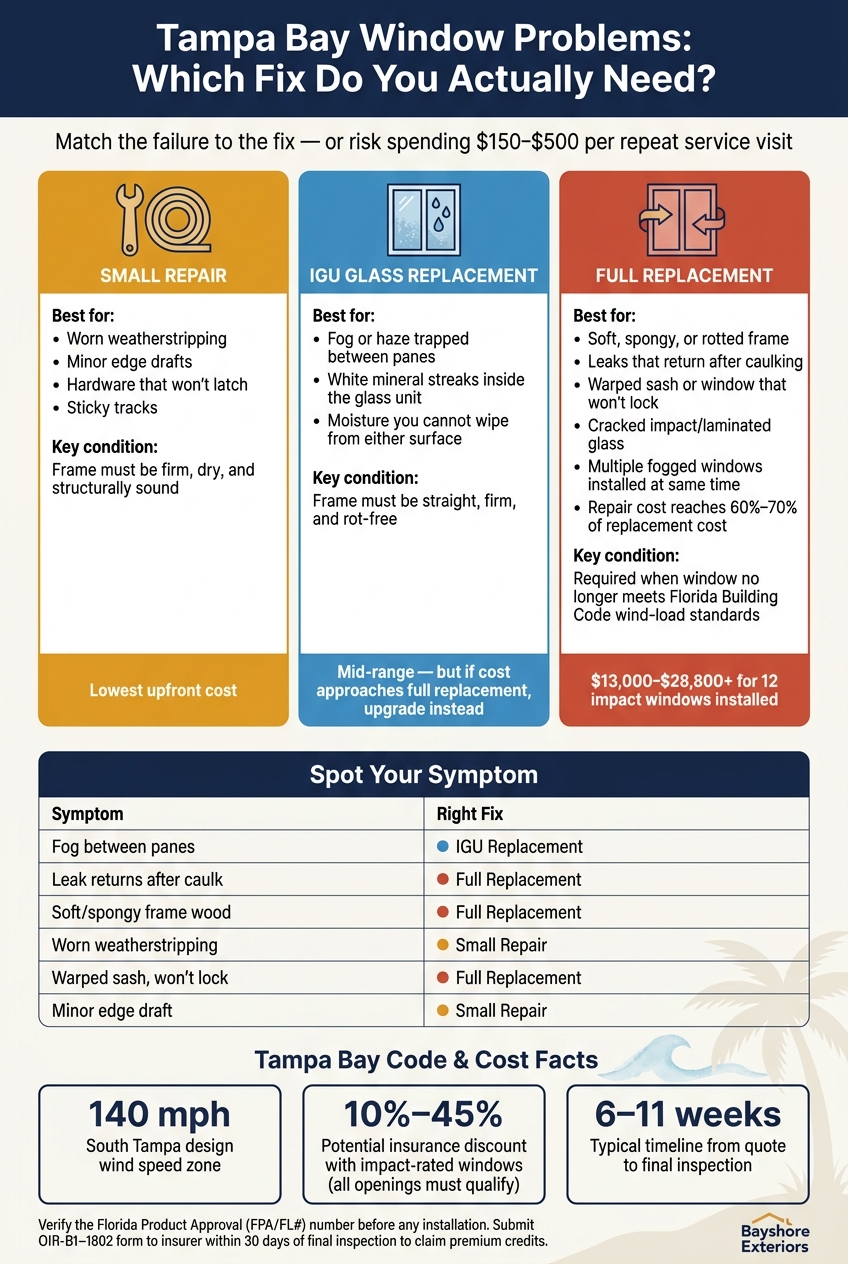
Tampa Bay Window Problems: Repair vs. Glass Replacement vs. Full Replacement
Window Repair | Window Replacement | Which Is Best For You?
sbb-itb-85e0110
Quick Comparison
| Problem | What it usually means | What you should do |
|---|---|---|
| Minor draft at edge | Worn weatherstripping or small gap | Small repair or resealing |
| Fog between panes | Failed IGU seal | Glass-only replacement |
| Leak that comes back after caulk | Flashing, frame, or install issue | Full replacement in many cases |
| Soft wood or frame rot | Moisture damage in the frame | Full replacement |
| Warped sash or window won’t lock | Frame movement from heat or moisture | Full replacement |
| Cracked impact glass | Broken storm-rated unit | Full replacement |
Or put another way: if the glass failed, replace the glass. If the frame failed, replace the window. If the issue sits at the edge and the frame is still sound, a small repair may be enough.
The rest of the article breaks down how to spot each problem and choose a code-compliant fix for your Tampa Bay home. This includes navigating Tampa HOA window rules and local permit requirements.
Failure signs that mean resealing is no longer the right fix
Caulk and weatherstripping only seal the edges of a window when the frame, wall, and glass unit are still in good shape. Once the frame, flashing, or glass unit fails, resealing doesn't solve the problem. It just covers it up for a while.
Recurring leaks usually point to frame, flashing, or installation failure
If stains or bubbling paint come back after new caulk, the water isn't getting in at the surface. It's getting in behind the frame. That usually means failed flashing or gaps left during installation.
But a new bead of caulk can make the problem LOOK fixed. It isn't. The leak comes back because the source never changed.
Fogging between panes means the insulated glass seal has failed
Haze, droplets, or white mineral streaks trapped between the panes are not on the glass surface. They're inside the glass unit. That's a different problem altogether.
A sealed glass unit has two panes with an insulating space between them. When that inner seal breaks, the insulating gas escapes and humid Tampa Bay air moves in. The result is permanent fogging that outside caulk can't touch. At that point, the window also loses insulating power.
If you can't wipe the moisture off the inside or outside surface of the glass, the failure is inside the unit. In other words: this is a glass replacement issue, not a resealing one.
Rot, warping, and drafts mean the window is losing structural performance
Start at the bottom of the frame. Press on the wood. If it feels soft or spongy, rot has already taken hold. That happens after years of moisture getting in, and no sealant can reverse it.
Soft frames also struggle to hold fasteners or stand up to wind pressure. That matters in South Tampa's 140 mph design wind speed zone. Warped sashes that stick, won't lock, show daylight when closed, or let air through all point to a frame that's moved past what surface repairs can fix.
| Symptom | Likely Cause | Why Resealing Fails |
|---|---|---|
| Fog/haze between panes | IGU seal failure | Damage is internal |
| Water stains that return after caulking | Flashing or installation failure | Masks the leak for a short time |
| Soft or spongy wood at the frame base | Rot from moisture intrusion | Structural damage remains |
| Warped sash, won't lock | Frame warping from heat/humidity | Frame has moved |
| Drafts with visible daylight | Frame gap or structural shift | Weatherstripping won't stop the draft |
These signs usually point to one of three paths: targeted repair, glass-only replacement, or full replacement.
What each problem actually needs: repair, glass replacement, or full window replacement
Each failure sign points to one fix: repair, glass-only replacement, or full replacement. Once you know what failed, the next step is simple: pick the smallest fix that will hold up.
Targeted repairs make sense when the frame is solid and the problem is isolated
Use a targeted repair only when the frame feels firm, stays dry, and the issue is limited to one part of the window. A minor perimeter gap, worn weatherstripping, or a lock or latch that no longer closes right can often be fixed without replacing the whole unit. That can bring the window back into shape for far less than full replacement.
This works best for one-off problems on a window with no history of leaks, fogging, or frame damage. But repeated failures change the math. At that point, the window has likely reached the end of what a repair can solve.
Glass-only replacement fits fogged units when the frame is still in good condition
Fog trapped between the panes means the IGU seal has failed. In other words: the glass unit needs replacement, not just a surface cleaning. If the frame is straight, firm, and free of rot or corrosion, replacing only the glass unit can bring back clear views and insulation.
But there's a cost line you shouldn't ignore. If glass-only replacement gets close to the price of a new installed unit, full replacement makes more sense.
Check the rest of the house too. If one IGU has failed, look at other windows installed at the same time. Multiple fogged units usually mean piecemeal glass replacement won't stop the problem for long.
If the damage spreads past the glass and into the frame, the right fix changes fast.
Full replacement is the better call when damage is widespread, recurring, or storm-related
Rotted, spongy, warped, or corroded frames point to full replacement. So do recurring leaks and cracked laminated impact glass. A damaged impact-rated window often needs full replacement to stay code-compliant. And when repair costs reach about 60%–70% of replacement cost, replacement is usually the better long-term move.
In Tampa Bay, repeated leaks or frame damage often mean the window has taken all the weather it can handle. For South Tampa homeowners in the 140 mph design wind speed zone, moving to properly rated impact windows may also help with wind-mitigation insurance discounts of 10%–45%.
| Situation | Right Move |
|---|---|
| Single fogged window, solid frame | Glass-only replacement |
| Drafty edge, worn weatherstripping | Targeted repair |
| Soft or rotted frame | Full replacement |
| Recurring leak | Full replacement |
| Cracked impact glass | Full replacement |
| Multiple fogged windows | Full replacement |
In Tampa Bay, the better long-term fix also depends on storm exposure and code performance. This includes ensuring other exterior components, like hurricane-rated siding, meet local wind requirements.
How Florida code and Tampa Bay storm exposure change the decision
Once resealing stops working, the next question is pretty straightforward: can the window still meet code?
In Tampa Bay, that answer often comes down to storm exposure and Florida rules. Florida code requires permitted replacement windows to meet current wind-load standards. So this choice is not just about price or what feels easier.
Damaged impact glass also changes the math. If the laminated glass is cracked, chipped, or punctured, the unit must be replaced. Shutters can protect the opening during a storm, but they do not repair a window that has already started to fail.
Impact-rated windows fix problems that resealing and shutters do not
Impact-rated windows solve issues that patchwork fixes cannot. They can correct failed seals, drafts, fogging, and frame damage, while also adding built-in debris protection.
That matters even more in South Tampa homes within 3 miles of Tampa Bay, including Davis Islands and Bayshore Boulevard. Salt air speeds up corrosion and seal failure. Because of that, coastal-rated replacements use hardware and finishes made for this setting, including Kynar 500 or UV-stabilized vinyl finishes and stainless steel hardware.
Before you sign any contract, check the Florida Product Approval (FPA/FL#) number for the exact window being proposed. Inspectors, insurers, and lenders use that record to confirm the product meets Florida requirements.
After the final inspection, make sure the completed OIR-B1-1802 form goes to your insurance carrier within 30 days if you want any premium credits that may apply.
In other words: shutters help during a storm, but they do not solve fogged glass, bad seals, rotted frames, or code issues. The right move depends on what has failed. Sometimes you need a short-term patch. Sometimes you need a new glass unit. And sometimes you need a full code-compliant replacement.
Comparison table: impact windows vs. shutters vs. continued repairs
| Option | Impact-Rated Windows | Hurricane Shutters + Older Windows | Continued Repairs |
|---|---|---|---|
| Addresses leaks and drafts | Yes - new seals and frames | No - relies on existing window condition | Partially, and often temporarily |
| Addresses fogging between panes | Yes - new insulated glass units | No | No |
| Corrects frame rot and structural failure | Yes | No | No |
| Hurricane debris protection | Built-in, 24/7 | Only when manually deployed | None |
| Wind-mitigation credit potential | High - if all openings are protected | High - if all openings are protected | Not eligible |
| Florida code compliance role | Can meet current wind-load and impact requirements | Meets opening protection requirement only | Does not upgrade a failing window to current code |
| Long-term fit for coastal Tampa Bay | Excellent - salt-air-rated specs available | Moderate - requires ongoing maintenance | Poor - rapid degradation near water |
| Approximate investment (12 windows) | $13,000–$28,800+ installed | $4,000–$12,000 | $150–$500 per repair visit |
The table shows the key difference. Shutters are an opening-protection strategy, not a repair strategy.
Or put another way: if the window itself is failing, shutters do not change that. They only cover the problem when a storm is coming.
Next steps for South Tampa homeowners: pick a code-compliant long-term fix
When resealing stops working, go with the smallest fix that will last. In most cases, you're looking at one of three paths. Use resealing for minor perimeter wear — worn weatherstripping, edge drafts, sticky tracks, or failed hardware on an otherwise sound frame. Use IGU replacement when fogging appears between panes. Choose full replacement when rot, warping, repeat leaks, or outdated units put the window out of line with current Florida Building Code wind-load and impact rules.
Once you match the problem to the fix, your home's exposure should guide the frame material. For South Tampa homes near the bay, anodized aluminum or UV-stabilized vinyl frames tend to hold up best, paired with stainless steel or marine-bronze hardware.
Code is the last check before work starts. Verify the Florida Product Approval number for the proposed window before installation begins. Most replacements run 6 to 11 weeks from quote to final inspection. Bayshore Exteriors handles impact window evaluations across South Tampa, Davis Islands, Hyde Park, Palma Ceia, Ballast Point, and Hillsborough County, with approvals and permit packages confirmed before the install date.
FAQs
Can a fogged window be repaired without replacing the whole window?
Usually, no. Fogging between panes means the insulated glass seal has failed for good, and moisture is now trapped inside.
You can replace the glass unit in some cases. But for Tampa Bay homes, that usually isn’t the best move. Once the seal fails, you often see other problems too: frame warping, rot, or hardware corrosion from salt air and humidity.
In other words: the foggy glass is often just the part you can see.
That’s why full-frame replacement with impact-rated windows tends to be the better long-term fix for Tampa Bay homeowners.
How do I know if a leak is from bad caulk or a failed window?
First, figure out where the air or moisture is getting in. A draft around a closed window or loose weatherstripping usually points to a fixable maintenance issue.
But some signs point to the window itself. Water stains, pooling on the sill, soft or warped frames, recurring leaks, or fog between panes usually mean the window has failed and likely needs replacement, not just caulk.
Do I need impact-rated replacement windows in South Tampa?
Yes. If you live in South Tampa, impact-rated replacement windows are often necessary and strongly recommended.
South Tampa sits in a 140 mph design wind-speed zone. That means your windows need to stand up to hurricane-force winds and wind-borne debris, not just heavy rain or a rough afternoon storm.
These windows can also help in a few practical ways:
- You may qualify for insurance discounts.
- You won't need storm prep like shutters.
- Local code may require them when you replace older windows.
Before you move forward, ask for the Florida Product Approval number or Miami-Dade NOA number. That’s the quickest way to confirm the window meets code.
Related Blog Posts
✔ START TODAY
Personal and targeted approach

✔ FAQ
Your Questions. Our Expertise.
How do I get an accurate price for my project?
Are you licensed and insured in Florida?
How long does a typical installation take?
Does your work come with a warranty?
Why do you recommend James Hardie siding for Florida?
What specific services do you provide?
✔ START TODAY
Ready to Get Started?
Trusted and reliable Hardie board siding services backed by expert craftsmanship and high performance materials. We help homeowners achieve a durable, low maintenance exterior that looks great and stands strong for years to come.
Book an Appointment
We have received your estimate request and will be reaching out to you shortly.
.webp)