
What to Expect During Impact Window Installation in Tampa Bay
Step-by-step timeline for permits, prep, installation, and final inspection of impact windows in Tampa Bay.
Lorem ipsum dolor sit amet, consectetur adipiscing elit. Suspendisse varius enim in eros elementum tristique. Duis cursus, mi quis viverra ornare, eros dolor interdum nulla, ut commodo diam libero vitae erat. Aenean faucibus nibh et justo cursus id rutrum lorem imperdiet. Nunc ut sem vitae risus tristique posuere.
If you replace impact windows in Tampa Bay, you need a permit, a licensed contractor, and a final inspection before the job is done.
Think window replacement is just a one-day glass swap? But it’s not. In Hillsborough County, the job starts with permits, product checks, and a Notice of Commencement, then moves to measurements, ordering, installation, and county sign-off. Most homes with 10 to 12 windows take 1 to 2 days to install, while permit approval and custom orders often add 6 to 12 weeks before the crew arrives.
Here’s the short version:
- Every window replacement needs a permit under Florida code.
- A licensed contractor must handle the job and pull the permit.
- Most Hillsborough homes face design wind speeds of 140 to 150 mph, so window ratings and approvals matter.
- Each impact window needs a Florida Product Approval number and the right DP rating for your address.
- You need to prep the house by clearing 3 to 4 feet around windows, removing wall items, and keeping pets away.
- Installation usually runs room by room, with each opening taking about 45 to 90 minutes.
- Crews should not leave openings unsecured overnight.
- The final county inspection closes the permit, and that record can matter for insurance and resale.
Or put another way: your part is to prepare the space and give access. Your contractor handles the permit path, code rules, installation, and fixes if the job fails inspection.
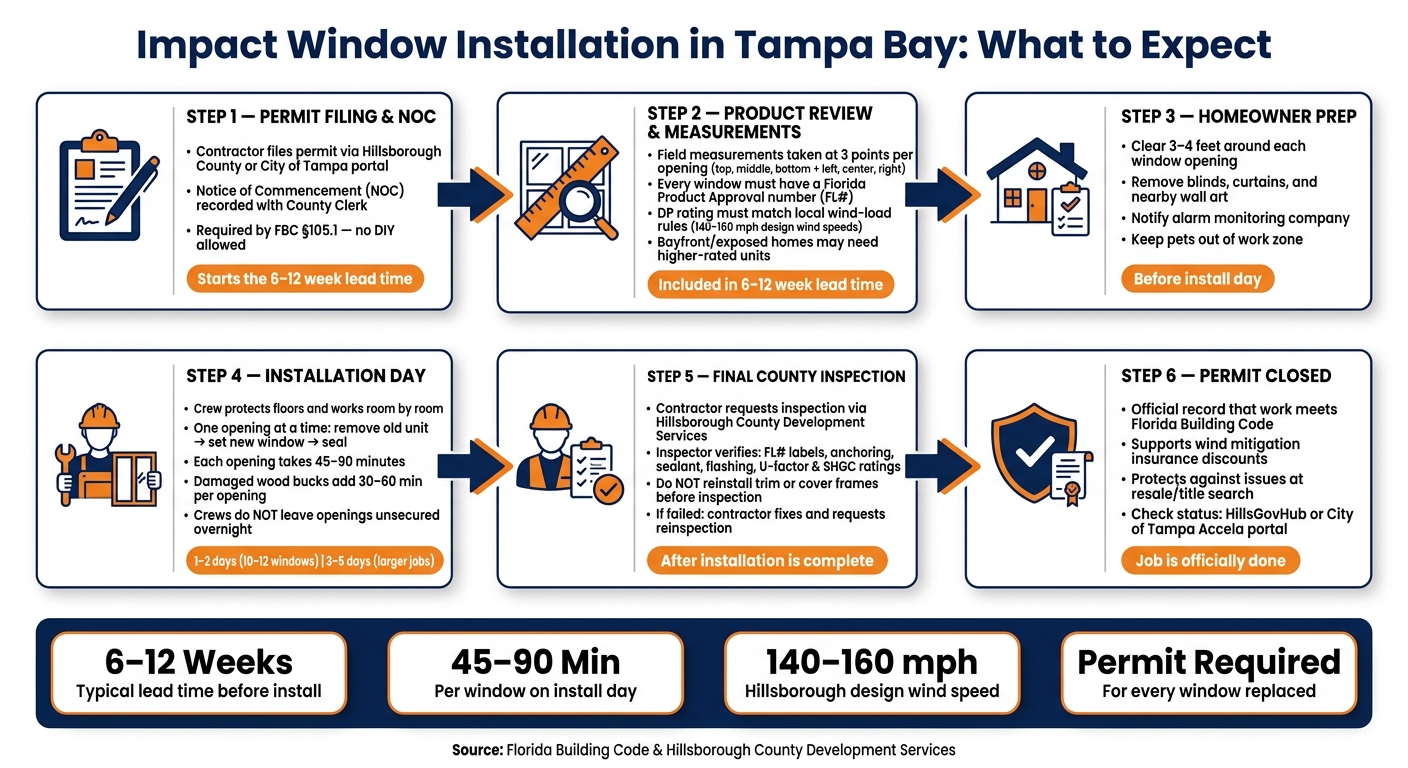
Impact Window Installation Process in Tampa Bay: Step-by-Step Timeline
Quick Comparison
| Stage | What happens | What you should expect |
|---|---|---|
| Before work starts | Permit filing, NOC recording, measurements, product order | A 6 to 12 week lead time is common |
| Product review | Contractor matches FL# and DP rating to your home | Bayfront or exposed areas may need higher-rated units |
| Install day | Crew protects floors, removes old units, installs one opening at a time | Noise, dust, and short periods with openings exposed |
| Timing | 45 to 90 minutes per window in many cases | 1 to 2 days for many standard homes |
| If damage shows up | Crew may repair wood bucks or framing issues | Extra time, often 30 to 60 minutes per opening |
| Final step | County inspector checks labels, anchoring, sealant, and permit match | Permit stays open until the job passes |
The rest of the article breaks down each step so you know what happens before, during, and after installation.
sbb-itb-85e0110
Florida law makes impact window installation a licensed, permitted project - not a DIY option
In Florida, window replacement is regulated work. FBC §105.1 requires a permit for every window replacement, and a licensed contractor must pull it — that rule applies whether you replace one window or twenty. There is no small-job loophole, and professional installation is a legal requirement, not a matter of preference. Bayshore Exteriors handles impact window permitting across Tampa Bay as a standard part of every project, not an add-on.
The permit puts the job under review before installation starts and after it ends. Before crews arrive, the building department checks the Florida Product Approval numbers and installation details to confirm the windows meet local wind-load rules.
After the work is done, a county inspector comes to the home. The inspector checks that the installed windows match the approved documents and that the crew anchored and weather-sealed them the right way.
How the permit process protects homeowners if something goes wrong
The permit does more than create paperwork. It creates a record and a path to fix problems before the job closes.
If the installation fails inspection, the contractor must fix it before the permit can close. In other words: the licensed contractor stays on the hook for the corrections. You don’t.
A closed permit also gives you an official record. Insurers and title companies often ask for that record when wind mitigation discounts or a future home sale are at stake.
Once the permit is approved, the project moves into field measurements, scheduling, and the Notice of Commencement before install day.
What happens before installation day in Hillsborough County
Before install day, the contractor moves through a set order: permit filing, recorded paperwork, field measurements, and then product ordering.
Permit filing and the Notice of Commencement come before any work begins
In Hillsborough County, the contractor files the permit through the right city or county portal.
Before any work starts, the contractor must record a Notice of Commencement (NOC) with the Hillsborough County Clerk and post it on-site. The Notice of Commencement lists the owner, contractor, and scope of work, and it protects lien rights.
This part takes time. Permitting and custom manufacturing often add a six- to twelve-week lead time.
Once the permit gets approved, the job moves out of paperwork mode and into planning.
Field measurements and Florida Product Approval numbers determine what gets ordered
After the permit process starts, your contractor schedules field measurements. Pros measure each opening at three points across the top, middle, and bottom, then again at the left, center, and right. A 1/4-inch difference can change how a window fits.
Those numbers drive the order. Every impact window for a Hillsborough County home must have a Florida Product Approval number (FL#), and the window’s Design Pressure (DP) rating must match the wind-load rules for your address.
Homes near Tampa Bay or open water often need higher-rated units. In other words: location shapes the order, not just window size.
What homeowners need to arrange before the start date
Your part is mostly prep. Clear a 3- to 4-foot path around each opening, remove blinds, curtains, and other window treatments, and take down artwork on nearby walls so vibration doesn’t knock anything loose or cause damage.
You’ll also want to notify your alarm monitoring company that windows will be open for part of the replacement process. Keep pets out of the work zone too.
After that, the crew shows up and the house moves into active installation.
What to expect on installation day
Once the permit gets approved and your windows are on order, things tend to move fast. The crew usually shows up early, protects your home first, then replaces the windows one room at a time. For a standard home with 10 to 12 windows, the job often takes one to two days. Bigger jobs, second-story openings, or custom-sized units can stretch to three to five days.
Expect room-by-room work, noise, and brief periods when openings are exposed
Crews handle one opening at a time. They remove the old unit, set the new impact window, then seal that opening before moving on. Most swaps take 45 to 90 minutes per opening.
That means each opening stays exposed to the outside for a short stretch. Controlled, yes. But it does happen.
You should also plan for noise. Drilling, cutting, and anchoring can go on through much of the day. In many Tampa Bay homes, crews drill into block walls, and that can create a lot of concrete dust.
Sometimes the crew finds damaged wood bucks, which are the wood frames around the opening. If that happens, repairs can add 30 to 60 minutes per opening. One point matters here: crews do not leave an opening unsecured overnight.
Crews need clear access and use floor protection and debris control throughout
Installers will move through your living spaces with tools, old frames, and new window units. So clear access helps. Crews put down floor protection and remove debris each day.
At the end of the day, they clean the new glass and walk you through how each lock works. That last part is easy to overlook, but it matters when you're checking each window after install.
Leave the Florida Product Approval or NOA stickers on the glass. The Hillsborough County inspector needs to see them before the permit can close.
After the crew wraps up, the county inspection is the last step before the permit closes.
The Hillsborough County final inspection closes the permit and confirms code compliance
When the crew finishes the install and clears the job site, the permit still stays open. Your contractor has to request the final inspection through Hillsborough County Development Services, and the county does not close the permit until that inspection passes.
That final inspection is the last step.
What the county checks after the windows are installed
The inspector checks the finished job against the approved permit. The product numbers on the installed units must match the permit documents, and the labels need to stay visible so the inspector can verify them.
The county also checks the installation details, including anchoring, sealant, and flashing. Inspectors may also confirm energy-code ratings like U-factor and Solar Heat Gain Coefficient (SHGC).
Don’t reinstall interior trim or cover the frame before inspection. If the inspector can’t see the parts that need review, the county may require another visit.
If the work fails, the contractor has to fix the issue and request reinspection before the county will close the permit. In other words: no pass, no closed permit.
Why a closed permit matters for insurance, protection records, and resale
Once the county closes the permit, you have the official record that the work meets code. It shows your home was updated to current Florida Building Code standards by a licensed contractor.
That closed permit also helps with insurance records and future wind-mitigation reviews.
But resale is where many homeowners feel the impact. Open permits or unpermitted window work can show up during title searches and home inspections, and that can delay closing or give buyers room to ask for fixes or concessions.
You can check permit status through HillsGovHub for unincorporated Hillsborough County or the City of Tampa’s Accela portal.
There’s also a practical point here. If the installation fails inspection and the contractor does not make the corrections, the open permit shows that the work still needs to meet code.
This final inspection serves as the county’s code check, the last confirmation that the installation meets the wind-load standards Hillsborough County requires, with design wind speeds that usually range from 140 to 160 mph.
FAQs
How long does the whole process usually take?
From the day you sign the contract to the day your home passes final inspection, the process usually takes 6 to 12 weeks.
Most of that timeline comes down to manufacturing. Your impact windows are custom-made, and that step often takes 4 to 10 weeks.
While the windows are being made, your contractor takes care of permitting and scheduling. Once the windows arrive, installation for a standard home usually takes 1 to 3 days. The final inspection usually happens soon after.
What could delay my window installation?
Several factors can slow down impact window installation in Tampa Bay: permit processing under FBC §105.1, custom manufacturing lead times, weather, and peak-season scheduling.
Local review can take longer in historic districts like Hyde Park or Seminole Heights. Those areas often need added approval before work starts.
Weather also plays a part. Tampa Bay’s rainy season runs from May through October, and storms during those months can shift install dates or stretch the timeline.
What happens if the windows fail inspection?
If your window installation fails inspection, your licensed contractor has to fix the problem and book a reinspection. The usual issues are missing product approval paperwork, bad anchoring, or weather sealing that doesn’t meet code.
But that doesn’t fall on you to sort out. In Florida, the installation has to meet Florida Building Code rules, so the contractor handles the corrections until the inspector signs off and the permit can close.
Related Blog Posts
✔ START TODAY
Personal and targeted approach

✔ FAQ
Your Questions. Our Expertise.
How do I get an accurate price for my project?
Are you licensed and insured in Florida?
How long does a typical installation take?
Does your work come with a warranty?
Why do you recommend James Hardie siding for Florida?
What specific services do you provide?
✔ START TODAY
Ready to Get Started?
Trusted and reliable Hardie board siding services backed by expert craftsmanship and high performance materials. We help homeowners achieve a durable, low maintenance exterior that looks great and stands strong for years to come.
Book an Appointment
We have received your estimate request and will be reaching out to you shortly.
.webp)