
Roof Insurance Claims in Tampa Bay After Florida's 2023 Reform
One-year claim deadline, AOB bans, high hurricane deductibles, and fast documentation determine whether a Tampa Bay roof claim pays.
Lorem ipsum dolor sit amet, consectetur adipiscing elit. Suspendisse varius enim in eros elementum tristique. Duis cursus, mi quis viverra ornare, eros dolor interdum nulla, ut commodo diam libero vitae erat. Aenean faucibus nibh et justo cursus id rutrum lorem imperdiet. Nunc ut sem vitae risus tristique posuere.
If your Tampa Bay roof took storm damage, waiting can cost you the claim.
Florida's 2023 insurance reform cut the main notice deadline to one year from the date of loss, and most supplemental claims now face an 18-month limit. AOB assignments to contractors are no longer available on newer policies, and each side typically pays its own legal fees in a dispute. Document fast, check your deductible, and stay in charge of the file.
Before you file, focus on these points:
- Deadline: Report the loss within 1 year
- Supplemental claim window: Usually 18 months from the loss date
- Control: You handle the claim, not the roofer
- Proof: Photos, storm date, repair records, and mitigation records matter
- Deductible math: A 2% hurricane deductible on a $400,000 home is $8,000
- Damage type: Insurers often deny for wear, age, old repairs, or salt-air wear
- Code issues: Florida's 25% roof rule can turn a repair into a larger job
- Red flags: Deductible waivers and claim promises from contractors
Storm damage doesn't guarantee a payout. You need documented proof of the storm event, repair costs that clear your deductible, and a licensed roofing inspection before filing makes financial sense. Bayshore Exteriors provides that inspection documentation with a written scope, which gives you what you need to evaluate the claim before committing to it.
7 best Tips on How to File your Roof claim with Your Insurance Company [Expert Public Adjuster]
sbb-itb-85e0110
Quick Comparison
| Issue | What changed | What it means for you |
|---|---|---|
| Claim deadline | 1 year from date of loss | Report damage soon after you find it |
| Supplemental claim | 18 months from date of loss | Missed damage has a shorter follow-up window |
| Attorney fees | No one-way fees | Small disputes may be harder to fight |
| AOB | Banned on many newer policies | You keep control of the claim |
| Deductibles | Often 2%, 5%, or 10% of Coverage A | Small roof losses may not pay |
| Damage review | Insurers check old photos and roof history | You need proof the storm caused the damage |
| Code rules | 25% threshold can affect scope | Repair vs. replacement may change |
The rest of the article breaks down when a roof claim is worth filing, what records to gather first, and what a licensed Tampa Bay roof inspection should show.
How Florida's 2023 Reform Changed Roof Claims: Shorter Deadlines and Less Contractor Control
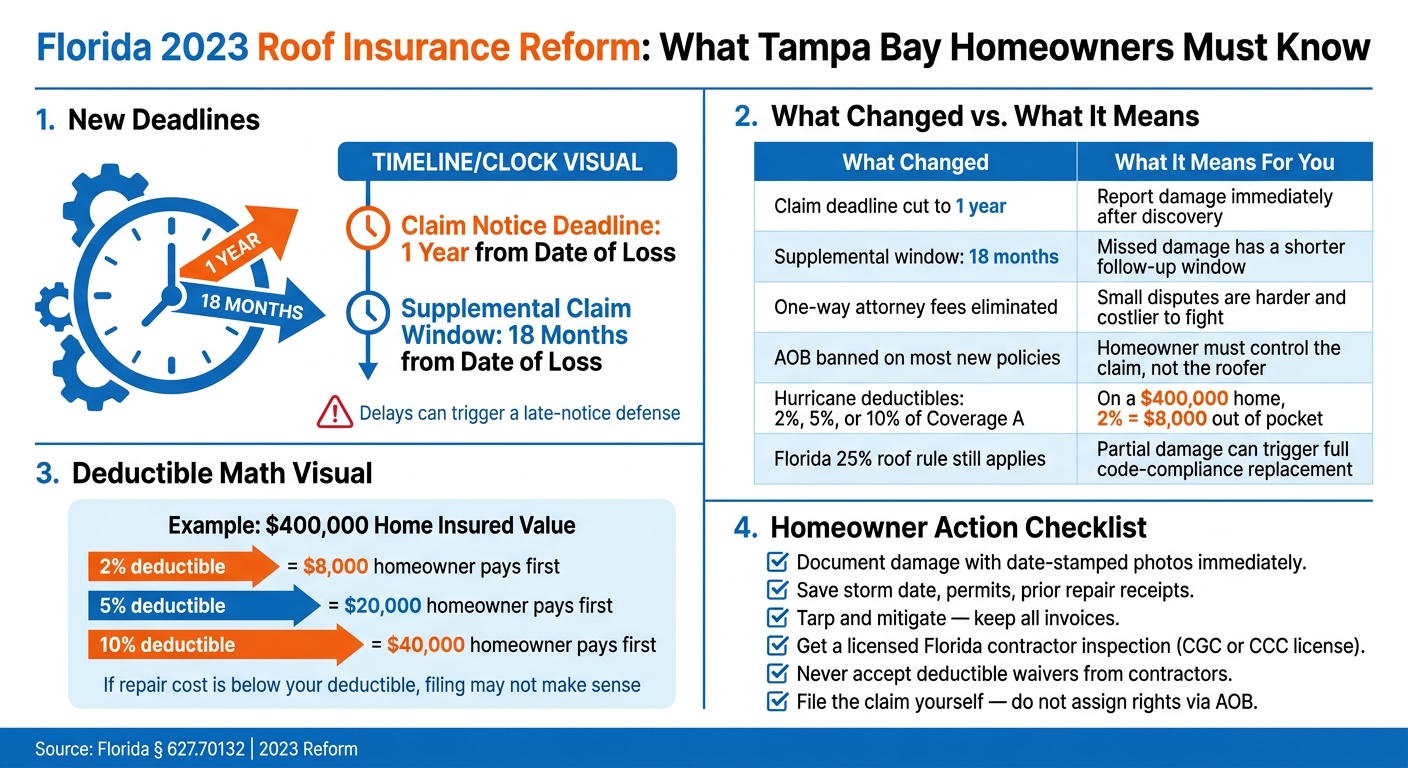
Florida 2023 Roof Insurance Reform: Key Changes for Tampa Bay Homeowners
For Tampa Bay homeowners, the change is pretty direct: you have less time to report damage, less room to fight if a dispute starts, and more work on your side from day one. So your first move matters.
Document the damage fast. Then keep control of the claim file yourself.
The One-Year Notice Deadline and 18-Month Supplemental Window: Why Delays Cost You
Start with the clock. Under Florida's amended § 627.70132, you generally must notify your insurer within one year of the date of loss.
For hurricane damage, that one-year period starts when the storm made landfall or damaged your property. If you spot damage later that the first inspection missed, you generally must file a supplemental claim within 18 months of the original date of loss.
Think waiting gives you more time to sort things out? It often does the opposite. A delay can hand the carrier a late-notice defense, even when the roof damage is major.
In other words: once you find the problem, act. Take photos, save notes, and notify your insurer soon after you see the damage. Not months down the line.
No More One-Way Attorney Fees: What That Means for Disputed or Underdocumented Claims
Florida no longer uses one-way attorney fees in property insurance disputes. Each side now usually pays its own legal costs under settlement rules.
But that shifts the math. Smaller disputes may no longer make financial sense to litigate.
That puts more pressure on your paperwork from the start. If your claim is thin, incomplete, or poorly tracked, it's harder to push back when the cost of going to court falls on both sides.
The AOB Ban: Why the Homeowner Must Stay in Charge of the Claim
The other big shift is control. The homeowner, not the roofer, has to run the claim.
AOB is prohibited on covered residential policies. Or put another way: you can't transfer your claim rights to a contractor.
A licensed roofing contractor can still help in a few direct ways:
- Inspect the roof
- Document damage
- Prepare a repair estimate
- Attend the adjuster's inspection and point out visible failure points
But the homeowner still handles the claim itself. You stay responsible for dealing with the insurer, working through any back-and-forth, and deciding how claim funds get released.
Here's the part not to brush off: do not accept deductible waivers or claim-handling promises.
Whether a Tampa Bay Roof Claim Pays Off Depends on Damage Evidence, Deductibles, and Florida Code
You control the claim now. But whether it pays comes down to proof and cost.
Because the homeowner carries the claim, you need to show the loss happened and explain why the filing makes sense. The key issues are storm proof, your deductible, and how Florida code affects the repair scope. So the next step isn't just asking whether the roof got hit. It's asking whether the claim survives deductible math and code review.
Storm Damage vs. Wear, Age, and Salt-Air Deterioration: How Insurers Tell Them Apart
Insurers look at the roof's history, not only what it looks like today. Carriers often use aerial imagery services to check older photos of your property and see whether the damage existed before the storm you claim. In Tampa Bay, salt air and heavy sun exposure can blur the line between storm damage and age-related wear.
Common denial themes include wear and tear, prior repairs, and maintenance-related leaks. Adjusters may call shingle pitting sun wear or say lifted shingles came from age-related seal failure. But outside signs can help you tie the damage to a storm: dented gutters, bent AC fins, and torn screens all support that argument.
Metal roofs bring a separate problem. Insurers often point to cosmetic damage exclusions when they see dents or scratches on the surface. To push back, you need to show the damage is functional, meaning it affects performance, warranty coverage, or structural integrity, not just appearance.
Covered claims often hinge on outside proof. Once you sort out the cause, the next gate is cost. A valid loss still may not pay if the deductible is too high.
Wind and Hurricane Deductibles Can Make Small Roof Losses Poor Claim Candidates
Florida homeowners often carry percentage-based hurricane or wind deductibles, usually 2%, 5%, or 10% of the home's total dwelling coverage, also called Coverage A. On a home insured for $400,000, a 2% hurricane deductible means you pay the first $8,000 before the insurer pays anything.
If the repair estimate does not beat your deductible, filing usually makes little sense. Some policies also include a roof-specific deductible, so you need to read the declarations page closely. That's the page to check first. If the repair cost stays below the deductible, the claim may not pay.
If the math still works, code compliance becomes the last major issue before you file.
Florida's 25% Repair Rule and How It Can Affect Whether an Insurer Approves Repair or Replacement
Florida's 25% rule can trigger code compliance when storm damage crosses a set threshold. Roofs built under the 2007 code or later usually need only the repaired section brought up to code. Older roofs can face much broader replacement costs.
In Hillsborough County, contractors must permit roof work and complete it to current Florida Building Code standards. That can expand the scope of a claim if the current roof falls far out of code.
Code can change the math fast. A repair claim can turn into a larger-scope claim, which may make a borderline loss worth filing. Or put another way: a small claim can get expensive in a hurry. If matching materials are not available, the insurer may need to extend repairs into adjoining areas.
What to Document Before You Call Your Insurer or a Contractor
You control the claim now. So before you call anyone, build your own file first.
Write down the storm date. Then save your photos, receipts, and notes in one place. Before an insurer or contractor looks at the roof, create your own record of the loss.
Date-Stamped Photos of Exterior and Interior Damage Help Establish Cause and Timing
Do not climb onto the roof. Start with ground-level photos or drone images for your first round of documentation.
Take wide shots of each roof slope first so you have context. Then move in for close-ups of damage like missing shingles, cracked tiles, or other visible impact points.
Don’t stop at the roof edge. Walk the full perimeter and photograph gutters, downspouts, AC fins, window screens, and debris nearby. Those details can help show how hard the storm hit.
Inside the house, photograph attic moisture, ceiling stains, and any active leaks. If you can see daylight through the roof deck, photograph that too.
Before you take photos, check your phone settings. Make sure GPS and date-time metadata are turned on. That matters if the insurer compares your images with past aerial photos.
Then match those photos with records that show the roof’s age and condition before the storm.
Prior Permits, Inspection Reports, and Repair Receipts Help Separate Old Damage From New
Gather the original roofing permit. It helps show the roof’s age and which version of the Florida Building Code applied when crews installed it.
Pull maintenance invoices, past repair receipts, and inspection reports too. Those records help separate storm damage from older wear and tear.
Timing matters here. Records made close to the loss date can help if there’s a fight over whether the damage was already there.
Tarping, Dry-Out, and Emergency Mitigation Records Show You Protected the Property
Florida law says policyholders must take reasonable steps to stop more damage after a loss. If you tarp the roof, remove standing water, or hire a dry-out crew, save every invoice and note each step you took.
Keep before-and-after photos of any temporary repair. Also write down the date and time you first found the leak.
These records help show the insurer that you met your duty to mitigate. They also support repayment for out-of-pocket costs.
Any contractor who handles temporary repair or dry-out work should have a valid "CCC" or "RC" license. Keep those invoices with the photos, tarp records, and dry-out records.
Use that file as your starting point for a licensed roof inspection.
The Next Step: Get a Licensed Roof Inspection Before You Commit to a Claim or a Contract
You’ve got your photos, permits, and receipts in one place. Good. Now get a licensed roof inspection before you file a claim or sign a contract.
That inspection helps answer three big questions: Is the damage storm-related? Did code get triggered? Is the loss even worth claiming? Your documentation file gives the inspector context, but the licensed inspection gives you the proof.
What a Florida-Licensed Contractor Can Document Without Taking Over Your Insurance File
A Florida-licensed contractor should back up your claim with evidence, not vague opinions. A proper inspection should include photo documentation of storm damage, your roof material type, a scope that separates storm damage from age-related wear, and a review of permit needs and code triggers.
Here’s the part many homeowners miss. You need proof that a specific storm caused the damage, not just proof that the roof looks old.
In other words: the report should connect visible damage to a clear date of loss. “This roof looks worn” won’t do the job. Ask the contractor how they document hidden damage too. Some use drones, moisture meters, or thermal imaging to spot issues you can’t see from the ground.
What to Compare Before Signing for Roof Repair or Replacement
Think all roof damage belongs in a claim? Not always. Use the inspection to separate claim-worthy storm damage from normal wear.
Before you sign anything, check these points:
| Comparison Point | Why It Matters for a Claim | What to Verify With the Contractor |
|---|---|---|
| License Status | Unlicensed work can trigger denial or code violations. | Verify an active Florida CGC or CCC license number. |
| Permit Handling | Most roof work needs a permit. | Confirm the contractor pulls all required local permits. |
| Material Scope | The estimate must match the existing material. | Ensure the estimate matches your existing material type. |
| Code Compliance | The 25% rule and your roof's build date can affect repair vs. replacement scope. | Ask how they document the damage percentage and applicable code version. |
| Documentation Quality | Strong evidence helps support the claim. | Ask for a digital evidence package with metadata-stamped photos and findings. |
| Warranty Terms | Insurance does not cover workmanship defects. | Verify both manufacturer material warranties and contractor labor warranties. |
If a contractor offers to cover your deductible, stop. That’s a red flag. Never let a contractor pay, waive, or rebate your deductible.
Conclusion: The Strongest Tampa Bay Roof Claims Are Filed on Time, Well-Documented, and Code-Aware
Before you commit to filing or signing, check four things: whether the damage looks storm-related and ties to a specific date of loss, whether repair or replacement costs clear your deductible, whether the 25% rule could push the job from a repair into a larger replacement, and whether your documentation is strong enough to meet the proof standard.
If the scope still feels unclear, don't file and don't sign until it isn't. Bayshore Exteriors (CGC1536143) is a licensed Florida general contractor serving Tampa and Hillsborough County, and a roofing inspection before you file gives you the documented scope to evaluate the claim on its merits.
FAQs
What if I find roof damage months after the storm?
In Florida, the one-year deadline for an initial property insurance claim starts on the date of loss. It does not start when you notice the damage.
That matters more than many homeowners think. If a storm hits and you spot roof damage months later, you still need to file within one year of that storm date. Miss that deadline, and the insurer can deny the claim automatically.
If you find more damage after you file, the timeline changes. Supplemental claims must be submitted within 18 months.
Will filing a roof claim raise my insurance premium?
Florida law usually bars insurers from hiking your premium or canceling your policy just because you filed one claim tied to an act of God, like a hurricane.
That matters in Florida, where storms are part of the deal and homeowners often worry that one claim will come back to bite them. In other words: if you file one valid hurricane claim, your insurer generally can’t single you out for a rate jump or policy cancellation for that reason alone.
Local premiums have shifted, but the picture isn’t one-way. Some recent Florida reforms have pushed certain carriers to ask for rate cuts instead of increases.
Filing a valid storm-damage claim is a normal step, not a red flag. It helps you fix damage early and protect your home’s long-term value.
Should I pay for an inspection before filing a claim?
Yes. Before you file, get an independent damage assessment from a licensed roofing contractor.
That inspection gives you clear documentation and a starting point for the damage. If the insurer’s first assessment comes in too narrow or puts the claim value too low, you’ll have a solid report to point to.
You should also stay the main contact with your insurance company. AOB agreements now face tighter limits, so it makes sense for you to keep control of the claim process.
Related Blog Posts
✔ START TODAY
Personal and targeted approach

✔ FAQ
Your Questions. Our Expertise.
How do I get an accurate price for my project?
Are you licensed and insured in Florida?
How long does a typical installation take?
Does your work come with a warranty?
Why do you recommend James Hardie siding for Florida?
What specific services do you provide?
✔ START TODAY
Ready to Get Started?
Trusted and reliable Hardie board siding services backed by expert craftsmanship and high performance materials. We help homeowners achieve a durable, low maintenance exterior that looks great and stands strong for years to come.
Book an Appointment
We have received your estimate request and will be reaching out to you shortly.
.webp)