
Getting a Siding Estimate in Tampa Bay: What to Expect
A Tampa Bay siding estimate should detail material, wind-code requirements, hidden repair allowances, and permit costs.
Lorem ipsum dolor sit amet, consectetur adipiscing elit. Suspendisse varius enim in eros elementum tristique. Duis cursus, mi quis viverra ornare, eros dolor interdum nulla, ut commodo diam libero vitae erat. Aenean faucibus nibh et justo cursus id rutrum lorem imperdiet. Nunc ut sem vitae risus tristique posuere.
Your siding estimate should show scope, code items, repair risk, and permit costs, not just one price.
If you live in Tampa Bay, you should expect a written estimate to cover four things up front: material choice, wind-code details, hidden repair allowances, and permit fees. Most homes land around $9,000 to $16,000 for vinyl and $15,000 to $30,000 for James Hardie fiber cement, but that number can change once a contractor checks for rot, flashing problems, trim work, and access issues.
Before you compare bids, make sure each estimate answers these points:
- What part of the house the job covers: full re-side or select walls
- What material the contractor priced: vinyl or James Hardie fiber cement
- What hidden damage plan the estimate includes: allowance or change-order pricing
- What code items the bid lists: Florida Product Approval, fastener type, spacing, WRB, and flashing
- What permit costs appear in writing, especially for jobs over 500 sq. ft.
- What labor details affect price: tear-off, disposal, soffits, fascia, trim, scaffolding, and cleanup
- What weather exposure the contractor accounted for: salt air, humidity, UV, and wind-driven rain
- What exclusions could add cost later: painting, rot beyond allowance, or structural repairs
Think the lowest number tells you enough? But it doesn't. A cheaper bid often leaves out repairs, permits, or moisture protection that another contractor already included.
Quick Comparison
| Item | Vinyl Siding vs. James Hardie | James Hardie Fiber Cement |
|---|---|---|
| Installed cost | $3 to $6 per sq. ft. | $6 to $12 per sq. ft. |
| Typical total for 1,500 to 2,000 sq. ft. home | $9,000 to $16,000 | $15,000 to $30,000 |
| Wind fit for Tampa Bay | Often 110 to 130 mph ratings | Tested to 157+ mph |
| Moisture and salt-air fit | Lower upfront cost, but more weather risk | Built for coastal heat, humidity, and salt air |
| Estimate details to check | Product, wind rating, fasteners, permit, repairs | HZ10 line, product profile, fasteners, permit, repairs |
The rest of the article breaks down what a contractor should inspect, what line items should appear in writing, and how to compare two estimates line by line before you sign.
sbb-itb-85e0110
What a Contractor Should Inspect Before Writing a Siding Estimate
The site visit sets the scope and the price. A good contractor should measure every wall, photograph trouble spots, and ask if you want the whole house re-sided or only certain elevations.
That matters more than many homeowners expect. On some Tampa Bay block homes, only gables, soffits, or additions need siding, so a partial job can cost much less than a full re-side. The inspection shapes the wall condition, repair needs, and final scope.
Existing Wall Condition, Moisture Exposure, and Sheathing Repairs
The biggest part of any Tampa Bay inspection happens before the old siding comes off. A contractor should look for soft spots near seams, peeling paint, swollen edges, and wavy panels. Those signs often point to hidden sheathing damage.
Algae that keeps coming back after washing can point to trapped moisture, not just dirt on the surface. That’s a red flag. A contractor should check suspect areas with a moisture meter and spell out any rot allowance or change-order pricing in the estimate. If those signs show up, the estimate should include a rot allowance.
Inside the house, clues matter too. Stained drywall below windows or a musty smell in closets along exterior walls often points to failed flashing. You may not see that problem from outside until the siding comes off.
Next, the contractor should note the trim and penetration details that change labor and material needs.
Trim, Soffits, Fascia, and Exterior Penetrations That Affect Scope
Before a contractor can give you an accurate number, they should list corner boards, window and door trim, soffits, fascia, vents, light blocks, hose bibs, and electrical meters. These often show up as separate line items. Skip them during the inspection, and surprise costs tend to show up later.
On many Tampa-area concrete block homes, soffit and fascia are the first places to rot, even when the main walls still look decent. That catches people off guard.
Every penetration should be documented: meters, vents, hose bibs, and light blocks. Each one needs flashing and sealant in the scope. That labor needs to be in the quote. If those penetrations are missing, the quote is incomplete.
Measurements, Access, and Whether the Estimate Covers the Full House or Select Elevations
Wall square footage is just the starting point. A contractor also needs to check the number of stories, gable ends, dormers, and whether the crew will need scaffolding or staging. Each of those items affects labor.
Waterfront homes need extra attention. Homes near Tampa Bay should be checked for salt-air corrosion on current fasteners and for faster wear on exposed walls from UV and wind-driven rain.
Those measurements and access notes should turn into line items in the written estimate.
How Tampa Bay Climate and Florida Code Affect Siding Recommendations and Pricing
Inspection findings shape the scope. Tampa Bay code shapes the system. So your estimate needs to turn local conditions into clear choices on materials, fastening, flashing, and permit costs.
Under Florida Building Code 8th Edition, Hillsborough County sits in a Wind-Borne Debris Region. That means siding and fastening must meet 140- to 150-mph design loads. That one rule affects both the product you can use and how the crew must install it.
A solid estimate should list the Florida Product Approval number for the exact siding assembly being installed. Here's why that matters: the approval only applies when the contractor uses the exact fastener type and spacing listed in that approved assembly. In other words: if the written estimate leaves that out, you can't check whether the install matches the approved system.
Those code-driven items should appear as separate charges, not buried inside labor. Tampa Bay's humidity, salt air, and wind-driven rain put pressure on the whole wall system, not just the siding surface.
Look for these as their own line items:
- WRB
- Flashing
- Corrosion-resistant fasteners
- Wind-rated fastening labor
- Permit fees
If permit costs are missing, or tucked into labor with no breakdown, the estimate is incomplete.
What belongs in a complete siding estimate and how vinyl compares to James Hardie fiber cement
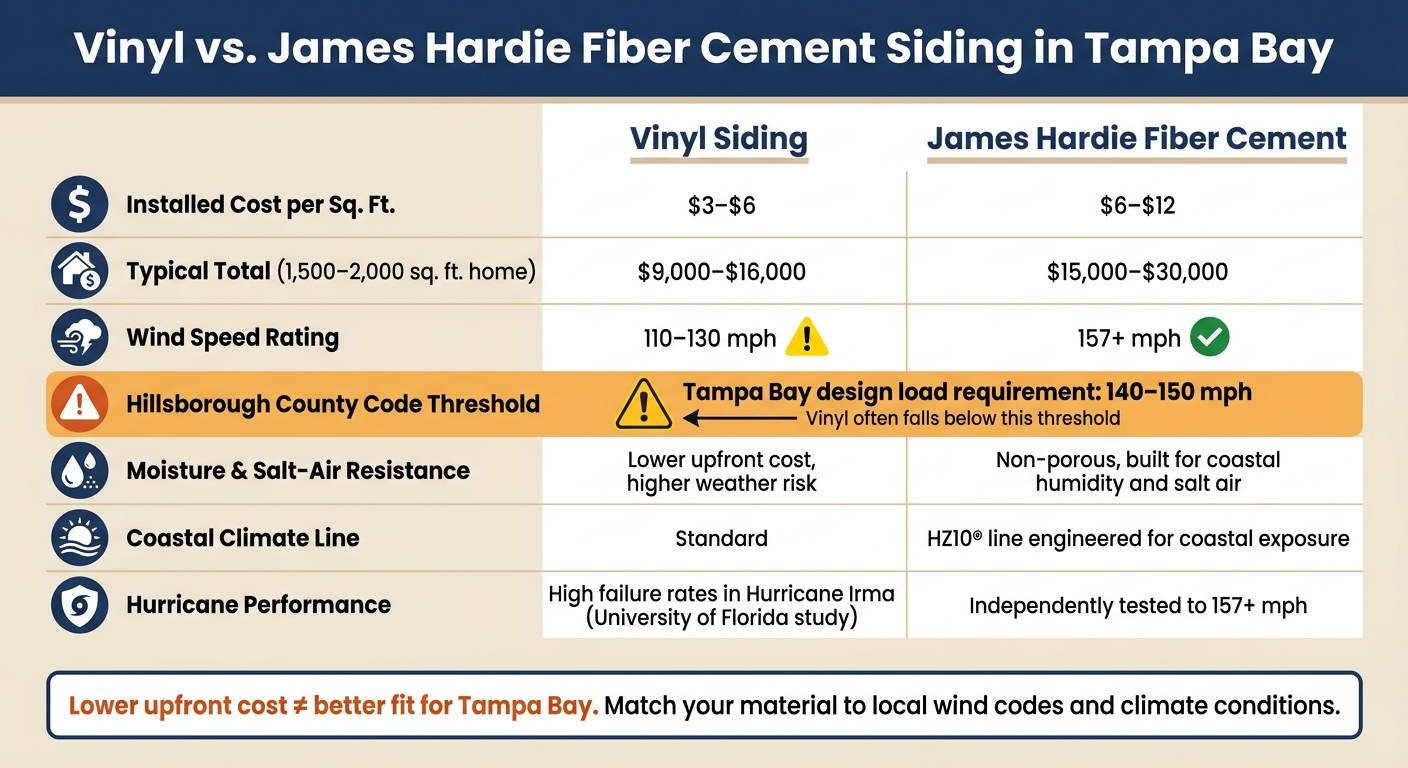
Vinyl vs. James Hardie Fiber Cement Siding in Tampa Bay: Cost, Wind Rating & Performance
After the inspection and code review, the written estimate should turn those findings into exact line items. You want every job cost spelled out, not buried under one big number.
Line items that show whether an estimate is complete or missing scope
A complete estimate should break out the full scope in writing. That means separate line items for tear-off and disposal of existing siding, continuous WRB and flashing at every opening, sheathing repair with a stated allowance for damaged boards, the siding material by product name and profile, finish type, trim and soffit replacement, permit costs, and final site cleanup.
But here's where many homeowners get tripped up. If a contractor folds those costs into one labor total, you can't compare bids side by side with any confidence.
Read the exclusions with care. Painting, structural repairs, and rot beyond the stated allowance usually cost extra.
Vinyl siding vs. James Hardie fiber cement in Tampa Bay humidity, salt air, and storm conditions
Price matters. But Tampa Bay weather puts materials under stress fast.
Vinyl costs less upfront, at $3 to $6 per square foot installed. Fiber cement runs $6 to $12 per square foot installed. On price alone, vinyl looks like the easy pick.
However, local weather changes that math. Vinyl is generally rated to 110 to 130 mph, which falls below Hillsborough County's 140 mph design threshold, and a University of Florida study found vinyl failed at high rates during Hurricane Irma.
James Hardie fiber cement tells a different story. It is independently tested to 157+ mph, is non-porous against moisture and mold, and the HZ10® product line is specifically engineered for coastal humidity and salt-air exposure.
In other words: lower upfront cost does not always mean the better fit for Tampa Bay.
What a complete James Hardie proposal should include
A James Hardie proposal should follow the same level of detail. It should spell out the product profile, the HZ10 climate zone specification, the finish type, the full trim package, the WRB and flashing scope, permit details, cleanup terms, and what happens if rot shows up beyond the stated sheathing allowance.
It should also list the fastener type and spacing required by the approved assembly. That point matters because product approval depends on the exact fastening method, spacing, and assembly, and deviating from those specifications can invalidate the approval in real use.
A good proposal leaves no gray area. You should know the scope, the materials, and how the contractor will handle hidden damage before the job starts.
How to compare siding estimates and decide on next steps
Once you know what belongs in a complete estimate, you can compare bids the right way. Two estimates for the same house can be $2,000, $5,000, or more apart because the scope is different. If the scope doesn't match, the bids don't either.
What to ask when two estimates have very different prices
If one bid comes in far below the others, start with one question: what's excluded? Low bids often leave out items that a complete estimate already includes. The key is whether those missing items show up in writing.
Ask if the estimate includes a full tear-off or if the contractor plans to install over old siding. That matters. Installing over old siding can hide rot and may violate code.
Put every exclusion and every allowance in writing.
Which estimate details matter more than the lowest price
Check the contractor's license with the Florida DBPR before you do anything else. Then ask for proof of at least $1 million in general liability insurance. You should also see clear warranty language for both materials and labor.
After licensing, focus on the estimate details that matter most in Tampa Bay. Look for the Florida Product Approval numbers for the siding, house wrap, and fasteners. Then check the exact fastener type and spacing, since those details help keep the system's wind rating in place.
If you're comparing James Hardie proposals, ask whether the bid names the HZ10 product line for coastal humidity and salt-air exposure. That's not a small detail. The bid should match the product and fastening rules your home needs.
Then compare the scope line by line, not just the total at the bottom. Think the cheaper bid wins? Here's what often happens: the lower number leaves something out. Compare the same tear-off, the same moisture protection, the same permits, the same material, and the same repair allowance. Once those match, the price difference makes a lot more sense. If they don't, the lower bid is often the incomplete one.
FAQs
How long does a siding estimate take?
For Tampa homeowners, the siding estimate process usually wraps up within the first week of the project timeline. That window covers contacting licensed contractors, getting at least three written quotes, and locking in the project scope and design details.
For accurate pricing, contractors should do a full site inspection. They need to check wall area, moisture levels, and flashing conditions. Start this phase 6 to 8 weeks before your target installation date.
Will my estimate change after old siding comes off?
Yes. Once crews pull off the old siding, they sometimes find damage that didn’t show up during the first inspection. That can include problems with the sheathing, framing, or weather barrier.
Removal and disposal costs usually stay fairly predictable. But hidden rot, termite damage, or worn-out wood can push the price up. Contractors need to fix those issues first so your fiber cement siding goes onto a solid, code-compliant surface.
Do I need permits for a siding project in Tampa Bay?
Usually, yes. In Tampa Bay, most siding replacement projects need a building permit.
Small repairs may be exempt, but that depends on your city or county. Full siding replacement almost always needs a permit. The same goes for material changes, like switching from vinyl to James Hardie fiber cement.
If you live in an HOA community, you’ll need architectural approval first. That step comes before the permit process.
Your contractor should handle the permits and inspections. That helps make sure the job meets Florida wind pressure code requirements.
Related Blog Posts
✔ START TODAY
Personal and targeted approach

✔ FAQ
Your Questions. Our Expertise.
How do I get an accurate price for my project?
Are you licensed and insured in Florida?
How long does a typical installation take?
Does your work come with a warranty?
Why do you recommend James Hardie siding for Florida?
What specific services do you provide?
✔ START TODAY
Ready to Get Started?
Trusted and reliable Hardie board siding services backed by expert craftsmanship and high performance materials. We help homeowners achieve a durable, low maintenance exterior that looks great and stands strong for years to come.
Book an Appointment
We have received your estimate request and will be reaching out to you shortly.
.webp)