
How Florida's Insurance Crisis Is Reshaping Tampa Bay Roofing
Roof age, material and missing permits are now the key factors driving insurance renewals, premiums, and home-sale hurdles in Tampa Bay.
Lorem ipsum dolor sit amet, consectetur adipiscing elit. Suspendisse varius enim in eros elementum tristique. Duis cursus, mi quis viverra ornare, eros dolor interdum nulla, ut commodo diam libero vitae erat. Aenean faucibus nibh et justo cursus id rutrum lorem imperdiet. Nunc ut sem vitae risus tristique posuere.
If your Tampa Bay roof is 15 years old or older, it can affect your insurance renewal, premium, and home sale.
Florida carriers now check roof age, roof type, visible wear, permit records, and wind-mitigation paperwork more closely than before. In Hillsborough County, average homeowners insurance ran about $3,500 a year in January 2026, while many Florida homeowners paid about $6,000 statewide in 2025. For many homes, the question is no longer just whether the roof leaks. It is whether the insurer will still accept it.
Age affects each material differently:
- Under 15 years old: Florida law gives you more protection against non-renewal
- 15 years or older: an insurer may require an inspection showing at least 5 years of remaining life
- Shingle roofs face the most pressure, often starting around 15 years, though upgrading to impact-resistant shingles can sometimes improve insurability
- Metal and tile roofs often get a longer runway, but carriers still check condition and permit records
- A permitted roof replacement with final inspection records and an OIR-B1-1802 wind mitigation form can lower premiums
- Missing paperwork can hurt renewal terms, delay a sale, or push homeowners toward Citizens
Roof age is one signal carriers use, not the whole file. Insurers also run aerial imaging, pull leak history, flag code upgrade requirements, and check permit records to judge whether a roof still meets their underwriting rules. The roof on your home now functions as an insurance document, and a roofing inspection with a current permit record and closed final inspection is the clearest way to keep that file in good standing.
Florida Says Your Roof Is Fine. Your Insurance Company Disagrees. Here's What Happens Next.
sbb-itb-85e0110
Quick Comparison
| Roof Type | Common Insurance Pressure | Main Carrier Concerns | Typical Cost in Tampa Bay | General Underwriting Outlook |
|---|---|---|---|---|
| Asphalt shingles | Starts earliest, often around 15 years | Granule loss, curling, wind uplift, repairs | $5 to $12/sq. ft. | Tightest renewal timeline |
| Metal | Lower age pressure | Corrosion, fasteners, product approvals | $12 to $20/sq. ft. | Often the easiest to insure long term |
| Tile | Mid-range pressure | Underlayment age, cracked tiles, repair records | $10 to $22/sq. ft. | Can hold up well if records are clean |
The rest of the article breaks down when roof replacement moves from a home project to an insurance issue, and what records can help you keep coverage in Tampa Bay.
Florida's Insurance Rules Changed the Roof Age Timeline for Tampa Bay Homes
Florida law and insurer behavior don’t line up as neatly as many homeowners expect. That gap can leave Tampa Bay homeowners exposed. Roof age now sits near the top of the underwriting checklist, and that changes when a roof replacement shifts from optional to necessary.
The first trigger is age. But age alone doesn’t tell the whole story.
The 15-Year Rule Matters, but It Does Not Guarantee Easy Renewal
Under Florida Statute 627.7011, insurers cannot refuse to issue or renew a policy solely because a roof is under 15 years old. Once a roof hits 15 years, an insurer can require replacement as a condition of continued coverage unless the homeowner provides an inspection from a licensed roofer, engineer, or home inspector showing at least 5 years of remaining useful life.
That sounds clear enough. However, carriers still look at condition, not just the birth date of the roof. In other words: 15 years is a common underwriting trigger, not a hard legal end point.
Even when a carrier renews an older roof, the policy terms may shift. Some insurers move older roofs to actual cash value, or ACV, which cuts the payout to account for wear and age. A 15-year-old shingle roof in Florida may be valued at only 40% to 50% of its replacement cost under an ACV policy.
After age, insurers turn to wear. Fast.
Why 15- to 20-Year-Old Shingle Roofs Get More Scrutiny in Coastal ZIP Codes
Tampa Bay’s sun, humidity, and salt air wear shingles down faster, so roofs that may last 30 years in other places often last only 12 to 22 years here.
That local climate matters in underwriting. Carriers now use aerial imagery to spot roof wear from a distance, flagging homes in coastal ZIP codes for visible deterioration before anyone sets foot on the property. But a satellite image doesn’t need to show a leak to trigger concern. Staining, granule loss, and uneven wear can be enough to invite a closer look.
In South Tampa and other waterfront areas, a 15- to 20-year-old shingle roof will usually face more scrutiny than a similar metal or tile roof. Those materials often get a longer underwriting window.
Or put another way: two homes may sit on the same block, but the one with older shingles usually gets harder questions first.
What Nonrenewal Pressure Looks Like for South Tampa and Waterfront Homeowners
This pressure often shows up in the renewal notice before anything else. When an older shingle roof triggers concern, carriers may send a conditional renewal notice and require an inspection within 120 days. If that inspection shows the roof no longer meets the carrier’s underwriting standard, your options can narrow in a hurry.
Many homeowners then turn to Citizens Property Insurance, Florida’s insurer of last resort. Citizens generally accepts shingle roofs up to 25 years old and metal or tile roofs up to 50 years old, as long as an inspection confirms at least 5 years of remaining useful life. That can sound like a fallback. But there’s a catch.
Citizens is moving policies back to private carriers, and those private carriers often set stricter roof age limits than Citizens does. So roof replacement timing and material choice now affect your coverage path, not just your repair budget.
For South Tampa homeowners, waiting carries more renewal risk than it did a few years ago. Carriers that once waited until around 20 years to flag a shingle roof are now acting closer to 15, and the mix of an older roof, a coastal location, and a tight private market leaves little room to stall.
What Insurers Now Review: Roof Condition, Permit History, and Florida Code Compliance
Once roof age draws attention, insurers look at three things fast: condition, permit records, and code compliance.
Visible Wear, Prior Repairs, and Leak History Now Carry More Underwriting Weight
Adjusters and inspection reports now zero in on four details: age, material condition, installation quality, and hidden damage like attic stains or rafter rot. That means missing shingles, curling edges, granule loss, brittle shingles, and patchwork repairs can all hurt your file.
Inside the house matters too. Water stains on ceilings or signs of past leaks can damage renewal odds just as much as the roof’s age. Insurers don’t view normal wear the same way they view deferred maintenance, because deferred maintenance points to a higher claim risk.
Think the issue is just age? Not anymore. Carriers want to know whether the roof will still be insurable next year, not just whether it has been sitting there for 15 or 20 years.
Once age puts the roof under a microscope, the next issue is proof of compliance.
Why a Permitted Roof Replacement Is Easier to Defend Than an Undocumented One
Insurers want documents, not guesses. In Hillsborough County, a permitted roof replacement gives them that paper trail.
Underwriters usually want the building permit, final inspection sign-off, completion certificate, and product data sheets. Those records show when the roof was replaced, what materials went on the house, and whether the job met code.
Without that file, the insurer may fall back on a stricter estimate of the roof’s age or condition. That can affect renewal terms and even real estate closings. No records, no benefit of the doubt.
Carriers also ask more often for installation photos. They may want images of the roof deck before shingles went down, the fastener pattern, and the secondary water resistance layer.
That documentation often decides whether you get mitigation credits.
Florida Code Upgrades That Can Support Mitigation Credits
Florida code upgrades can lower wind-loss costs. Insurers use the OIR-B1-1802 wind mitigation form to confirm whether a roof qualifies for credits, and those credits can make up 45% to 70% of the wind-loss part of a premium.
| Wind Mitigation Feature | Underwriting Value |
|---|---|
| Roof Deck Attachment | 8d ring-shank nails at 6-inch spacing qualify for high credit |
| Secondary Water Resistance (SWR) | Peel-and-stick membrane supports 25%–35% discount on windstorm portion |
| Roof-to-Wall Connection | Double wraps or clips carry high credit weight |
| Roof Covering | FBC-compliant materials installed after 2002 qualify for baseline credit |
A sealed roof deck usually adds about $1,000 to $3,000 during a re-roof, but it can cut premiums by $1,000 or more per year. That’s not a small line item. It can change the math of the whole project.
Insurers also want Florida Product Approval (FPA) numbers or Miami-Dade Notice of Acceptance (NOA) numbers for roofing parts like shingles, underlayment, and vents. In other words: code-compliant upgrades are part of staying insurable. They’re not just nice extras.
File the OIR-B1-1802 form within 30 days of any roof replacement if you want the credits to hit right away. About 40% of Florida homeowners miss wind-mitigation credits because they never submit the form after roof work.
Those credits also shift based on roof material, which is why shingles, metal, and tile don’t get treated the same in Florida underwriting.
Asphalt Shingles vs. Metal vs. Tile: How Each Roof Type Holds Up Under Florida Insurance Standards
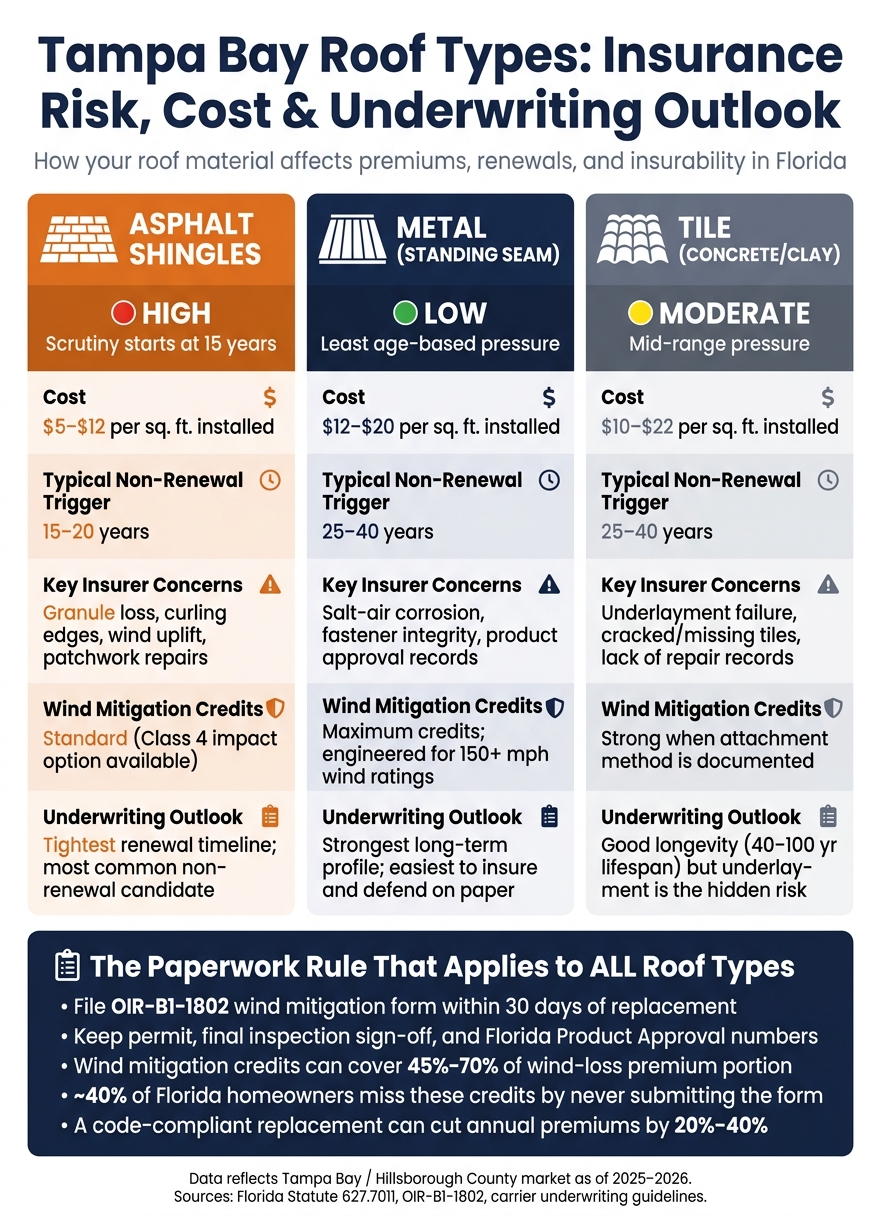
Tampa Bay Roof Types: Insurance Risk, Cost & Underwriting Outlook
In Tampa Bay, your roof material now affects renewal risk and premium cost. Insurers use it as a quick read on wind exposure, roof age, and how well the system is documented.
| Feature | Asphalt Shingles | Metal (Standing Seam) | Tile (Concrete/Clay) |
|---|---|---|---|
| Typical renewal pressure | High | Low | Moderate |
| Common Underwriting Concerns | Granule loss, curling, wind uplift | Fastener integrity, salt-air corrosion | Underlayment failure, cracked tiles |
| Underwriting defensibility | Standard credits; Class 4 impact option | Easiest to defend; maximum wind credits | Strong when attachment is documented |
| Upfront Cost Range (Tampa Bay) | $5–$12/sq. ft. installed | $12–$20/sq. ft. installed | $10–$22/sq. ft. installed |
| Underwriting outlook | Frequent inspection and renewal pressure | Strongest long-term underwriting profile; fewer replacement cycles | Good, but underlayment is the main risk point |
Why Asphalt Shingles Often Face the Tightest Renewal and New-Policy Timeline
Asphalt shingles are the most common pick for Tampa Bay homeowners because they cost less up front. Installed pricing usually lands between $5 and $12 per square foot.
But lower cost up front often means less time before insurance scrutiny picks up. Many private carriers flag shingle roofs at 15 years, then ask for a condition certification or full replacement to renew. Some carriers non-renew at 20 years even if the roof still looks fine from the ground.
Inspectors and adjusters usually look for a few clear signs:
- Granule loss
- Curling edges
- Weakened flashing
- Reduced resistance to wind uplift
Poor attic ventilation can make things worse. Heat builds from below, dries the shingles out, and speeds up wear. When that happens, insurers may label the issue as wear and tear instead of storm damage.
If your shingle roof is getting close to a renewal review, book an inspection early. You want records that show remaining useful life before the carrier asks for them.
That timing matters. Many Tampa Bay homeowners replace shingles before the insurer forces the call.
How Metal Roofing Can Improve Wind Performance and Long-Term Insurability
Standing seam metal usually gets the best reception from insurers. These systems can be engineered for 150+ mph wind ratings, often avoid age-based non-renewal pressure for 25 to 40 years, and often receive better underwriting treatment and mitigation credits than asphalt.
The main drawback is price. In Tampa Bay, installed cost usually runs $12 to $20 per square foot.
For waterfront homes, the details matter more than the label. Underwriters often care most about the coating, the clip system, and the Florida Product Approval number. If those records are missing, metal loses part of its edge.
Salt air also changes the picture. In coastal areas, insurers pay close attention to corrosion and fastening details because those are common long-term trouble spots. At inspection time, proof of corrosion-resistant materials can make a big difference.
In other words: metal helps not only because it holds up well in wind, but because it is often easier to defend on paper over time.
When Tile Roofing Works Well for Insurance - and What Can Undercut It
Concrete and clay tile roofs can last 40 to 100 years, and insurers often accept them for 25 to 40 years. That gives tile a longer window than shingles, at least on the surface.
However, the tiles are only part of the story. The underlayment often becomes the weak point. As tile roofs age, insurers look harder at whether the underlayment is failing. If the roof has no inspection records or repair history, underwriters may question the system even when the tiles still look solid.
Tile can still perform well in underwriting when the attachment method and underlayment records are documented. But cracked tiles, missing tiles, and repairs with no paperwork can all draw scrutiny during review.
Or put another way: tile ages well when the file is clean. Documented repairs usually carry more weight than patch jobs with no record behind them.
Earlier Replacement, Better Records, and Code-Compliant Choices Protect Premiums and Resale
Once roof age starts shaping insurance decisions, replacement turns into a timing issue, not just a repair call. If you wait until the roof is plainly failing, you usually end up making rushed choices. Homeowners who replace earlier, before the carrier sets the schedule, are more likely to stay in the private market and avoid getting pushed into Citizens.
Material matters. But paperwork often decides what you pay.
A code-compliant replacement with a signed final inspection and a wind mitigation form filed within 30 days can cut annual premiums by 20% to 40%. In Hillsborough County, where the average homeowners insurance premium hit about $3,500 as of January 2026, that can mean meaningful savings year after year.
Those same records matter when it’s time to sell. Homes with roofs older than 15 years often hit delays at closing because buyers may struggle to get the insurance their lender requires. Or put another way: a roof that’s tough to insure is tough to sell.
Keep a roof file, both digital and paper, and update it after every repair or inspection. Your file should include:
- Permit
- Final inspection
- Florida Product Approval numbers
- Wind mitigation form
That paperwork helps protect resale and gives you proof if a carrier flags the roof by mistake because of aerial imagery or an estimated age.
What Tampa Bay Homeowners Should Take From the Insurance Shift
If your roof is 15 years old or more, a useful life inspection usually costs about a useful life inspection usually costs about $150 to $300.50 to $300. That inspection can show five or more years of remaining life and stop an insurer from refusing renewal based on age alone under Florida Statute 627.7011.
For Tampa Bay homeowners, the right roof is the one insurers will cover and buyers can finance. Bayshore Exteriors provides permitted shingle, metal, and tile roof replacements built to 2023 Florida Building Code standards, along with the records insurers and buyers expect.
FAQs
Will my insurer drop me if my roof is over 15 years old?
Yes. Your insurer may non-renew your policy once your roof hits 15 years old.
But age alone doesn't always decide it. If a licensed inspection shows at least 5 years of remaining useful life, the insurer can't refuse renewal based only on the roof's age.
However, the inspection still matters. If it finds major wear or structural problems, the insurer may require repairs or a full replacement to keep your coverage.
What roof documents should I keep for insurance and resale?
Keep a complete roof file for insurance and resale. The key documents are the wind mitigation inspection form (OIR-B1-1802), your building permit, and the signed final inspection approval that shows your roof meets code.
You should also keep your contractor’s completion certificate, manufacturer product data sheets, Florida Product Approval numbers, dated installation photos, maintenance receipts, and any professional roof condition reports that show remaining useful life.
Which roof type is easiest to insure in Tampa Bay?
In Tampa Bay, metal and tile roofs are usually the easiest to insure. Insurers tend to view them more favorably because they hold up better and resist wind better than asphalt shingles.
Asphalt shingle roofs often get tighter underwriting review. Once they hit 15 to 20 years, an insurer may flag them for an inspection or push for replacement.
Metal and tile roofs usually stay eligible for coverage much longer, often 30 to 50 years. But age still matters. No matter what your roof is made of, if it’s 15 years or older, you may need an inspection that shows at least five years of remaining useful life.
Related Blog Posts
✔ START TODAY
Personal and targeted approach

✔ FAQ
Your Questions. Our Expertise.
How do I get an accurate price for my project?
Are you licensed and insured in Florida?
How long does a typical installation take?
Does your work come with a warranty?
Why do you recommend James Hardie siding for Florida?
What specific services do you provide?
✔ START TODAY
Ready to Get Started?
Trusted and reliable Hardie board siding services backed by expert craftsmanship and high performance materials. We help homeowners achieve a durable, low maintenance exterior that looks great and stands strong for years to come.
Book an Appointment
We have received your estimate request and will be reaching out to you shortly.
.webp)