James Hardie Zone System: Siding for Hot Climates
Explains why HZ10 fiber cement outperforms vinyl in hot, humid, coastal climates and what installation details matter.
Lorem ipsum dolor sit amet, consectetur adipiscing elit. Suspendisse varius enim in eros elementum tristique. Duis cursus, mi quis viverra ornare, eros dolor interdum nulla, ut commodo diam libero vitae erat. Aenean faucibus nibh et justo cursus id rutrum lorem imperdiet. Nunc ut sem vitae risus tristique posuere.
If your home sits in South Tampa, James Hardie HZ10 fits the climate better than vinyl.
You’re dealing with heat, humidity, salt air, wind-driven rain, and 140 mph design wind rules in Hillsborough County. Vinyl siding often costs less at the start, usually about $4 to $8 per sq. ft. installed, but it can soften around 160°F to 165°F and has tighter code limits in high-wind areas. James Hardie HZ10 costs more, about $8 to $14 per sq. ft. installed, but it’s made for hot coastal weather and has testing at 157+ mph for approved assemblies.
Here’s the short answer:
- HZ10 is the right Hardie zone for coastal Florida
- Vinyl is cheaper upfront, but heat and storms can shorten its service life
- Fiber cement handles sun, moisture, and salt air better
- Install details matter: ZIP code match, WRB, flashing, stainless fasteners, permits, and product approvals
- Wrong materials or wrong install can void the warranty
Think lower price settles it? But... South Tampa weather changes that equation.
James Hardie Siding: Worth the Cost? A Contractor’s Honest Review
sbb-itb-85e0110
Quick Comparison
| Category | James Hardie HZ10 | Vinyl Siding vs. James Hardie |
|---|---|---|
| Climate fit for South Tampa | Built for hot, humid, coastal areas | Lower upfront cost, but less suited for extreme heat and storm exposure |
| Heat behavior | Holds shape under high surface temps | Can soften and warp around 160°F to 165°F |
| Wind performance | Tested to 157+ mph in approved assemblies | More prone to storm failure in high winds |
| Moisture response | Resists rot, swelling, and mold | Can trap moisture behind panels |
| Salt-air concerns | Siding holds up, but needs stainless fasteners near water | Panels and hardware can have more issues over time near the coast |
| Fire rating | Non-combustible | Combustible |
| Service life | About 30 to 50+ years | Often 20 to 30 years |
| Installed cost | $8 to $14/sq. ft. | $4 to $8/sq. ft. |
In other words: if you want siding for a South Tampa home, the bigger question is not just price. It’s how the siding holds up after years of Florida sun, rain, wind, and salt exposure. If you're ready to upgrade, our siding remodeling service can help protect your home.
Why James Hardie's Zone System points to HZ10 for coastal Florida
James Hardie's HardieZone map places coastal Florida in HZ10, the zone made for hot, humid, storm-exposed climates. The map uses eight climate variables: temperature range, humidity, rainfall, UV exposure, wind, hail, snow and ice, and terrain. That match matters in Tampa because heat, humidity, and salt air can wear siding down fast.
For South Tampa and Hillsborough County homeowners, this goes past the label on the box. James Hardie publishes a HardieZone by ZIP code reference, so you can check whether your ZIP code falls under HZ5 or HZ10 before anyone orders materials. Your contractor should confirm the ZIP code and order the climate-zone product that matches it, because using the wrong one can void the warranty. After that, the whole wall system should stay within the same climate-zone spec.
HZ10 covers the full exterior system, not only lap siding. Panels, trim, fascia, and soffit parts all come in HZ10 versions for hot, humid coastal conditions. Mix zone formulas, and you can end up with uneven movement and early wear where materials meet. That's where problems often start.
The climate variables behind the HardieZone map
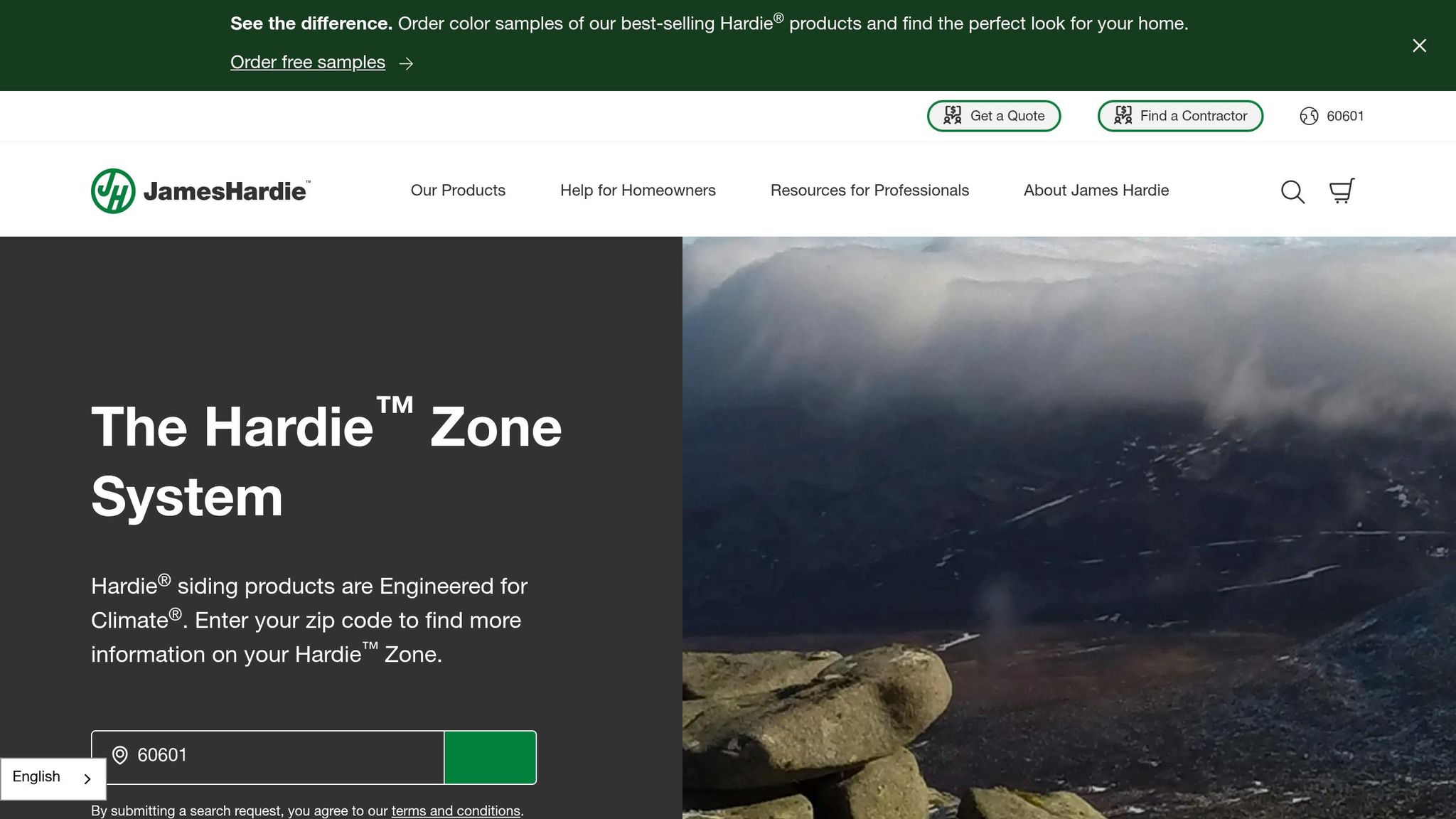
Each of the eight variables James Hardie tracks affects siding over time. Temperature swings cause expansion and contraction. Humidity and rainfall add moisture stress to the wall assembly.
UV exposure speeds up fading and finish breakdown. Wind, hail, snow and ice, plus terrain, shape how well a siding system holds up in a given region. In other words: the map is not guesswork. It ties product choice to weather patterns that hit your house year after year.
What HZ10 must withstand in Tampa Bay
James Hardie builds HZ10 to resist cracking, splitting, rotting, and swelling in hot, humid, storm-prone climates. That matters in Tampa Bay, where the weather keeps pressure on exterior materials for most of the year.
Tampa gets about 54 inches of rain each year, and average relative humidity often sits between 74% and 90% year-round. Add direct sun, and wall surfaces can top 150°F. That's rough on siding that wasn't made for that kind of heat.
Near the coast, James Hardie also calls for stainless steel fasteners near oceans or large bodies of water to help resist salt-air corrosion. But the siding itself still has to fit the climate. Or put another way: in Tampa, the zone match is part of the system, not a small detail.
How Tampa Bay's climate affects siding performance
Tampa Bay throws multiple stressors at siding at the same time: heat, UV, humidity, wind-driven rain, and salt air. That mix puts pressure on more than the outer layer. The wall assembly matters just as much as the cladding.
Why high surface temperatures are harder on vinyl than fiber cement
Heat is the first test. Vinyl starts to soften once temperatures climb high enough, and it can distort at surface temperatures around 160–165°F.
That number matters more than many homeowners think. A wall does not need extreme air temperatures to get there. Dark colors, south- and west-facing walls, and reflected sunlight from low-e windows or nearby surfaces can drive siding far above the day’s air temperature, even during a normal Florida summer afternoon.
James Hardie HZ10 is mineral-based, so it stays stable in heat. In other words: when a sun-beaten wall gets hot, it does not soften, buckle, or warp the way vinyl can. On darker exteriors or walls that take heavy afternoon sun, that kind of stability shows up over years of Tampa summers.
Why water management matters in a humid, storm-prone climate
Moisture is the second test. Storm-season wind-driven rain pushes water into joints, laps, and penetrations. Tampa Bay’s average relative humidity stays between 74% and 90% year-round.
That creates a tough setup for any wall. If water gets behind the cladding and cannot drain out, it can feed mold growth or damage the sheathing and framing.
That is why the full wall system matters. A continuous, code-compliant weather-resistive barrier, properly integrated flashing at windows, doors, and roof-wall transitions, and a clear drainage path to the exterior all work together. The siding sheds water. The wall system handles the moisture that tries to get past it.
How salt air affects finishes and fasteners on waterfront homes
Salt air is the third test. On waterfront homes, it never takes a day off. But the weak point usually is not the siding itself. It is the fasteners and metal trim.
James Hardie HZ10 will not corrode or rot from salt exposure, but the system still relies on parts that must hold up in a coastal setting. Standard carbon steel can corrode faster than many people expect in a high-humidity, salt-adjacent area, and once fasteners corrode, they lose pullout strength over time.
James Hardie’s coastal guidelines call for stainless steel fasteners near oceans and large bodies of water, and coastal guidance recommends stainless or hot-dipped galvanized hardware within roughly 300 feet of a saltwater shoreline. Metal flashings, trim details, and exposed connectors need that same level of care.
Wrong fasteners fail before the siding does.
Those climate stresses are where HZ10 pulls away from vinyl.
James Hardie HZ10 vs. vinyl siding in hot climates: key performance differences
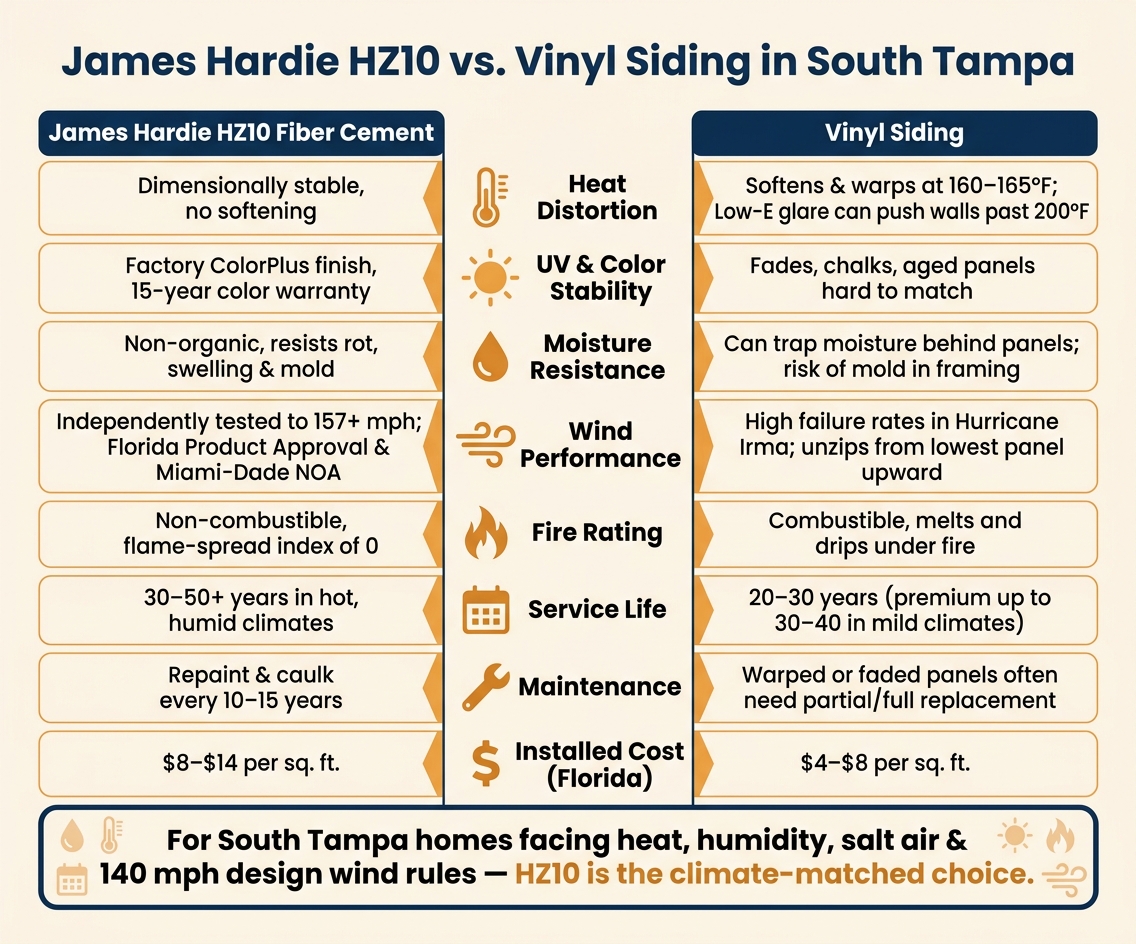
James Hardie HZ10 vs. Vinyl Siding: South Tampa Climate Performance
Here’s how HZ10 and vinyl stack up in Tampa Bay. Under South Tampa heat, humidity, storms, and sun, those differences matter.
| Category | James Hardie HZ10 Fiber Cement | Vinyl Siding |
|---|---|---|
| Heat distortion behavior | Dimensionally stable; resists warping, buckling, and softening under high surface temperatures | Softens and distorts at about 160–165°F; reflected glare from Low-E windows can push wall temperatures above 200°F |
| UV and color stability | Factory-applied ColorPlus Technology; 15-year color warranty | Prone to fading, chalking, and uneven weathering; matching aged panels is difficult |
| Moisture behavior in high humidity | Non-organic; resists rot, swelling, and mold | Can trap moisture behind panels; risk of mold and rot in underlying framing |
| Wind and hurricane performance | Independently tested to 157+ mph; Florida Product Approval and Miami-Dade NOA available for tested assemblies | High failure rates documented during Hurricane Irma, typically unzipping upward from the lowest panel course |
| Impact resistance | High; rigid composition resists windborne debris | Limited; can crack or break from impact |
| Fire resistance | Non-combustible; flame-spread index of 0 | Combustible; melts and drips under fire exposure |
| Typical lifespan | 30–50+ years in hot, humid climates | 20–30 years; premium products may reach 30–40 years in moderate climates |
| Maintenance profile | Repainting and caulking every 10–15 years; periodic cleaning | Mostly cleaning; warped or faded panels often require partial or full replacement |
| Typical installed cost per sq ft (Florida) | About $8–$14/sq ft installed | About $4–$8/sq ft installed |
Heat and UV stability favor fiber cement in long, hot summers
South- and west-facing walls in South Tampa can get much hotter than the day’s air temperature. That’s where vinyl starts to show its limits. Its softening point sits around 160–165°F, and that mark is easier to hit than many homeowners think.
Low-E window glare can drive wall surface temperatures past 200°F. That’s enough to warp vinyl, and darker colors tend to get there faster. Think the danger comes only from extreme weather? It can happen on a bright summer day.
HZ10 fiber cement doesn’t hit the same kind of heat-distortion wall. It’s mineral-based, so it keeps its shape through repeated Florida summers.
Color tells a similar story. Vinyl color runs through the PVC itself, so once panels fade, you can’t fix the look with paint and expect a clean match. Replacing a few aged panels often leaves you with patchy color differences that stand out.
James Hardie’s ColorPlus Technology works differently. The finish is factory-baked onto the board, and it comes with a 15-year color warranty.
Wind, moisture, and fire performance favor HZ10 fiber cement
Hillsborough County’s 140 mph design wind speed puts siding choices under a harsher test. HZ10 lines up well with that demand. HardiePlank lap siding has independent testing to 157+ mph, and tested assemblies carry Florida Product Approval and Miami-Dade NOA documentation when installers follow the stated fastener schedule.
Vinyl has a weaker storm record. A University of Florida study found high failure rates during Hurricane Irma, often starting at the lowest panel course and then unzipping upward. But the product alone isn’t the whole story. The install has to match the approved assembly.
Moisture also matters in Tampa Bay. HZ10 is non-organic, so it resists rot, swelling, and mold in humid conditions. Vinyl panels can trap moisture behind the siding, which can lead to mold and rot in the framing underneath.
Fire performance is just as clear. James Hardie fiber cement has a flame-spread index of 0 and a non-combustible classification. Vinyl can melt and drip when exposed to fire.
Upfront cost is higher, but long-term value often favors James Hardie
The price gap is plain. In Florida, fiber cement usually lands around $8–$14 per square foot installed, while vinyl often falls between $4–$8 per square foot installed. You should still confirm those numbers with your contractor before you set a budget.
But price at install isn’t the whole picture. A lower-cost vinyl job can get expensive if panels warp from reflected heat, come loose in a storm, or fade unevenly over time.
Or put another way: the cheaper bid can cost more later.
Fiber cement usually lasts 30–50+ years in hot, humid climates. Vinyl more often falls in the 20–30 year range, though premium products can reach 30–40 years in milder climates. In Tampa Bay, where heat, humidity, wind, and salt air all work against exterior materials, that longer service life can shift the cost-per-year math toward HZ10. That only holds if your installer uses the right approved product and follows the required install details for your home.
What South Tampa homeowners should confirm before hiring a contractor for HZ10 siding
Installation decides whether HZ10 works the way it should. Once you pick the right product, the small job-site details decide how well it holds up.
Florida approvals, permitting, and warranty alignment are part of the product decision
In Hillsborough County, you should confirm that your contractor will pull the required permit, follow the current Florida Building Code and Hillsborough County permit rules, and schedule the needed on-site inspections. You also need the Florida Product Approval that matches the exact product and assembly.
That approval matters ONLY if the crew follows the tested method exactly. In other words: the fastener type, fastener diameter, penetration depth, spacing, weather-resistive barrier, and flashing details all need to match the approved assembly.
You should also make sure the written scope of work includes the installation steps needed to keep James Hardie's 30-year limited, transferable warranty in force.
Questions to ask a James Hardie siding contractor in Tampa Bay
Use these questions to tell the difference between a fiber cement installer and a general siding contractor:
- What is your Florida DBPR license number, and is it active for siding work?
- Will you pull permits and schedule Hillsborough County inspections?
- Can you confirm my HardieZone by ZIP code and verify that all siding, trim, and soffit materials are HZ10-rated?
- What WRB, flashing, and corrosion-resistant fasteners will you use?
- Do you have James Hardie Elite Contractor status and specialize in fiber cement installations?
- Can you provide the Florida Product Approval, installation details, and local project references?
Contractors who focus on fiber cement are more likely to get clearances, joints, and finish details right. But a general siding contractor may miss those points, and that's where problems start. Bayshore Exteriors installs James Hardie fiber cement siding and can provide license details and permit guidance.
For Tampa Bay homes, climate-specific fiber cement beats vinyl
For South Tampa and Hillsborough County homes, James Hardie HZ10 is the better long-term pick. It is made for heat, humidity, salt air, and storm exposure, and James Hardie backs it with a 30-year limited, transferable warranty when the installer follows the manufacturer's instructions.
Bayshore Exteriors can inspect your home and map out the right siding installation.
FAQs
How do I confirm my home needs HZ10?
Look for hot, humid, storm-prone coastal or Southern conditions, where siding has to stand up to intense heat, UV exposure, heavy humidity, and hurricane-force winds.
Check the moisture protection too. You want a weather barrier, flashing, and sealed joints installed the right way. If you keep seeing mold or stains, gaps at the seams, or failing caulk, you may need a properly specified HZ10 system.
Is James Hardie worth the higher cost in Tampa?
Yes. James Hardie fiber cement siding makes sense for Tampa homeowners because it’s built for the local climate.
Think vinyl and fiber cement perform about the same? Not in Tampa. James Hardie siding holds up better against heat, humidity, salt air, and hurricane-force winds.
Compared with vinyl, it gives you better durability, fire resistance, and impact protection. It can also pay off over time with lower maintenance, improved energy efficiency, and stronger resale return.
What installation details matter most for HZ10?
For HZ10, focus on fastening, spacing, and moisture management. Follow Florida Product Approval-listed rules for fastener type, diameter, penetration depth, and spacing. Use stainless steel or hot-dipped galvanized nails to help prevent rust.
Leave a 1/8-inch gap at openings and trim. Add housewrap, flashing, seam tape, and approved flexible exterior-grade sealants to help with drainage and joint sealing.
Related Blog Posts
✔ START TODAY
Personal and targeted approach

✔ FAQ
Your Questions. Our Expertise.
How do I get an accurate price for my project?
Are you licensed and insured in Florida?
How long does a typical installation take?
Does your work come with a warranty?
Why do you recommend James Hardie siding for Florida?
What specific services do you provide?
✔ START TODAY
Ready to Get Started?
Trusted and reliable Hardie board siding services backed by expert craftsmanship and high performance materials. We help homeowners achieve a durable, low maintenance exterior that looks great and stands strong for years to come.
Book an Appointment
We have received your estimate request and will be reaching out to you shortly.
.webp)