
Fall Maintenance for James Hardie Siding
Inspect gutters, caulk, flashing and splash zones; clean fiber-cement with low pressure and hire a licensed contractor for recurring stains.
Lorem ipsum dolor sit amet, consectetur adipiscing elit. Suspendisse varius enim in eros elementum tristique. Duis cursus, mi quis viverra ornare, eros dolor interdum nulla, ut commodo diam libero vitae erat. Aenean faucibus nibh et justo cursus id rutrum lorem imperdiet. Nunc ut sem vitae risus tristique posuere.
If your siding stays wet in fall, small water issues can turn into repair bills fast.
In Tampa Bay, fall still brings heat, humidity, rain, and salt air. That mix keeps James Hardie siding damp longer, especially near gutters, caulk joints, flashing edges, and lower wall splash zones. If you see stains that come back, trim that feels soft, or caulk that keeps pulling apart, you should treat that as a repair warning, not a cleaning issue.
Here’s the short answer:
- Check where water hits your walls first
- Clean out gutters and extend downspouts away from the house
- Look for cracked caulk at windows, doors, trim, and board joints
- Wash fiber cement with low pressure only, not a pressure washer
- Watch shaded and coastal-facing walls for mildew and salt film
- Compare repeat staining and trim movement before you blame surface dirt
- If problems show up on more than one wall, get a licensed Florida siding contractor to inspect the wall system
Think fall maintenance means washing the siding and moving on? But that misses the main problem. In other words: moisture paths matter more than surface marks.
3 Ways To Maintain James Hardie Fiber Cement Siding

sbb-itb-85e0110
Quick Comparison
| Area to Check | What You May See | What It Often Means | What You Should Do |
|---|---|---|---|
| Gutters and downspouts | Overflow, dirty streaks, mildew bands | Water keeps running down the wall | Clean gutters and move runoff away from the house |
| Caulk and joints | Gaps, pulling, exposed edges | Water can enter behind siding or trim | Replace failed sealant and inspect nearby flashing |
| Lower wall area | Splash marks, darker boards, soft spots | Repeated wetting near grade or hard surfaces | Fix drainage and inspect trim and sheathing |
| Shaded coastal walls | Salt film, mildew, repeat staining | Slow drying hides trouble | Clean gently and check for repeat marks |
| Finish surface | Chalking, bubbling, paint wear | Moisture stress or finish wear | Inspect seams and problem spots after washing |
Quick Comparison: Vinyl vs. James Hardie in Tampa Bay Fall Weather
| Criteria | Vinyl Siding | James Hardie Fiber Cement |
|---|---|---|
| Heat and humidity | More movement as temperatures shift | Less movement in humid conditions |
| Salt-air exposure | Tends to wear faster near the coast | Handles coastal exposure better |
| Storm conditions | Depends heavily on product rating and fastening | Often chosen for storm-exposed areas |
| Moisture stability | More sensitive to hidden wall moisture issues | More stable over time |
You’ll get the most from fall maintenance when you focus on water entry points first, then cleaning, then repair signs. If you notice significant damage, consult licensed fiber cement pros to ensure repairs meet local wind codes.
Fall moisture exposure is the main risk to James Hardie siding in Tampa Bay
Fall moisture is the top risk for James Hardie siding in Tampa Bay. Fiber cement holds up well, but it still needs clear gutters, sealed joints, and solid flashing to keep water out of the wall. Tampa Bay’s warm, humid fall slows drying time, so even small drainage issues can turn into bigger problems fast.
Once water gets involved, the fix usually comes back to the basics: drainage, sealing, and surface cleaning.
Overflowing gutters and short downspouts keep siding wet at the wall line
Fall leaf drop clogs gutters fast. When debris builds up, water backs up and spills over the edge onto the fascia and upper siding courses. James Hardie’s coastal care guidance specifically calls out clearing gutters, downspouts, and overflows as a moisture-control priority. That overflow keeps water running down the wall line and increases leak risk.
During a fall walkthrough, check the lower siding courses and the splash zone above patios, walkways, and planting beds. Look for:
- Dirty splash marks
- Mildew bands
- Peeling or chalking paint
- Areas where the siding edge looks darker or stays wet longer after rain
Downspout extensions should move water several feet away from the house to cut down on splash-back against lower siding and trim. Hardie’s installation guidance also calls for at least 1 inch of clearance between gutter end caps and siding or trim.
If you clean the gutters and water still hits the wall, check the sealant line next. That’s often where the next problem starts.
Cracked caulk and open joints are common entry points for moisture
Caulk wears out. That’s why fall is a good time to inspect it. Forest Products Laboratory research notes that caulk joints cannot be expected to remain functional indefinitely and that adhesive failure between caulk and substrate is the most common failure mode.
The highest-risk spots on a James Hardie-clad home include window and door perimeters, vertical trim joints, butt joints between siding boards, horizontal transitions where siding meets belly bands or other trim, and terminations at roof-to-wall intersections and flashing edges. James Hardie’s coastal care guidance recommends permanently flexible caulks and sealants at penetrations, flashings, and plank-to-trim connections.
Flag any joint with pulled-back caulk, exposed substrate, or interior staining. Those are clear signs water may already be getting where it shouldn’t.
Salt air and shaded walls speed up residue buildup on coastal properties
After you check drainage and joints, look at the walls that stay damp the longest. On coastal homes, shaded walls dry slowly and hold salt film and mildew longer. That buildup can hide early trouble.
Clean and inspect those elevations first. In other words: start with the walls that get the least sun and the most damp air. Catching residue and mildew early helps you deal with small surface issues before they turn into drainage or flashing problems.
Cleaning and inspection work should protect the factory finish, not wear it down
After you check drainage and caulk, clean the siding with a gentle touch so dirt doesn't hide damage. James Hardie's factory-applied finish, especially on ColorPlus products, is meant to be cleaned with soap and water and a soft brush or cloth.
Low-pressure washing is safer than pressure washing for fiber cement finishes
James Hardie's maintenance guidance is plain: high-pressure washing can damage the fiber cement surface and is not recommended. Instead, use a low-pressure garden hose spray, a soft brush, and mild soap when grime or mildew film won't come off on its own.
James Hardie says to clean the siding once or twice a year, and that lines up well with a fall maintenance routine.
Keep spray away from caulk lines, trim joints, seams, and flashing edges. Forced water can get behind the siding in those spots. Wash from top to bottom in small sections, then rinse fully so you don't leave streaks behind.
Before you use any cleaning solution on a visible wall, test it in a hidden spot first to check for discoloration.
As you clean, look closely for finish failure and open joints.
A fall inspection should focus on seams, flashing edges, and lower-wall splash zones
Check for bubbling, chalking, cracked caulk, and wear around seams, flashing edges, and splash zones. Those are the areas that often show trouble first.
Take a low-angle look in direct sunlight too. It can show warping or surface irregularities that are easy to miss when you look straight at the wall.
If the same marks keep coming back, don't shrug them off as surface dirt. In other words: repeat staining often points to a drainage or wall-assembly problem.
Vinyl siding and James Hardie fiber cement perform differently in Tampa Bay fall and storm conditions
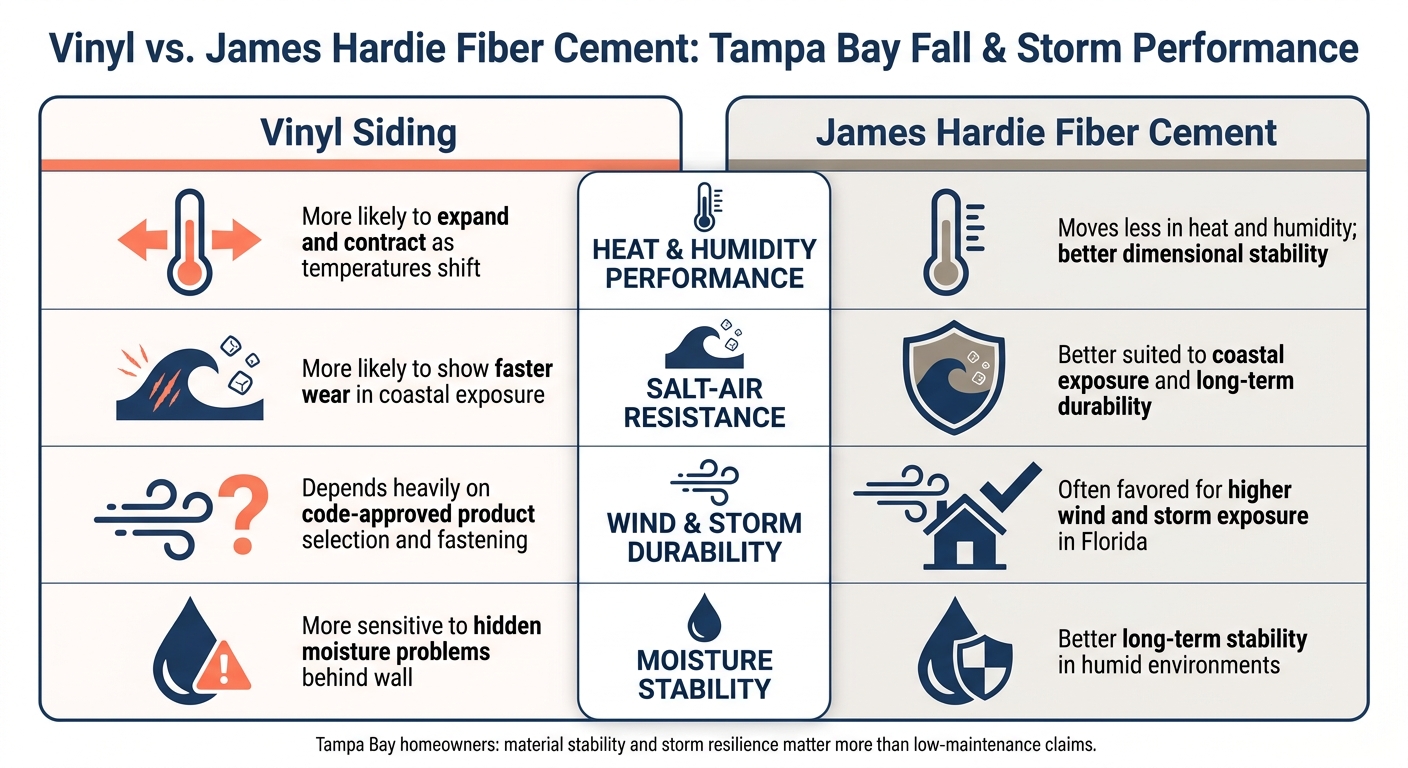
Vinyl vs. James Hardie Fiber Cement Siding: Tampa Bay Fall Performance
Fall is the time to look past sales talk and focus on how these materials hold up. Tampa Bay's humidity, salt air, and storm exposure push vinyl and James Hardie fiber cement in different ways. You usually see that gap first in how each one deals with repeated wetting, wind, and sealant stress.
Humidity and salt air are harder on vinyl than on fiber cement in coastal Florida
Vinyl usually wears out sooner in coastal Florida. Fiber cement stays more stable and tends to last longer in Tampa Bay's heat, humidity, and salt air.
In Tampa Bay, vinyl is more likely to expand and contract as temperatures shift. Over time, that movement can strain fasteners and joints and lead to earlier wear, especially at seams and penetrations where moisture and failed sealant already create trouble spots. Fiber cement moves less in heat and humidity. Because it contains cement, sand, and cellulose, it keeps its shape better in Gulf Coast conditions and deals with the same moisture paths with more long-term stability.
Storm durability matters more than maintenance claims in hurricane-prone areas
In Florida, siding has to meet local wind-pressure rules, so this choice goes beyond looks. Vinyl depends heavily on code-approved product selection, fastening, and installation, especially in coastal areas. Fiber cement is often favored for coastal and storm-exposed homes because it offers better stability and stronger long-term performance in wind-driven storm conditions.
That gap shows up in a few day-to-day ways:
| Vinyl Siding | James Hardie Fiber Cement | |
|---|---|---|
| Performance in Humidity | More likely to expand and contract in heat and moisture | Moves less in heat and humidity |
| Salt-Air Resistance | More likely to show faster wear in coastal exposure | Better suited to coastal exposure and long-term durability |
| Wind/Storm Durability | Depends heavily on code-approved product selection and fastening | Often favored for higher wind and storm exposure |
| Moisture Stability | Can be more sensitive to hidden moisture problems | Better long-term stability in humid environments |
In Tampa Bay, material stability and storm resilience matter more than low-maintenance claims. When stains keep coming back or trim starts to move, you're not looking at a maintenance issue anymore.
Persistent staining, trim movement, or recurring sealant failure usually calls for a professional repair evaluation
Once cleaning and inspection show repeat stains or moving trim, you need to shift from upkeep to repair review. If stains come back after cleaning, or trim starts to move, treat it as a repair problem. At that point, you’re not looking at surface dirt anymore.
Recurring moisture marks often point to drainage or wall assembly problems, not surface dirt
When the same stain shows up again after cleaning, pay attention to the location. A mark below a window, along a horizontal trim band, or at the base of a wall often points to hidden water getting into the wall system. Most cladding failures start at windows, doors, trim joints, and flashings, not in the open siding field itself.
Soft or spongy trim matters too. So do swollen siding edges and caulk lines that keep cracking after repair. Those aren’t one-off upkeep issues. They’re warning signs.
If a stain or soft spot stays put after a proper low-pressure wash, stop trying to scrub it away. Treat it as a repair trigger instead.
What a qualified siding contractor should evaluate before recommending repair or replacement
The next step is to look past the visible defect and check the wall system behind it. A qualified contractor should inspect the full wall assembly, not just the stained area. That review should include:
- Flashing at windows, doors, and roof-to-wall joints
- The water-resistive barrier
- Drainage paths and splash zones
- Fastening to confirm it meets Florida code
Florida exterior remodeling contractors must hold a valid DBPR license, and permitted siding work must follow the Florida Building Code, including rules for flashing, joint treatment, and water-resistive barriers. You can check a contractor’s license at myfloridalicense.com before any evaluation starts.
If a contractor tells you to pull your own permit, that’s a red flag. Homeowners hear that advice all the time. But it usually shifts risk onto you.
When the problem stays limited to a few joints or one trim section, a targeted repair may make sense on cost. However, when you see repeat stains, trim movement, and failing sealant across more than one elevation, a larger repair often makes more sense over time. Bayshore Exteriors evaluates these problems through permitted work and helps homeowners decide between targeted repair and full remediation.
Conclusion: Address moisture pathways this fall and choose fiber cement for long-term coastal durability
Fall gives you a clear window to fix the moisture issues summer storms left behind. The biggest trouble spots are overflowing gutters, failed caulk, and splash-back at the base of the wall. Those are the moisture paths most likely to lead to swollen trim, soft sheathing, or paint failure before the next storm season comes back. Fixing them now usually costs a lot less than waiting for the damage to spread.
Once you control those moisture paths, your siding choice matters. James Hardie fiber cement tends to beat vinyl in Tampa Bay because it stands up better to humidity, salt air, and wind-driven storms.
But if the same problem keeps coming back, the wall system is probably the issue, not the outer surface. Recurring stains, shifting trim, or failing sealant point to a repair evaluation, not another round of cleaning. If stains or trim movement keep showing up, bring in a siding specialist before the next storm cycle.
Bayshore Exteriors provides James Hardie siding inspection, repair, and replacement across the Tampa Bay area. Contact the team before fall ends.
FAQs
How often should James Hardie siding be cleaned in fall?
Clean James Hardie siding every 6 to 12 months. For most homes, a fall wash makes sense.
Use a garden hose, mild soap or detergent, and a soft brush. Rinse it well. Skip the pressure washer.
If your home sits near the coast, salt changes the schedule. Wash it more often, up to about every 3 months, with extra attention to eaves and the areas around windows and doors.
What are the first signs of hidden moisture damage?
Early signs of hidden moisture damage include:
- Worn or missing caulk around windows, doors, and trim
- Staining or mold growth
- Gaps at seams and joints
- Cracks, chips, or discoloration on siding panels
After storms, check for warping, bubbling, bowing, loose panels, or interior wall staining near exterior walls.
When should I call a licensed siding contractor?
Call a licensed siding contractor if your James Hardie siding has damage that goes past basic upkeep. That includes missing or worn-out caulking, loose panels, gaps at the seams, stains that keep coming back, mildew that returns after cleaning, or visible cracks.
But here's the part many homeowners miss. Fiber cement siding needs specialized installation if you want it to hold up and keep its warranty coverage.
In Tampa Bay, your siding deals with humidity, salt air, and hurricane weather on a regular basis. A contractor who knows James Hardie products can fix the problem the right way, so your siding keeps doing its job.
Related Blog Posts
✔ START TODAY
Personal and targeted approach

✔ FAQ
Your Questions. Our Expertise.
How do I get an accurate price for my project?
Are you licensed and insured in Florida?
How long does a typical installation take?
Does your work come with a warranty?
Why do you recommend James Hardie siding for Florida?
What specific services do you provide?
✔ START TODAY
Ready to Get Started?
Trusted and reliable Hardie board siding services backed by expert craftsmanship and high performance materials. We help homeowners achieve a durable, low maintenance exterior that looks great and stands strong for years to come.
Book an Appointment
We have received your estimate request and will be reaching out to you shortly.
.webp)