
How Long Does Siding Installation Take in Tampa Bay?
Crew installs usually take 3–7 business days; full projects often run 4–8 weeks with permits, lead times, HOA review, and weather.
Lorem ipsum dolor sit amet, consectetur adipiscing elit. Suspendisse varius enim in eros elementum tristique. Duis cursus, mi quis viverra ornare, eros dolor interdum nulla, ut commodo diam libero vitae erat. Aenean faucibus nibh et justo cursus id rutrum lorem imperdiet. Nunc ut sem vitae risus tristique posuere.
If you live in Tampa Bay, most full-home James Hardie siding jobs take 3 to 7 business days on-site, but the full project often runs 4 to 8 weeks once permits, material lead times, HOA review, and September rain get factored in.
Small repairs often take 1 to 2 days on-site. Large or detailed homes can take 7 to 10 days, and hidden rot can stretch the work to 1 to 3 weeks after tear-off starts. Crew days are the shortest part of the timeline on most siding remodel projects — permits, HOA review, and material lead times are what set the total window.
The factors that shape your timeline:
- Partial repairs: 1 to 2 business days on-site
- Standard full-home install: 3 to 7 business days on-site
- Large or detailed homes: 7 to 10 business days on-site
- Permit review in Hillsborough County: 3 to 7 business days, sometimes 2+ weeks
- HOA approval: 1 to 6 weeks
- Material lead time: 2 to 3 weeks for standard colors, 5 to 7 weeks for custom colors
- September storms: can add 2 to 4 calendar days to a 5-day job
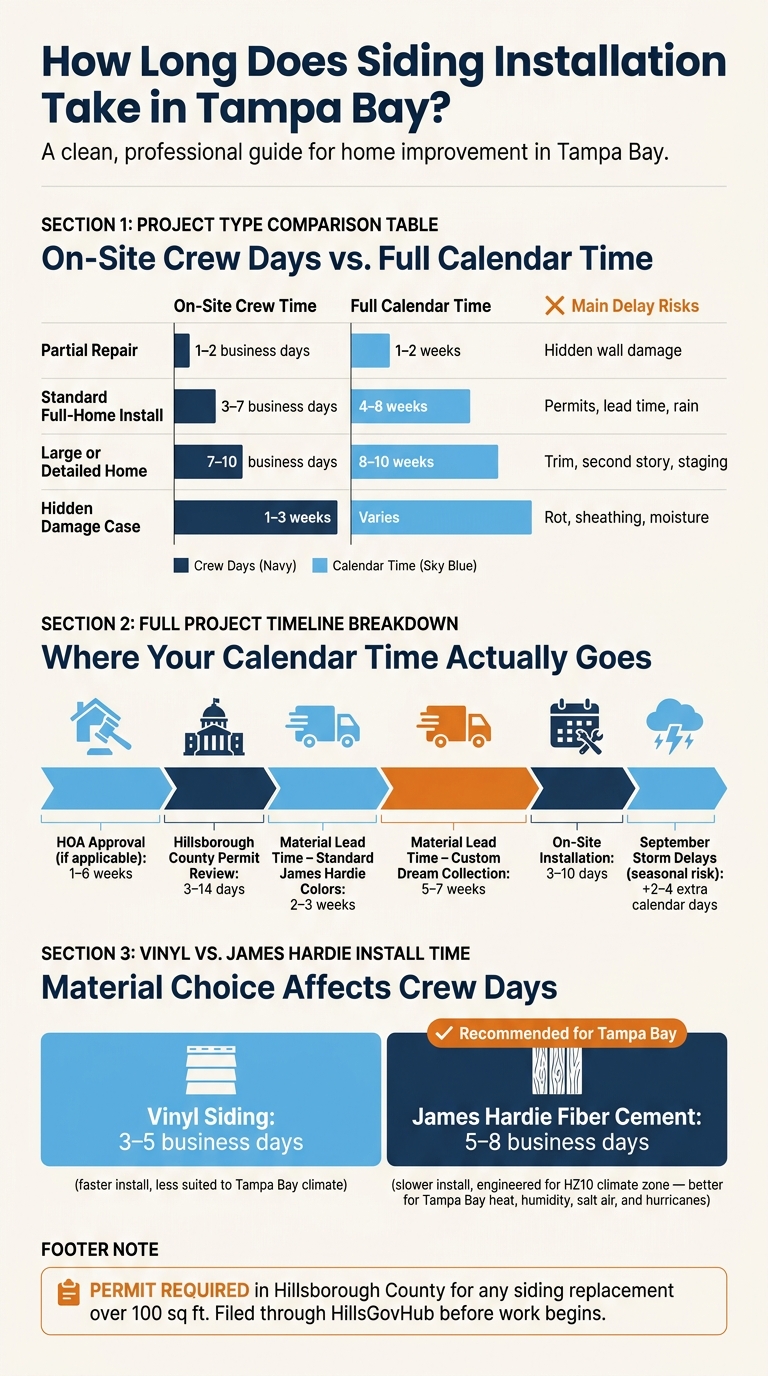
Tampa Bay Siding Installation Timeline: On-Site Days vs. Full Calendar Time
How Long Does It Take to Install New Siding? | Hawthorn Home Exteriors
sbb-itb-85e0110
Quick comparison
| Project type | On-site crew time | Full calendar time | Main delay risks |
|---|---|---|---|
| Siding repair or replacement | 1–2 business days | 1–2 weeks | Access, hidden wall damage |
| Standard full-home | 3–7 business days | 4–8 weeks | Permit review, lead time, rain |
| Large or detailed home | 7–10 business days | 8–10 weeks | More trim, second story, staging |
| Hidden damage case | 1–3 weeks on-site | Varies | Rot, sheathing repair, moisture issues |
What matters most before you set a date
If your home sits in Hillsborough County, siding work over 100 square feet needs a permit before the crew starts. James Hardie also takes longer than vinyl because fiber cement is heavier and needs tighter cutting and fastening. However, many Tampa homeowners still pick it because it holds up better in heat, humidity, salt air, and storm conditions.
Or put another way: if you want a date you can trust, count the permit time, material wait, and weather risk first, then count the install days.
What adds days to a James Hardie siding project in coastal Tampa Bay
In Tampa Bay, crew time comes down to three things: house size, exterior complexity, and fastening needs. Two homes that look close on paper can still end up on different timelines. The biggest schedule drivers are home size, tear-off surprises, and the material you choose.
Home size, stories, and trim detail add crew days
Two-story homes usually take longer than single-story homes. Crews need scaffolding, more setup time, and more labor to move materials up and down the house.
Details on the exterior also slow the job. Gables, dormers, bay windows, and heavy trim all add layout and finish work.
Tear-off difficulty and substrate repairs are the biggest schedule risk
Tear-off is the biggest wildcard. Once the old siding comes off, crews may find hidden rot, damaged sheathing, insect damage, or missing weather barriers that no one could see from the outside.
That’s where schedules can shift. If those repairs stack up, the project can run well past the first timeline.
James Hardie typically takes longer to install than vinyl because fiber cement is heavier and needs more precise cutting and fastening
Material choice changes the schedule, even when the house size stays the same. A 1,500-square-foot home usually takes 3 to 5 days with vinyl and 5 to 8 days with James Hardie fiber cement.
Why the gap? James Hardie tends to take longer because fiber cement is heavier, and crews need tighter cutting and fastening. In other words: the install demands more time at nearly every step.
After the crew timeline is set, permit review can still add more calendar days before work starts.
Hillsborough County permit timing adds calendar days before installation starts
Crew time is only part of the schedule. Permit review can slow the start, and in Hillsborough County that step often adds 3 to 7 business days before siding work begins.
Hillsborough County also has a clear trigger for permits. If your siding replacement covers more than 100 square feet, you need a building permit, and you must file the application through HillsGovHub before work starts.
HillsGovHub review time is separate from installation time
Think the install window tells the whole story? Not quite. A standard siding permit in Hillsborough County usually takes 3 to 7 business days, while more complex jobs can take 2 weeks or longer.
That wait happens before the crew starts, not during the install. In other words: the permit clock sits apart from the 5 to 8 business days a standard James Hardie installation usually takes.
Review times can shift, so leave some buffer in your schedule before installation begins. Even after permit approval, September rain can still add calendar days.
How September rain and material choice both affect your schedule
Two things shape your September siding timeline: afternoon storms and material choice. One affects calendar days. The other affects crew days. Both matter if you're trying to pin down a start and finish date.
September afternoon storms can stretch a 5-day job across more calendar days
Once permits clear, weather becomes the next schedule variable. September sits right in Tampa’s wet season peak, and afternoon thunderstorms can shut down exterior work fast.
A standard James Hardie installation may take 5 to 8 business days of crew time, but storms can push that work across 2 to 4 extra calendar days when crews have to stop early. That’s the part many homeowners miss. A five-day job doesn’t always finish in five straight days.
In other words: crew time and calendar time are not the same thing. If you’re booking siding work in September, add a few extra days for weather.
Vinyl siding vs. James Hardie comparisons often favor speed on paper, but James Hardie fits Tampa Bay better over time
Weather affects calendar days. Material choice affects crew days. But...
The faster option on paper does not always save much time in September.
Vinyl usually takes 3 to 5 business days to install, while James Hardie usually takes 5 to 8. James Hardie takes longer because crews need more precise cutting and fastening. That extra labor is part of the job.
However, Tampa Bay’s humidity, salt air, and hurricane conditions change the math. September rain can wipe out part of vinyl’s calendar-day edge anyway. And over time, James Hardie tends to fit local conditions better because fiber cement is engineered for the HZ10 climate zone, while vinyl is more prone to warping in intense heat, UV fading, and wind damage.
Or put another way: a few extra install days can buy better long-term performance in Tampa Bay.
That’s why total calendar time matters more than crew time alone.
The real question is how much total calendar time your home needs, not just installation days
Installation days tell only part of the story. Your full project timeline also depends on permits, material lead times, HOA approval, and September weather. A crew might finish the labor in five days, but your total calendar window can stretch much longer.
Here’s where that extra time usually goes:
| Project Phase | Typical Duration |
|---|---|
| HOA approval, if applicable | 1–6 weeks |
| Hillsborough County permit review | 3–14 days |
| Material lead time, standard James Hardie colors | 2–3 weeks |
| Material lead time, custom Dream Collection | 5–7 weeks |
| On-site installation | 3–10 installation days |
September storms in Tampa Bay can slow things down. Afternoon rain can stop exterior work and add extra calendar days to what looked like a five-day install.
Think faster always means better? Not quite. Vinyl can go up faster, but James Hardie often makes more sense for Tampa Bay homes over time.
Plan for the Full Calendar Window, Not Just the Crew Days
Crew time tells you how long the work takes. The full calendar window tells you when you can realistically finish. For most Tampa Bay homes, those two numbers look very different.
A standard James Hardie install takes 5 to 8 business days on-site. The full project window, once permits, material lead time, HOA review, and September weather are accounted for, often runs 4 to 8 weeks. That gap is where most scheduling surprises come from.
The practical planning sequence for a siding remodel in Hillsborough County: start the HOA submittal first if one is required, allow 3 to 14 days for permit review after the application goes in, order materials only after the permit clears, and build in a weather buffer if the install window falls in September. Standard James Hardie colors arrive in 2 to 3 weeks; custom colors take 5 to 7 weeks and set the whole schedule when they are in play.
Bayshore Exteriors installs James Hardie fiber cement only, which means material lead times, fastening requirements, and permit documentation follow a consistent process on every job. A project-specific timeline based on your home's scope, permit timing, and color selection is part of every estimate.
FAQs
When should I order siding before my ideal start date?
Plan your siding project 6 to 8 weeks before your target start date. That window gives you time to choose a contractor, get HOA approval, and move through the Hillsborough County permit process, which can add 3 to 14 business days.
Order materials early too. Standard James Hardie siding usually arrives in 2 to 3 weeks, while custom colors or specialty trim can take 5 to 7 weeks.
Can my siding project start before permit approval?
No. Your siding project cannot legally start before permit approval.
In Hillsborough County, siding replacement over 100 square feet requires a permit. Start work before approval, and you can run into local code violations, failed inspections, insurance claim problems, and legal trouble. In most cases, permit approval adds 3 to 7 business days to your timeline.
What delays are most likely in September?
In September, the biggest source of delay in Tampa Bay is the peak wet season. Afternoon thunderstorms hit often, and they can add 2 to 4 days to your roofing timeline.
That extra time usually goes to protection work. Crews may need tarping and dry-in work to keep exposed sheathing covered until conditions improve.
September also falls in tropical storm season. Named storms can clog contractor schedules and push start dates back 4 to 8 weeks.
On top of that, Hillsborough County permits usually take anywhere from a few days to two weeks.
Related Blog Posts
✔ START TODAY
Personal and targeted approach

✔ FAQ
Your Questions. Our Expertise.
How do I get an accurate price for my project?
Are you licensed and insured in Florida?
How long does a typical installation take?
Does your work come with a warranty?
Why do you recommend James Hardie siding for Florida?
What specific services do you provide?
✔ START TODAY
Ready to Get Started?
Trusted and reliable Hardie board siding services backed by expert craftsmanship and high performance materials. We help homeowners achieve a durable, low maintenance exterior that looks great and stands strong for years to come.
Book an Appointment
We have received your estimate request and will be reaching out to you shortly.
.webp)